We Are All Trying Here director on making Koo Kyo Hwan, Oh Jung Se and Park Hae Joon heartbreakingly human | Interview
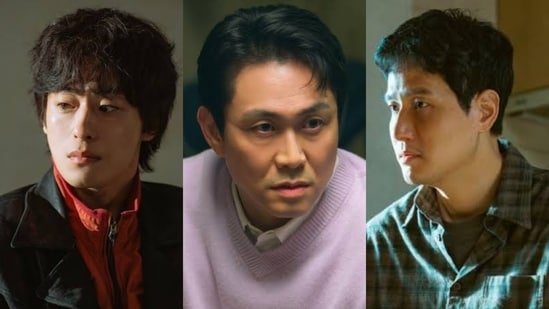

While mainstream television heavily relies on the high-octane thrill of professional triumph, JTBC and Netflix’s recently concluded series We Are All Trying Here spent 12 hours doing the exact opposite. It sat quietly with the deep-seated fear of mediocrity, the shame of unfulfilled potential, and the complex mechanics of masculine isolation. Through a powerhouse male ensemble, Koo Kyo Hwan, Oh Jung Se, and Park Hae Joon—the show investigated how different men process the terrifying sensation of worthlessness.

The K-drama follows Hwang Dong Man (Koo Kyo Hwan), an aspiring film director who remains the only member of his university film club “The Eight” without success after 20 years. Overwhelmed by anxiety, envy, and fear of failure, he hides his insecurity behind constant, excessive chatter. He eventually finds unexpected emotional refuge in Byeon Eun Ah (Go Youn Jung), a sharp film producer dealing with her own trauma.
In the second part of exclusive interview with director Cha Young Hun, the filmmaker uncovers the intentional physical vocabulary of brotherhood, the nuances of actor-driven tears, and why the series stubbornly refused to grant its characters a magical career cure.
The Rhythm of public persona and anxiety
HT: The drama opens with Dong Man’s manic energy at a dinner party, immediately cut against the crushing silence of his solitary nighttime bus ride. How did you direct Koo Kyo Hwan to balance that loud, abrasive mask with his deep private emptiness?
Cha Young Hun: This was the first scene that explained the root of Dong Man’s patheticness, which may have made viewers feel somewhat uncomfortable throughout Episode 1, so I agonized over it a great deal during filming.
I wanted viewers to empathize with Dong Man’s pain as he runs himself into the ground, thinking, ‘If I can’t prove myself by being impressive, then I’ll prove myself by falling apart.’ So Koo Kyo Hwan and I talked a lot about not expressing this scene through just one single layer of emotion. Although we couldn’t use it in the drama due to copyright issues, we filmed the scene while listening to Gilbert O’Sullivan’s Alone Again. Like that song, which has a cheerful rhythm yet carries an immense sadness, I wanted to show multiple layers of emotion.
More than anything, I think this sequence was elevated by Koo Kyo Hwan’s uniquely unpredictable sense of rhythm as an actor. Thanks to his performance, the scene was able to convey not just simple sadness or anger, but also the many emotional layers within Dong Man — shame, self-loathing, and everything in between.
HT: Dong Man’s anxious relationship with food stands out across the show. How did you use the act of eating as a physical performance of panic rather than just a simple quirky character trait?
Cha Young Hun: In this series, hunger is less about physical appetite and more of an emotional state. It represents Dong Man’s desperate struggle to overcome the sense of lack born from self-loathing and shame.
That’s why I felt Dong Man shouldn’t simply be eating food—he should be forcing it into himself. I wanted viewers to watch those moments and feel sympathy for him, almost as if he were crying.
To make that act feel like a genuine struggle, I spent a lot of time thinking about combinations of food that felt fundamentally wrong together. There needed to be something unsettling about it: scooping rice with a rice paddle instead of a spoon, dipping yakgwa (honey cookie) in gochujang (chili paste), or grabbing whole radish kimchi with his bare hands. The more heartbreaking and desperate those scenes of Dong-man forcing food down by himself became, the more I believed the warmth and comfort of the meal scenes he later shares with Eun-ah or his brother would resonate with viewers.
Three dimensions of loneliness
HT: Jin Man (Park Hae Joon) is seen drowning his worthlessness alone over alcohol. How did you shoot this to differentiate his specific flavour of despair from Dong Man’s?
Cha Young Hun: Like everyone else in the series, both Dong-man and Jin-man are engaged in a fierce struggle against their own feelings of worthlessness. But there is a crucial difference in the nature of their loneliness.
If Dong-man’s loneliness is a kind of hot, restless despair—the desperation of someone still fighting to prove his worth to the world—then Jin-man’s loneliness is closer to a cold resignation, the state of someone who has already let go of everything. In that sense, perhaps even the word “loneliness” is too indulgent a term for what Jin-man is experiencing.
With that distinction in mind, I wanted to approach them differently on a visual level. Dong-man’s emotions were filmed in a more dynamic way, while Jin-man’s emotions were captured in a much more static tone. The same principle applied to their dialogue. Dong-man tends to pour his emotions out, whereas Jin-man simply spits them out.
HT: The scenes between the two brothers are incredibly raw. How did you and the actors construct that specific, awkward physical vocabulary of brotherhood?
Cha Young Hun: Relationships between siblings who have shared hardship and deprivation can sometimes be defined less by open affection than by a certain awkwardness and emotions that can never quite be put into words. I wanted to portray two brothers who care deeply for each other, yet find it almost unbearably embarrassing to say so out loud.
As we talk about it, I’m reminded of the sequence surrounding Jin-man’s first suicide attempt. Dong-man does not try to persuade his brother directly as he stands at the edge of death. Instead, he calms him with something entirely ordinary: “You’re just hungry. I’ll make you some kimchi fried rice. Come here.” He then reads part of a poem Jin-man wrote years earlier, deliberately avoiding a serious or sentimental tone, gently easing his brother’s anger and despair. And only when he sees focus return to Jin-man’s eyes does he quietly reach out and take his hand.
Because the situation itself was already so emotionally extreme, I felt that we needed to minimize any exaggeration in the actors’ expressions, dialogue, or physical gestures. Paradoxically, the more restrained we were, the more truthful the emotion would feel. I remember having many conversations with the actors about approaching the scene in exactly that way.
Fearing worthlessness from above
HT: Park Gyeong Se’s (Oh Jung Se) sudden breakdown—”Only Hwang Dong-man is pitiful? Am I not pitiful too?”—shifts him completely away from being a simple antagonist. How did you direct Oh Jung Se to tap into that specific devastation of a successful man terrified of being forgotten?
Cha Young Hun: In some ways, Gyeong Se’s harshness toward Dong Man is a response to the harshness he feels he has received from Dong Man over the years. But I wanted viewers to empathize with both characters. If the audience ended up rooting for only one of them, I would consider that a failure on my part [laughs].
The approach I chose was to wrap Gyeong Se’s desperate outburst in a layer of comedy. He becomes completely absorbed in condemning Dong Man’s embarrassing behavior, forgetting even his own sense of shame, while the rest of the group—including Yeong Soo (Jeon Bae Soo)—keeps responding in an oddly offbeat way, repeatedly emphasizing their twenty years of friendship rather than engaging with what Gyeong Se is actually trying to say. I think that contrast softens the sharp edges of Gyeong Se’s cruelty, at least to some extent.
But the bigger reason Gyeong Se never functions as a simple antagonist is Oh Jung Se himself. I honestly believe Oh Jung Se is one of those rare actors who can make even the most unpleasant qualities feel deeply human and strangely lovable. The scene you mentioned was more than two pages long on paper, and he delivered the entire monologue in a single emotional breath.
Rather than any specific directing note, I sometimes wonder whether I myself may have served as a kind of reference point for him. The truth is that I wrestle with many of the same fears as Gyeong Se. I’ve been fortunate enough to make several projects, but I still live with the fear of being forgotten. I’m the kind of person who feels wounded by criticism, yet also pretends not to care because I’m conscious of how others see me. And despite all of that, I can still find myself alone with my own self-doubt, trapped inside what feels like a private cave of insecurity. As I talk about it, I realize I’m starting to sound rather miserable [weeps/laughs]. Perhaps those sides of myself revealed themselves naturally through our long conversations.
Resisting the magical cure
HT: Koo Kyo Hwan cries an immense amount in this show, yet it never feels manipulative. More broadly, the finale completely refuses a “magical cure” or a massive, satisfying career triumph for him. Were you afraid audiences would find this too depressing?
Cha Young Hun: I honestly think all the credit for the crying belongs to Koo Kyo Hwan. What makes him such a remarkable actor is that he is never afraid of being unconventional or allowing himself to fall apart on screen. At times, Dong Man manages to convey profound sadness without shedding a single tear—through nothing more than a runny nose. Because of that, he portrayed the kind of crying we encounter in real life.
As for the ending, a story that refuses to look away from human anxiety and isolation was certainly a frightening undertaking for me. There was a very real concern that viewers might turn away from the series altogether.
There is certainly something powerful and comforting about a drama in which the protagonist overcomes adversity and ultimately achieves success. Stories like that can provide tremendous catharsis. However, I think the kind of comfort that We Are All Trying Here wanted to offer was somewhat different. What I wanted to say was this: “Oh Jeong-hui, Noh Kang-sik, and CEO Choi may seem successful, but they are all struggling against feelings of worthlessness as well. It’s not only Dong-man, with all his flaws… In the end, perhaps living itself is a constant struggle against worthlessness.”
So don’t think you are the only one having a hard time. Everyone is fighting that battle. Try not to lose hope. Instead, cherish the small moments of joy and happiness that find their way into your life, and then find the strength to make it through another day.
In that sense, the ending of Episode 12 is actually a very dramatic success. He doesn’t magically become a celebrated industry titan overnight, but he gains the ability to pick up his camera, shake off the weight of old failures, and simply keep trying. That was the kind of comfort I hoped the series could offer.