



6 min readApr 16, 2026 07:30 PM IST
The frantic phone calls Gautam Gambhir made to the KKR team management before the 2012 IPL auction had a request on the loop: “Even if you buy just one player, make sure it’s Sunil Narine.”
To muttering sceptics, the KKR captain, himself a masterful destroyer of spinners, reasoned: “I couldn’t read his variations. I had no clue!”

The management eventually relented; their hot pursuit ended with a $7million cheque handed to the Trinidadian. Narine’s impact was instant, he orchestrated multiple title triumphs, chimed in with pinch-hitting at the top of the order, and 14 years on, remains a plummeting KKR’s bulwark.
The man Gambhir saw then is not the man he is now. He has sold his mystery, and the knuckleball with a cock-screw twist of his fingers remains the only vestige of his cryptic past; he has changed his action more frequently than the posh cars in his garage. He once held the ball over his head in his right hand, offering the batsman a good view of his grip, throwing a challenge, “read me if you can” as he whistled into the crease.
These days, he ambles in, hiding the ball behind his back, like it is a precious relic. The mohawk has flattened; the neck doesn’t strain in the mangle of gold chains.
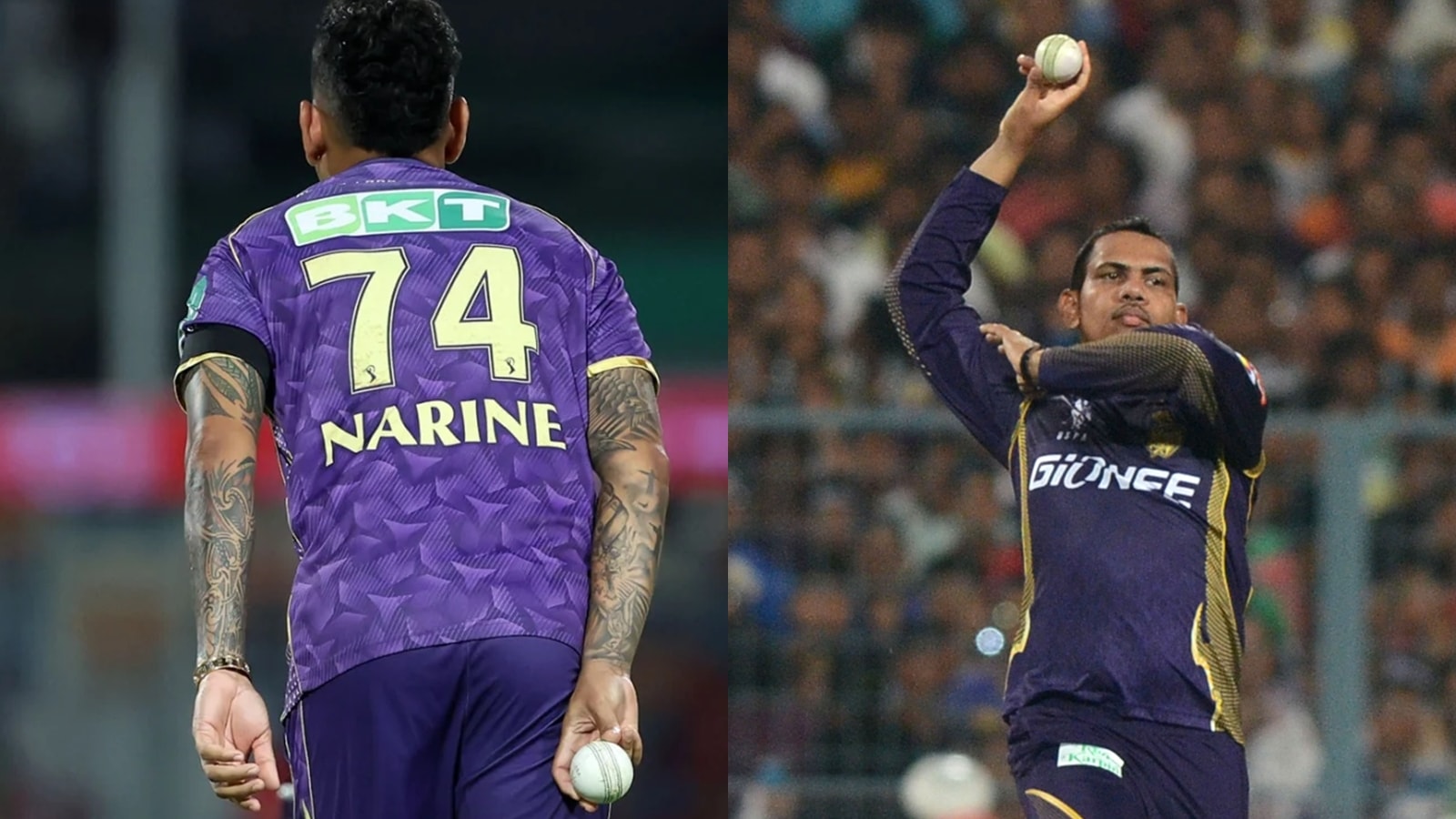 once held the ball over his head in his right hand, offering the batsman a good view of his grip. These days, he ambles in, hiding the ball behind his back, like it is a precious relic. (BCCI Photo/Express Archive Photo)
But for the skinny frame, the loose wrists, the fresh face and the facial hair adventures, Narine is almost unrecognisable. He has retooled himself into an almost different bowler, both in action and craft, locked in a personal mission to illustrate that he could perplex batsmen with or without mystery. From mystery to non-mystery, Narine has traversed a path less travelled.
Maybe, he knew all along his journey that there is no existence more precarious than that of the mystery spinner, that he has to perpetually evolve his craft, unlearn all that he had learnt, and master the plebeian tricks that made the careers of all great spinners. Some of it was forced by the mandated re-modelling of his action. But he had the examples of mystery-twirlers blooming and burning out, like fireflies by the night.
Story continues below this ad
Although he lost his carrom ball, doosra and the ripping off-break (the ball that was called by umpires) in the re-modelling spree, he knew that he had to remain unpredictable, the most valued virtue for a T20 bowler. He did that not by a splurge of variations, but by interchanging lengths and shuffling pace. Most spinners have a default length. Narine’s was good length, but it’s difficult to discern his preferred length these days.
For instance, in the recent match against Chennai Super Kings where his figures read 4-0-21-1 when most of his colleagues bled more than 10 runs an over, he confused the marauding Sanju Samson and Dewald Brevis with shrewd length modulations. The first ball to Samson was full and flighted. The second was good length; the third was back of a length. All three landed on the off-stump. One came back at the angle; the second spun away a wee bit and the third went straight. The trajectories in the air were different — floated, semi-flat and then flat. As was pace — the first ball was the slowest (90kph or thereabouts), the second fastest (late 90kph) and the third was somewhere in the mid-90s.
Mind-reader
Much of the hitting in T20s is preemption. Batsmen second-guess the bowler’s designs and line up for the big shot. The uncertainty of length disrupts their original idea, forcing a safer outlet. Or in other words, Narine is now playing with the batsmen’s mind, and not their eyes. They are not zooming their telescopes to decrypt his grip or release, but calculating in the mind the length he would bowl.
The mastery of pace kicks in next. No one knows which ball would come at what pace.
Story continues below this ad
When spinners go back of length, batsmen expect the ball to rush into them. They instinctively shape for the cut, but Narine keeps them waiting. A played-on, thus, is a common form of dismissal.
When batsmen expect the ball to sit up, it fizzes onto them. The other way around too. Batsmen have little cues to pick the ball — not a change in arm speed, release or grunt. It is as though Narine knows the batsman’s mind more than the batsmen himself, a trait Wasim Akram identified during his coaching stint with KKR: “He has the ability to read batsmen’s minds. That’s his real big skill.”
The Trinidadian relies on three variations — the knuckle-ball, the off-break that turns gently, and the one that straightens a touch. Those are not strike balls, but set up his strikes. Batsmen when re-watching their dismissals would wonder at the delivery’s plainness. A staple off-break that spun a shade bowled Sarfaraz Khan. He might not be as voracious a wicket-taker as he once was and hasn’t enjoyed a 20-wicket season after 2014, but in the last five editions, he has bled only 6.9 runs an over.
Add the pinch-hit runs, wickets (52) and the knack of bowling at any stage of the game, and Gambhir’s intuition stands vindicated. Narine might not be the man Gambhir once saw, but he remains the man Gambhir wanted him to be. A match-winner and a bowler batsmen still misread.



