



The 2025-26 Los Angeles Lakers, all things considered, probably outperformed expectations. They beat their projected win total by 6.5 games. They solved the fit issues between Luka Dončić, Austin Reaves and LeBron James in a blistering 16-2 March. They won a playoff series that Dončić missed and Reaves didn’t join until Game 5. Purely on paper, the season was a success.
In reality, very little was actually accomplished. This season, more than anything, was about buying time. Time for James’ max contract to expire and create cap space. Time to gain further access to their own draft capital for trade purposes. Time to evaluate what they had so they’d know what they need. The last season and a half was an uncomfortable collision between the end of the last era and the beginning of the next. Starting this summer, the real work of building the Luka Dončić Lakers begins.
The end goal of that effort, functionally, is building a team that can compete with the Oklahoma City Thunder. They’re the bar, at least alongside the San Antonio Spurs. Those are the teams the Lakers are going to have to beat to win a championship, and they’re what make this season, on some level, a disappointment.
The Lakers acquired Dončić in February 2025. It’s been a season and a half. They have not yet acquired a single player who appears poised to be a central part of their strategy against the Thunder moving forward. They just played Oklahoma City in a series that the Thunder frankly slept through. The first halves were competitive. The second halves, when the Thunder woke up, were not. Oklahoma City became the first team in 26 years to win the first three games of a series by more than 16 points.
What’s next for LeBron James? Setting odds for his next team, plus why retirement seems like real possibility
Sam Quinn
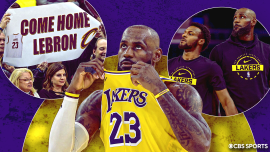
Dončić’s absence makes proper evaluation difficult, of course. Everyone was overburdened without him. But Deandre Ayton was a mess and called out for his effort on the Game 3 broadcast. Jake LaRavia was borderline unplayable. Marcus Smart and Luke Kennard had their moments, but Smart is 32 and injury-prone, while Kennard’s offense came and went throughout the postseason. Both can become free agents this offseason. Reaves, though injured, played most of the series with a target on his back defensively. The only Lakers who consistently held up were the 41-year-old James, whose future is uncertain, and Rui Hachimura, also an impending free agent with serious defensive question marks.
The Lakers are almost starting from scratch here. They have Dončić. They’ll probably have Reaves. JJ Redick will be their coach, and this year’s over-performance suggests he’s a keeper. And they’ll need basically everything else: at least one center better than anyone they currently have, multiple wing defenders who can shoot and another ball-handler to replace James, whether he leaves now or in a year. We can say very little with confidence about who will be playing for the 2027-28 Lakers, when Dončić will be in the final year of his contract and presumably expecting to seriously contend.
That’s what this offseason is about. Beating modest Vegas expectations and knocking out dysfunctional opponents is no longer relevant. The entire goal is to find the players who will surround Dončić during the prime of his Lakers tenure. Who those players might be and how the Lakers can try to get them are what we’ll try to figure out today.
The short-term financial outlook
The projected salary cap for the 2026-27 NBA season is $165 million. The Lakers currently owe roughly $92.6 million to nine players, and their No. 25 overall pick will cost about $3.2 million. Factor in a $20.9 million cap hold for Reaves, allowing them to go over the cap to re-sign him, and you’re looking at roughly $116.7 million in obligations, giving the Lakers a bit more than $48 million in projected cap space.
That figure is not set in stone. It assumes that Ayton and Smart will both pick up their player options. Either of them could decline, which would give the Lakers more space — Ayton’s option is for $8.1 million, and Smart’s is for $5.4 million — but it would mean either replacing them or re-signing them.
At this stage, Ayton is probably slightly more likely than not to pick up his option. He and Dončić share an agent, Bill Duffy, who helped set Ayton up to join the Lakers, and given his roller-coaster performance, his market will likely be soft. Smart, who had a great year for what he was paid, will probably opt out and seek a bigger payday. If he does, the Lakers can give him a 20% raise if they operate above the salary cap, they can re-sign him using cap space, or they can re-sign him using the cap room mid-level exception projected at $9.4 million.
So, what does a projected $48 million in cap space actually mean? It means that if the Lakers want to either absorb outside players through trade without sending money back or pursue external free agents, they have $48 million to do that with. After that $48 million is spent, they’d have that cap room mid-level exception, and beyond that, only minimum salaries. Creating that $48 million in cap space means renouncing their rights to all of their free agents. Most notably, that would be James, but it would also include Hachimura, Kennard and Jaxson Hayes.
If the Lakers want to retain some of their own free agents, they are free to do so. Say James is willing to come back for $20 million. The Lakers could simply pay him that much and then still have $28 million to spend. If they want to bring back all of their free agents, they would opt to operate above the salary cap. That would mean retaining their rights to everyone, bringing them back, and hoping to use the non-taxpayer mid-level exception projected at $15 million to add one impact free agent.
If the Lakers are pursuing any big-name, external free agents or well-paid veterans through trades, they’re probably operating below the cap and will have to pay what it takes to get their targets. If they’re operating above the cap and running it back, the idea will probably be to overpay everyone on bloated, one-year contracts. This will allow them to kick the cap space can down the road to 2027, when the free-agent class is stronger, and give themselves a lot of tradable salary to work with during the season. We’ll cover every scenario below.
What do the Lakers have to trade?
Part of the reason the Lakers hesitated to make a major trade at this year’s deadline was that they had only one pick to trade, their 2031 selection. By waiting until this summer, that number ballooned to three. Teams can trade picks seven years out, so when the league calendar flips, their 2033 pick is in play, and once the Lakers actually use their 2026 pick, the Stepien Rule restrictions preventing them from going multiple years without a pick (since they owe Memphis their 2027 choice) expire.
In addition to those three outright first-round picks, the Lakers can trade first-round swaps in three more drafts: 2028, 2030 and 2032. Don’t sleep on the value of those swaps. In a flattened lottery environment, they’re more valuable than they’ve ever been. The Thunder have even traded outright picks for swaps in the past. That might seem counterintuitive, but it makes sense when you’re as asset-rich as they are. Oklahoma City doesn’t have enough roster spots for all of its picks. They don’t want volume. They want upside. The Spurs have targeted swaps for the same reason. There will probably be a number of teams looking to turn swaps into lower-upside outright picks this offseason. The Lakers could be one of them.
If the Lakers are using their cap space in the trade market, well, that’s straightforward. Being able to absorb $48 million in salary without sending any back is enormously valuable and would allow the Lakers to sign any player in the NBA except the league’s 25 highest-paid stars. However, given the limitations that would impose on the Lakers in free agency and in retaining their own players, they’d likely only use cap space in a big trade if it were for a true star.
More likely, the Lakers will try to match money in the trade market and keep their cap space separate. The two likeliest Lakers to move in this scenario would be Jarred Vanderbilt, who makes around $12.4 million, and Dalton Knecht, who makes around $4.2 million. Neither is a desirable contract, but if the Lakers are sending out draft picks, taking them is probably the cost of doing business for the acquiring team. If either Smart or Ayton picks up their options, they could be used as a matching salary as well.
The Lakers could also sign-and-trade their own free agents to create more matching money if needed, but that’s a complicated process that requires cooperation from the player, interest from the team, and the navigation of some complex CBA mechanics like base-year compensation. As it’s unlikely outside a few niche cases, it’s not worth covering for now. Where it might come up, we will address it.
LeBron James may be at retirement age, but everything else tells us he’s not done yet
John Gonzalez
What to do with LeBron James?
In January, James leaving the Lakers, either through free agency or retirement, felt inevitable. March and April were far better. He figured out how to function as a No. 3 option. He’s comfortable in Los Angeles. The chemistry felt real. It’s hard to imagine he’d find a better chance at contending than the version of the Lakers that dominated the league before Dončić and Reaves got hurt. It makes sense to bring him back, but only under the right circumstances.
If he’s willing to return for the minimum or even the cap room mid-level exception? Awesome. Take him. Even now, he generates massive surplus value at that price point. Signing him at this price does nothing to interrupt any other plans the Lakers might have. They could still use the full $48 million to improve. If James is willing to take this sort of discount, it’s probably with an understanding that the Lakers are using their resources, both the money and the picks, to actually do so. It would be a joint effort to push for the 2027 title.
If the Lakers determine their best course is preserving their cap space for the 2027 offseason, re-signing James to a hefty one-year deal would also be fine. In this scenario, they’d mostly be running back this year’s roster on short-term deals. Maybe they’d use those big expiring contracts to make an in-season trade. More likely, winning it all next year isn’t the plan, and James is returning mostly for the money. With full Bird Rights, the Lakers could pay him anything up to the max.
Where the decision gets harder is when keeping James impedes their ability to add players they’d view as long-term fits. If the Lakers plan their offseason around pursuing younger 2026 free agents on multi-year deals or acquiring such players through trade, paying James more than the cap room mid-level exception would become counterproductive. There is no point in doing free agency halfway. They have Reaves’ artificially deflated cap hold here and now. Next year, he’ll simply be making market value, so their path to cap space will basically mean clearing everyone else off the roster. So they’re either building their team in full now, or they’re waiting to do so in a year. Splitting your space between James and some free agent accomplishes little.
So James’ Lakers fate hinges on the big-picture plan, and on his demands. A return of some sort seems likelier than, say, retiring or departing for another team, but it is far from a certainty.
What to do with Austin Reaves?
The Reaves situation, in the short term, is probably far simpler. Dončić wants him around and considers him “a long-term piece” on the roster, according to The Athletic. The Lakers are almost certainly going to keep him on a contract close to his max, which is fortunately only 25% of the cap since he’s just a five-year veteran.
Armchair general managers have been skeptical of this plan. Can you build a viable defense with both Dončić and Reaves? Does paying them both hamstring the Lakers’ pursuit of other players? Can he score enough in a playoff setting? These are reasonable questions. They just ignore the reality of the situation. Reaves is an unrestricted free agent and if the Lakers don’t pay him, someone else will. This is not a team so loaded with assets that it can afford to lose an All-Star-caliber player for nothing. You might argue that the Lakers should consider a sign-and-trade for Reaves. Well, Reaves would have to sign off on that. How do you think he’d respond if the Lakers approached him and told him they’d like to trade him? That might be the sort of thing that spooks him enough to consider offers from other teams.
If they approach him with a sign-and-trade, it has to be one desirable enough that he’d reasonably consider it. I’m sorry to any Laker fans who want Giannis Antetokounmpo. It’s just hard to imagine Reaves signing up to join the Bucks when he could simply walk into Brooklyn or Chicago’s cap space. Purely from an asset management perspective, the Lakers probably have to just re-sign Reaves while they can.
That doesn’t mean they can’t consider trades later. They’d probably like to actually see how the Dončić-Reaves pairing fares in another postseason first. If they move him any sooner, it’s probably because they have a path to a superstar. For now, one isn’t visible, though we’ll address a few broader concepts down the line.
Which 2026 unrestricted free agents make sense?
Pickings are remarkably slim when it comes to unrestricted free agents in areas of need for the Lakers. Ideally, they’d have plenty of centers and 3-and-D wings to choose from.
The center market is just too risky for them. While there are starting-caliber players available, all of them — Kristaps Porziņģis, Mitchell Robinson, Robert Williams III — carry medical red flags that prevent them from actually playing a starter’s typical minutes load. They are better suited to time shares. Ayton’s durability could make that viable, but the Lakers just aren’t secure enough in their overall roster construction to take serious health risks. If they’re using cap space and letting productive players leave in order to do so, they need more certainty.
The three-and-D side of the equation is a bit better, though by no means perfect. Quentin Grimes is probably the best the market has to offer, and he’s enough of a ball-handler to potentially help pick up some of the duties James would cede upon his eventual exit. He’s probably gettable for slightly above the mid-level exception. The 76ers tend to prefer ducking the tax, and such a deal would take them above the line even before considering a new deal for Kelly Oubre Jr. However, Grimes is only a decent defender, far from a great one. He’d fit, but he’s not exactly the stopper the Lakers will eventually need to acquire.
That sort of player doesn’t really exist on the market. Keon Ellis is too small, and he hasn’t held up in the postseason for Cleveland. Matisse Thybulle is another major injury risk, and his offense is a big negative anyway. The same applies to Dean Wade. The Lakers had Jordan Goodwin in the building and let him go. Besides, he’s more of an energy player than a real impact defender. Ayo Dosunmu leans much more on the offensive end of that spectrum, and while the transition offense he’d bring would be welcome on a slower, Dončić-led team, the Timberwolves aren’t letting him go cheap.
The Lakers should absolutely take swings on the fringes. If there’s a two-way player who’s impressed them elsewhere or a low-end free agent with upside, go for it. Players like Grimes, Dosunmu or Ellis could make sense situationally, and the Lakers could perhaps add two of them. But they should probably aim a bit higher.
Which 2026 restricted free agents make sense?
The real targets of 2026 free agency are in the restricted class. The two younger players the Lakers have most frequently been linked to are Tari Eason and Peyton Watson, two high-end athletes who can defend multiple positions and have at least grown into nominal 3-point threats.
The danger of restricted free agency isn’t just that the original team can match the offer. It’s that they have two days to do so. That’s two days of sitting on your hands, watching the market dry up as players sign elsewhere. Sign an offer sheet that gets matched and you’ve functionally sat out of the productive portion of free agency. There’s not even a guarantee that your own free agents will wait for a resolution.
Houston has around $13 million in room below the tax, but no great reason to avoid paying it. If they let Eason go, it’s because they simply don’t think he’s a good value on the offer sheet he signs. Watson is a trickier case. The Nuggets are already pressed against the second apron before factoring in his deal. They are expected to try to shed money to keep him, but we don’t yet know how successful they’ll be on that front. Put a $25 million-per-year offer in front of him and the Nuggets may be staring down a nine-figure tax bill.
Restricted free agency is a game of chicken. Suitors are so afraid of the match period that they often don’t bother with offer sheets. That allows teams to keep their players at well below market prices. However, once an offer sheet is signed, it’s usually well above market rate to try to scare off the incumbent. Teams can sidestep this through sign-and-trades. Maybe that’s the solution. The Lakers could dangle a first-round pick to the Nuggets or Rockets while using the threat of a big offer sheet to try to scare them into accepting. Until we know what these teams are planning, there’s no way to predict how such a pursuit would play out.
There’s another big name worth mentioning, though, and it’s someone we largely assumed wouldn’t be gettable until now: Jalen Duren. He’s probably about to make an All-NBA team, making him eligible for up to 30% of the cap. He is also in the middle of a very disappointing playoff run. With Ausar Thompson eligible for a rookie extension that will surely be expensive and the two posing serious offensive compatibility questions, could Duren be gettable? If it’s at all possible, it probably needs to be for the max. The Pistons, like the Lakers with Reaves, won’t be eager to lose their asset for nothing. They’d have to be so scared off by the offer that they’d have no choice.
Speaking of Reaves, this is the one somewhat feasible sign-and-trade scenario for him, at least for now. The Lakers need size. The Pistons need scoring. Detroit wanted to draft Reaves in the second round back in 2021. He talked them out of it because he wanted to sign with the Lakers as an undrafted free agent. Maybe there’s a workable framework here. Detroit, unlike Los Angeles, is brimming with the sort of athletic defenders it would take to hide Reaves on his weaker end of the floor. Duren has struggled with the cramped paint that Detroit’s weak offense creates. Ask Dereck Lively and Daniel Gafford what Dončić can do for the right center. Teams tend to err on the side of caution when it comes to retaining key, young players. Detroit is probably going to wind up keeping Duren. This postseason has just cracked that door an inch.
Who’s looming in 2027, and is it worth waiting for them?
The 2026 free agent class is relatively weak. Things look better, at least for now, in 2027, when Nikola Jokić, Giannis Antetokounmpo and Donovan Mitchell headline a potentially loaded class.
I use the word “potentially” very loosely there because players of that caliber almost never reach free agency anymore. They either sign contract extensions or use the looming threat of free agency to force trades to preferred destinations. The Lakers are helpful in that respect. They’re such a terrifying boogeyman that teams are going to acquiesce to whatever trade demands are made this offseason. Even with Reaves, the Lakers have paths to max space next offseason, provided they’re prudent everywhere else.
Fans have fantasized about a Dončić-Jokić partnership for years. The two are friends. But Jokić has indicated at every turn that he plans to remain in Denver. He is eligible to extend this offseason. He was eligible last year, too, and while there were financial reasons for him to wait, the fact that he didn’t sign did power the rumor mill briefly. If, for whatever reason, he elects not to extend this offseason, the Lakers drop everything and prepare for max space next summer. Who cares if such a pairing couldn’t stop anyone? It’s two of the best five players in the league.
Antetokounmpo is all but assuredly going to be settled via trade this offseason. The Bucks are open for business. There’s less clarity on the Mitchell front. The Cavaliers are still playing, after all. If he plays out next year on an expiring deal, he’s worth pursuing in 2027. He’s redundant with Reaves, but he’d cost no assets. Sign him, trade Reaves and picks for defensive-minded role players afterward. Dončić and Mitchell would lay the foundation for the NBA’s best offense.
The role player class is deeper on paper in 2027 than it is in 2026. It rarely works out that way. The last few CBAs have pushed players towards signing extensions. There will be a handful of capable starters, but it’s unclear who or at what position. If the Lakers are waiting for 2027, it’s for one of two reasons: either they believe they can benefit from the star upheaval in some way, or because, frankly, no better pathways presented themselves in 2026.
Who should the Lakers target in trades this offseason?
The short answer here is almost any non-star. That’s what nearly $50 million in cap space and three first-round picks buys you. If the Lakers are meaningfully dipping into that pool, though, they have to make it count. So, which starting-level players make any sense? A handful come to mind.
- How badly do the Magic want to save money? They’re pressed up against the second apron and have Anthony Black‘s rookie extension looming. If the Lakers wanted to take on the descending annual salary contract of defensive star Jalen Suggs, they could probably do so. His injury issues and offensive weaknesses likely make that a non-starter, though.
- Herb Jones has been a popular target for some time. The Pelicans have always resisted overtures, but he’s coming off a down year in which he shot below 31% from deep. That’s the question. His shooting has come and gone, and if he’s not getting guarded, that makes life much harder for Dončić offensively. One first-round pick probably doesn’t get it done. Maybe two could. That’s a bit steep for an arguably one-way player. If the Lakers could get the Pelicans to take on Vanderbilt’s contract, maybe it’s a conversation.
- The Mavericks have an entirely new front office. How attached are they to either of Dončić’s former centers, Gafford or Lively? Would ownership allow another trade with the Lakers? It’s worth the call, but it’s hard to imagine these teams working together again.
- If the Bucks trade Antetokounmpo, they probably wouldn’t mind getting out of Myles Turner‘s contract. The Lakers have been interested in him for years. He’s slipped defensively, but he’d be a monster on offense with Dončić both setting him up for lobs and benefitting from his spacing. The price would likely be relatively low.
- The Thunder have team options on both Isaiah Hartenstein and Lu Dort, along with pressing tax and apron concerns. Dort is probably more gettable than Hartenstein, but given how rare 3-and-D players are, Dort will likely get first-round offers from other teams. Besides, the “3” side of the equation hasn’t been great for some time now. Hartenstein is the better player, but he’s not the lob threat Dončić prefers at center, and the Thunder may look to keep him until they know Thomas Sorber is up to speed.
- Here’s an unlikely scenario: LeBron James wants to return to Cleveland, but he wants to get paid handsomely to do it. In this world, perhaps there’s a sign-and-trade possibility for Cavaliers center Jarrett Allen. Doing this probably means dipping into cap space. Cleveland isn’t going to have the flexibility to take on a contract like Vanderbilt’s and, because of base-year compensation, James would only count for half of his new salary in terms of outgoing money for the Lakers. Still, Allen is probably the best center the Lakers could access without using picks as bait… if the Cavaliers need him to pursue LeBron. He’s about to start a three-year, $90 million contract, though, so the Lakers would have to feel comfortable paying him through his age-30 season.
These are the obvious names. Others will come up. That’s what happens with blank slate rosters like the Lakers’. They have one mega star in Dončić. They’ll likely have another All-Star-adjacent player in Reaves. But no other slot on the roster is secure. The Lakers will cast a wide net in building around their new franchise player. This offseason, they’ll finally have the tools to do so.



