
China Takes Supercomputer Crown From U.S. for First Time Since 2017 | Technology News
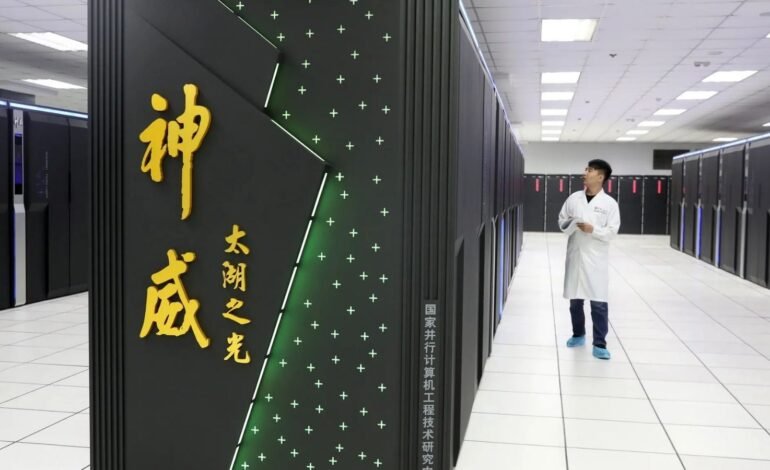

China took back a coveted computing crown from the United States on Tuesday, ratcheting up a fierce technological competition that has implications for science, national security and geopolitics.
LineShine, a massive computing system in Shenzhen, China, was declared the world’s fastest by a group of researchers using a set of standard tests for supercomputers. Besides raw speed, the system stood out because it uses only standard microprocessors and not the special-purpose chips called graphics processing units, which most high-end supercomputers rely on for heavy number crunching.

That underlying design could point to a better way to blend artificial intelligence with traditional scientific tasks, said Jack Dongarra, an organiser of the so-called Top500 list of the world’s most powerful supercomputers.
Dongarra, a professor of computer science and electrical engineering at the University of Tennessee, recently inspected the new machine, at the Shenzhen Cloud Computing Centre. LineShine’s test results were more than 20% faster than those of El Capitan, a system at Lawrence Livermore National Laboratory in California that has topped a twice-yearly ranking of supercomputer performance since November 2024. China had not placed a machine at the top of the list since 2017.
“It’s an impressive system,” Dongarra said of LineShine. “They upped us by developing a system that is not reliant on GPUs.”
The new supercomputer adds to the race between China and the United States for technological supremacy. U.S. tech giants like OpenAI, Anthropic and Google have developed leading AI models, while another American company, Nvidia, has become the world’s dominant supplier of AI chips. China has tried to innovate in different ways, with the Chinese startup DeepSeek releasing a cutting-edge artificial intelligence model last year using just a tiny fraction of specialised AI chips.
Supercomputers, a term for the largest machines dedicated to science, have been used since the 1960s for tasks such as creating climate models, cracking codes and designing nuclear weapons. They typically use high-precision mathematics, expressing numbers with 64 bits of data.
Story continues below this ad
Commercial AI systems from companies like Google and OpenAI, by contrast, can be even faster. They can use approximations for tasks such as identifying images or selecting the next word in a sentence, relying on what are known as 4-bit and 8-bit numbers that allow the systems to make many simpler calculations at once.