



When the final whistle blew at the Vitality Stadium in Bournemouth, the hosts pegging Manchester City to a 1-1 draw, North London erupted. Arsenal were champions — after a wait of 22 years. Long not only in its length, but in its pain. The endless cycles of near misses burned like an open wound. Happy tidings of a dynasty loomed when they raised the trophy in 2004, the season they went without dropping a game.
But fate wrote the script differently. The construction of a new stadium — a necessity, not greed — bore its brunt on wages and transfer policy. The talismans left. Around them rose clubs muscled with petrodollars; their visionary vice-president and co-owner David Dein sold his shares and departed; football itself forsook the romantic ideals of the peak Wenger years.

In the years that followed, they watched Alex Ferguson — once Wenger’s equal — scale luminous heights. They endured the insults Jose Mourinho spat at their manager. They glanced covetously at Pep Guardiola raising an empire, Jurgen Klopp a kingdom, Leicester City spinning an unlikely fairytale. And they watched the silverware slip through their own nervous palms, even under Mikel Arteta. No club in the Premier League can have suffered quite as much in their quest to squeeze another title onto the shelf.
This, then, was not only a triumph of quality but of will and persistence. Such callous fate could have broken most teams and managers. But not Arteta. He painstakingly refined his squad to such a level of efficiency that they always found a way through. April was cruel — injuries wreaked their customary havoc, anxiety crept in. But in May, they rose above every setback, those of the mind and on the ground. Since City drew level on points, Arsenal tigerishly clung to every point they could muster. It was not always beautiful football — rugged and physical at times, a departure from the free-flowing Arteta-ball of his early years and the ideals of Wenger’s Invincibles.
The reliance on set-up pieces was not accidental, but a shrewd exploitation of the diminishing aerial ability of opposition defenders. They utilised the deadball to such devastating effect that EPL woke up to its lost value.
Unfair parallels will be drawn, because this is their first title since that epochal season. Arteta’s men are no Invincibles — they are flawed and human, and it makes the narrative richer, not poorer. But look beyond the outward beauty of Wenger’s virtuosic side and there are threads that bind both teams. Both were built on unshakeable trust — forged by men bound by professional allegiance, intimacy and friendship.
The Invincibles’ captain Patrick Vieira spoke of that culture in Amy Lawrence’s book Invincibles: “The objective of going to eat outside is to get to know each other better. You talk about something you don’t normally talk about, you realise how much you shared about your life when you were young. It brings you closer and then when you are out there on the pitch you know that he will watch your back.”
Story continues below this ad
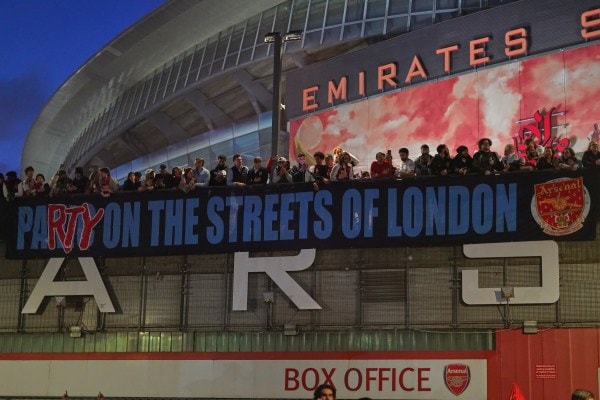 Arsenal supporters gather at the Arsenal stadium after Arsenal won the Premier League title in London. (AP Photo/Alberto Pezzali)
Arteta’s men bond over a game called Werewolf, also known as Mafia. A moderator divides the team into villagers and werewolves. Arteta made it mandatory that every player report first to Colney, Arsenal’s Hertfordshire training base, before travelling together to away fixtures. “They’re very close, they spend a lot of time together off the field as well and that’s something really important,” Arteta said. “You can tell in the way they communicate and the way they look at each other that there is something special.”
The camaraderie overflows on the pitch. Everyone fights for everyone — as did Wenger’s battalion. In the silk and satin of Thierry Henry and company, the defensive solidity of Sol Campbell and Kolo Toure is often forgotten, the indefatigable Vieira screening in front of them.
“We were fighters and gentlemen,” Vieira would say. Arteta’s attackers may not be of Henry’s calibre, but William Saliba and Gabriel rank among the greatest centre-back pairings of the Premier League era. They are not only the meanest defence in the division — they went the entire season without conceding a penalty or receiving a red card.
If Wenger built his team around his forwards, Arteta built his around his midfield, spearheaded by Declan Rice — whom he calls the lighthouse, though powerhouse fits just as well. Every signing was made carefully, to the team’s precise specifications. Rice arrived in 2023, and in subsequent seasons Arteta added Mikel Merino, Martin Zubimendi and Eberechi Eze to make the core more dynamic and solid.
Story continues below this ad
This season, Arteta introduced more verticality and greater variation in attack — shifting shape depending on the opponent, the situation and the personnel available. Often it is a 4-3-3, with Odegaard and Rice triangulating with Zubimendi; at other times a 3-2-4-1 when Riccardo Calafiori moves infield. They pressed transitions harder too, looking to strike before opponents could settle into a low block.
Evolution has been the watchword. “We need to make sure that when we are evolving, we are maintaining the great things that we do and just tweaking and making things that can give us big value,” Arteta said. And so they have — ending a long and painful wait to become champions again. Celebrations will spill into Sunday’s fixture against Crystal Palace, and well beyond.



