


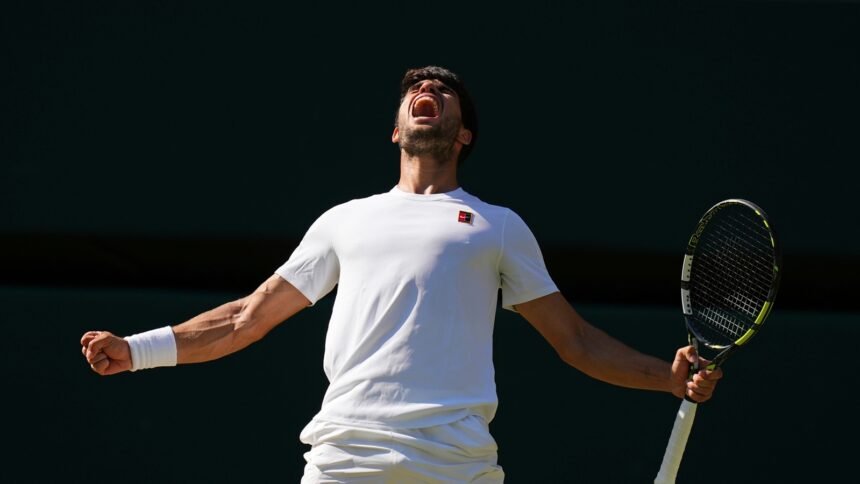
What makes Carlos Alcaraz, a natural clay court savant, the tour-leading grass court player in men’s tennis at the moment? To understand, watch the last 15 minutes of his four-set semifinal victory over Taylor Fritz at Wimbledon on Friday. At 1-1 in the tiebreak, the Spaniard picked up a Fritz drop shot with comfort, marching towards the net with trademark grass court baby steps, as opposed to the clay court slide, hitting a perfectly weighted backhand lob, and following it up with a measured overhead. At 1-3, he mixed things up with a serve-and-volley, and despite mistiming his run, still found the balance to meet the ball on the backhand side and blunt it just past the net.
Down double set point at 4-6, he leathered a first serve return to take control, sending Fritz side to side before ending the point with a forehand volley. To set up match point of his own, at 6-6, he hit a huge second serve and then sent a big forehand to the feet of Fritz, who was approaching the net. The fifth-seeded American put up a resolute fight despite his one-dimensional game, dependent largely on serve. His game plan worked well in both the second and fourth sets, but Alcaraz simply found another gear when he had to. Ultimately, wired and locked in, the 6-4, 5-7, 6-3, 7-6 (6) victory for Alcaraz looked more tedious by scoreline than in terms of actual tennis.

Andre Agassi, an insightful commentator despite his droll humour, would rave about the 22-year-old. “The dude just executes (his game plan) when he needs to. That’s why he has won five Majors,” he would say. Last month, at the French Open, Agassi would claim that the mix of Alcaraz’s movement and hitting zone – where he likes to make contact with the ball on his groundstrokes – actually makes grass his best surface.
As he has marched into his third straight Wimbledon final over the last fortnight, he seems intent on confirming the eight-time Major winner’s telling. Alcaraz, the second seed and two-time defending champion at SW19, became only the ninth player in the history of Open Era men’s tennis to achieve this hat-trick. His 35th victory on grass courts, as compared to merely three losses, puts his winning percentage at 92.1% on the surface, the best at ATP level according to Opta (minimum 10 matches).
The Spaniard became an instant favourite with fans, both casuals and diehards, ever since he burst onto the scene as a teenager, thanks to his variegated artistry and pummelling power. He has only honed those strengths further, and they have amalgamated to make him a dominant force on the surface that was most alien to him in his clay-obsessed upbringing in Spain. This year, his new, smoother service motion has made him better on the first strike, too.
Wimbledon streak
Ups and downs are an ingrained part of the Spaniard’s game. He won the French Open last month by saving championship points against Jannik Sinner and then needed five sets to dispatch the Italian veteran Fabio Fognini in the opening round in London. He has dropped three more sets along the way. But he has such an aptitude for the runs and momentum shifts of five-set tennis, has the physicality to go through the motions, and has the decisiveness on the big moments, that even when he finds himself in an unlikely spot of bother – usually the result of his own wavering focus – he is hardly ever under any threat. The dude does, indeed, know how to execute when it matters most.
On Friday, Fritz would become yet another member of the assembly line of opponents he has brushed past – no matter the scoreline – on his way to a 20-match winning streak at the Championships.
Story continues below this ad
The tone for this semifinal was set on the very first point. Fritz may not have more than one game plan, based largely on his booming first serve, but it is effective on grass. He came into Wimbledon with two grass titles in as many weeks and won two five-setters en route to the semis. But merely serving well was not enough. On the first point, Alcaraz put a return back into play, then hammered a few groundstrokes, made his way into the forecourt, and hit a drop shot winner. Smelling blood, he broke in the very first game and then played a near-flawless set to take the opener.
Fritz showed fight, taking bigger risks on his backhand and serve, and took advantage of the only lapse Alcaraz made throughout an entire service game, at the backend of the second, to take it. But Alcaraz found another gear, returning with more aggression and better placement and taking the early break in the third, and seizing the advantage by breaking again to serve first with a lead in the fourth.
The American came back rolling in the fourth, and on the face of it, deserved to take it after a solid breaker. But Alcaraz just had more left in him: more gas, more variety, more plans, the better tennis. Few have been able to match him recently.
On Sunday, he will have the chance to make history. He will be facing the very best opposition, in a rematch of an epic he has already had, and won, on this stage. He is unlikely to blink. One way or another, expect him to enjoy it.