



3 min readNew DelhiMar 30, 2026 07:07 AM IST
In West Bengal, migrants are a major voting bloc but are among the most vulnerable groups as the adjudication phase continues following the Special Intensive Revision (SIR) of electoral rolls.
The 2011 Census showed that while Bengal saw substantial migration outside the state, it wasn’t among the top states in this regard. Uttar Pradesh (1.23 crore), Bihar (74.53 lakh) and Rajasthan (37.57 lakh) had the largest out-migrant populations, with Bengal ranking seventh highest at 24.06 lakh, of whom 14.52 lakh were women and 9.53 lakh men.

If 5.43 crore total inter-state migrants accounted for 4.5% of the country’s population in 2011, Bengal’s out-migrants counted for 2.63% of its population then.
Neighbouring Jharkhand had the largest population of migrants from Bengal at 4.95 lakh, followed by Maharashtra at 3.1 lakh, Uttar Pradesh at 2.34 lakh, Bihar at 2.28 lakh, and Delhi at 1.82 lakh. In fact, across India, two of the top 50 most popular migration corridors originated from Bengal and ended in Jharkhand and Maharashtra.
The Census data showed a jump of 45% in the number of migrants from Bengal compared to the 2001 Census. In number terms, 7.18 lakh more people left Bengal in this period compared to a decade earlier.
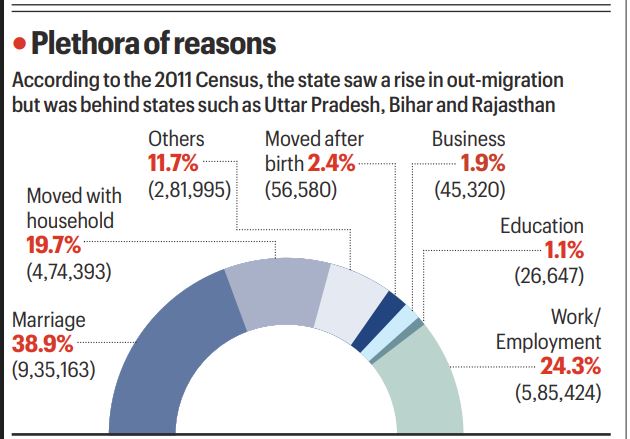
In 2011, marriage was the biggest reason for migration from Bengal, with a total of 9.35 lakh or 38.88% of the migrants citing this reason. Women comprised almost all of this number, at 9.14 lakh, compared to just over 20,000 for men. Employment and moving with households were the next biggest reasons for migration, at 5.85 lakh or 24.34% and 4.74 lakh or 19.72% of the migrants, respectively.
Other data
With the Census data on migration now over a decade out of date, there are some more recent measures of migration that give an indication of numbers leaving Bengal.
Story continues below this ad
The 2016-17 Economic Survey of India used a Cohort-based Migration Metric (CMM) to gauge net migration as the percentage change in population between the 10-19 year-old cohort in an initial Census period and the 20-29 year-old cohort in the same area a decade later. “It is likely to capture labour migration, as other bilateral movements for reasons such as marriage are netted out in the equation,” the report says.
The 2016-17 Economic Survey data showed that UP and Bihar had the highest such net migration, with numbers increasing between 1991-2001 and 2001-11. While Bengal saw about 30,000 people aged 20-29 years leave the state in 1991-2001, this figure rose to 2.35 lakh in 2001-11, the Survey noted.