

At India’s annual pre-Budget consultation with States, Tamil Nadu mounted a detailed fiscal case against what it described as delayed project funding, shrinking post-GST revenues and rising exposure to external trade shocks, particularly from recent tariff actions by the United States.
Speaking at the meeting chaired by Union Finance Minister Nirmala Sitharaman, State Finance Minister Thangam Thennarasu argued that unresolved Centre-state accounting issues were distorting Tamil Nadu’s fiscal indicators and constraining its borrowing capacity.

“The Union government had approved the long-pending Chennai Metro Rail Phase-II Project in October 2024. However, even after one and a half years, the State has not yet received the full benefit of this approval,” Thennarasu said.
Tamil Nadu, he noted, had already advanced approximately Rs 9,500 crore towards the Union government’s share of the project. “This accounting issue adversely affects the State’s debt-GSDP ratio and reduces its permissible borrowing limit,” he said, urging the Centre to correct the entries “in accordance with the Cabinet approval” so that the expenditure was reflected appropriately in both budgets.
He also asked the Centre to revisit metro rail proposals for Madurai and Coimbatore, stating that the grounds cited for their rejection “do not appear consistent with approvals granted to other cities”.
Beyond infrastructure, the minister devoted considerable attention to Tamil Nadu’s exposure to global trade disruptions, warning that recent US tariff hikes had had an outsized effect on the State’s export-driven economy.
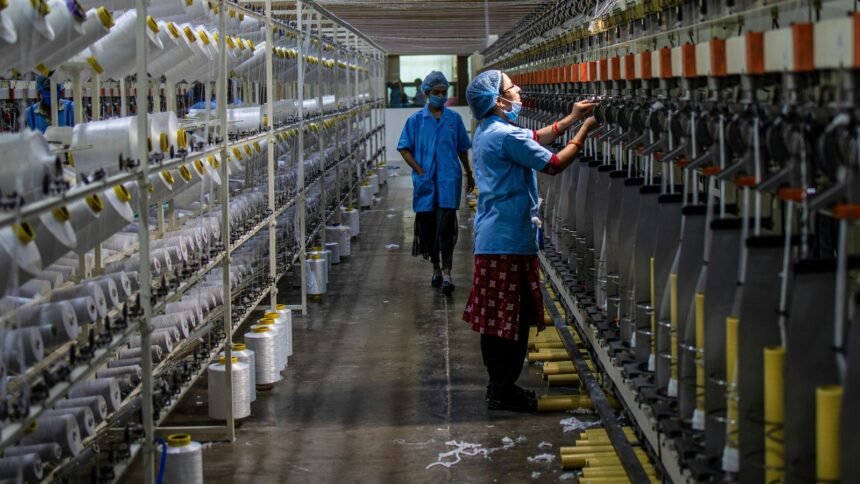
“With 31% of Tamil Nadu’s goods exports destined for the US market, these measures affect the State more severely than most others,” he said, pointing to manufacturing and employment risks. Textiles, in particular, were under strain. “As Tamil Nadu accounts for 28% of India’s textile exports and provides employment to more than 75 lakh workers, this is a matter of national concern,” he said.
Story continues below this ad
If current conditions persist, “an estimated 30 lakh jobs are at immediate risk, with many MSME units facing closure,” Thennarasu warned. He called for a targeted intervention, seeking “a dedicated support package for the textile sector, including measures such as interest subvention, targeted subsidies, export incentives, and appropriate tax relief.”
On the Goods and Services Tax, the Minister returned to a theme raised repeatedly by States since the end of the compensation regime. “GST was introduced in the spirit of cooperative federalism, with States agreeing to give up their autonomy on the assurance that their revenues would be protected,” he said.
That assurance, he argued, had weakened over time. “For the State of Tamil Nadu alone, the estimated revenue loss in the current financial year is about Rs. 10,000 crore, ” he said, urging the Union government to restore a compensation mechanism to address persistent shortfalls. He also criticised the Centre’s increasing reliance on cesses and surcharges. “New central levies… keep the tax burden on consumers unchanged, while accruing the additional revenues entirely to the Union government,” he said, calling for their merger with base tax rates so that States received their constitutionally mandated share.
Centrally Sponsored Schemes were another point of contention. Referring to the Viksit Bharat–Guarantee for Rozgar and Ajeevika Mission, Thennarasu said the revised funding pattern shifted costs sharply onto States. “For the State of Tamil Nadu… the additional burden is estimated at around Rs. 5,000 crore,” he said.
He also flagged stalled releases under key welfare programmes. Under the Jal Jeevan Mission, “no releases under this Scheme have been made since September 2024,” he said, seeking the immediate release of Rs 3,112 crore. The Centre’s refusal to provide Rs 2,283 crore for the Hogenakkal Water Supply Project Phase III, he added, had delayed financial closure.
Story continues below this ad
Similarly, “the Union government has not yet released its approved share under the Samagra Shiksha Scheme for the years 2024-25 and 2025-26, amounting to Rs 3,548 crore,” affecting 44 lakh students and 2.4 lakh teachers, he said.
The minister concluded by seeking fresh railway investments in industrial corridors, a semi-high-speed rail link connecting Chennai, Salem and Coimbatore, and priority funding for national highway projects, including elevated roads between Tambaram and Chengalpattu.