


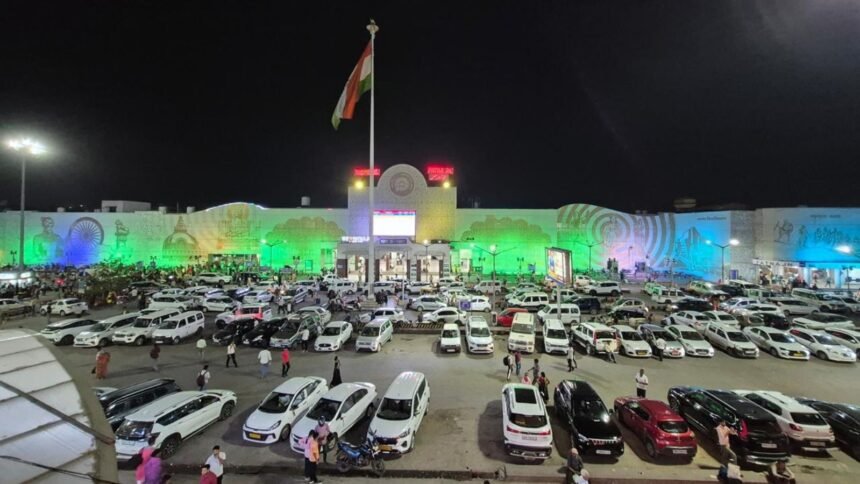
The summer afternoon sun beat down on Platform No. 1 at Patna Junction as the Magadh Express from New Delhi eased into the railway station shortly after 12.30 pm. Sweat-streaked passengers spilled out of the coaches, clutching bags and belongings, their faces etched with the fatigue of a journey that had begun the previous evening in the national capital.
Among them was 32-year-old Rajesh Paswan from Punpun, who has worked as a daily-wage construction labourer in Delhi for the past eight years. Standing at the door of one of the coaches, Paswan held his three-year-old son, who had fallen asleep against his shoulder, with one arm. The other hand gripped a faded cloth bag stuffed with clothes and utensils. A small backpack strained against his back. His wife, who had stepped down just ahead of him, turned to take the child, and Paswan adjusted the bag on his shoulder before jumping onto the platform.

“We left because there is no gas,” he said, wiping his forehead with the back of his hand. “In Delhi, a small cylinder that used to last us 10-12 days now costs Rs 300-350 per kg on the street. I earn Rs 600-650 on a good day. After rent, food and sending something home, nothing is left. Here, at least we can light a chulha with wood or dung cakes from the village.”
Paswan’s story is repeated across platforms at Patna Junction railway station — one of the ways in which the US-Israeli war on Iran, which has since expanded across West Asia, has impacted India. With tightened LPG supplies and spiralling black-market prices in several cities across the country, scores of migrant workers from Bihar are choosing to return home rather than stretch already meagre earnings on cooking fuel.
On Platform No. 2, the New Delhi-Patna Special Fare Summer Special, which had arrived around the same time as the Magadh Express, saw another large group of passengers disembark. Two young men in their mid-20s, Amit Kumar and his younger brother Sandeep, both from Jehanabad district, walked down the sloping ramp that connects the platforms to the exit. Each carried a large gunny sack over one shoulder, and with the other hand, they carried smaller bundles.
They had left for Delhi shortly after the Covid-19 pandemic eased — it was the first time either had ventured out for work. They lived in the Sangam Vihar area of Delhi, and their was simple: earn enough through daily labour to support their parents and save for their two sisters’ weddings.
“For three-and-a-half years, we managed to survive in Delhi on Rs 4,000-5,000 a month after sending money home,” Amit said, adding, “We lived in a room of four-five others and cooked using a small gas cylinder that we refilled every fortnight. Now, that refill costs Rs 700-800 for barely 5 kg, and even that is hard to find. Vendors say supplies are tight because of the situation (the war in West Asia). We decided it was better to come back and look for whatever work we can find closer to home rather than keep sending half our earnings to the gas seller.”
Story continues below this ad
Also at the railway station was 28-year-old Manoj Kumar from Barh, who had arrived on the Shramjeevi Express from Ghaziabad at around 7.30 am after a night-long journey. A mason by trade, he worked at construction sites around the National Capital Region for nearly four years. “In Ghaziabad, we used to share one cylinder among four families in the basti. Last month, the price jumped for the same 14-kg cylinder, and even then, many had to book through the black market, paying double the amount sometimes. Work is not guaranteed throughout the month, and my wage of around Rs 500 could not cover the cost of gas. Better to eat roti-sabzi cooked on wood at home than starve in the city,” he said.
Not far away, Sunil Yadav, who had travelled from Ludhiana on the Himgiri Express that pulled in shortly after midnight, was folding his polythene sheet spread on the floor. “I reached here around midnight, but couldn’t get transportation to my village at that hour. So, I slept here last night,” he said with a tired smile. He is now wrapping up his luggage, which he had used as a pillow, as he prepares to leave for Muzaffarpur through a connecting bus.
The 35-year-old painter recalled the struggle to get cooking fuel back where he worked, saying, “We wandered places for hours to refill a gas cylinder and still got nothing. The small cylinders that painters and labourers use are now being sold at Rs 400 a kg in some places. I earn Rs 500-550; how do you send money home and also eat? In the village, my wife will cook on the chulha. It is slower, but at least we will not go hungry.”
Not just labourers
The returnees are not only labourers. The Sampoorna Kranti Express from New Delhi had arrived shortly after 6.30 am, and 24-year-old Abhishek Ranjan, a UPSC aspirant from rural Patna, has been waiting since then for his friend to pick him up. He had been preparing for the civil services examination in a crowded paying guest facility near Old Rajinder Nagar for the past 18 months. “Most of us shared mess arrangements where the cook used commercial cylinders,” he said. “When those cylinders became expensive and scarce, the mess charges went up by almost 40% in two months. We were spending more time hunting for gas than studying. It made no sense to stay on. I will continue preparation from home now. At least the family kitchen runs on subsidised gas or wood when needed.”
Story continues below this ad
A dozen returnees on the platforms and outside the station revealed a common thread: most did not hold official domestic LPG connections in Delhi or other cities because their jobs were temporary and their addresses changed frequently. Without a connection, they relied on small, unregulated gas cylinders refilled by local vendors whose prices fluctuated daily. Official 14.2-kg domestic cylinders, which cost a little over Rs 900 when subsidised, were largely out of reach for those without paperwork.
Meanwhile, the central government has maintained that there is no widespread scarcity. In a statement, the Ministry of Petroleum and Natural Gas said supply had been affected by the prevailing geopolitical situation, but that no distributor had run dry. It noted that online bookings had risen sharply and delivery authentication measures had been strengthened, with over 55 lakh domestic cylinders delivered nationwide on Wednesday. Officials urged citizens to avoid panic buying.
Yet, for the workers streaming into Patna Junction, the immediate reality is harsher. As Rajesh Paswan gathered his family near the station exit and prepared to board a local bus to Punpun, he summed up the choice many are making, “Delhi gives work, but it has become impossible to cook a simple meal. At home, we may earn less, but we will not have to choose between food and fuel.”