

As foreign ministers of the G7 and partner countries met near Paris Thursday to explore “potential avenues for negotiation that could lead to a de-escalation of the conflict” in West Asia, External Affairs Minister S Jaishankar and his French counterpart Jean-Noel Barrot discussed “working jointly towards ensuring the security of the Strait of Hormuz”.
Later, speaking at a G7 session with invited partners, Jaishankar, alluding to the impact of the war, raised the “Global South’s concerns about energy challenges, fertiliser supplies and food security.” He also “highlighted the urgency of UNSC reforms, streamlining peacekeeping operations, and strengthening humanitarian supply chains.”

Also Thursday, news agency Reuters quoted Admiral Nicolas Vaujour, Chief of Staff for the French Navy, saying he had held talks recently with various naval counterparts, including from Britain, Germany, Italy, India and Japan, to “share our analyses and coordinate our actions in response to the situation” in West Asia.
“We are exchanging views on issues related to freedom of navigation and maritime security, as the sea is a vital artery for our global economy and regional stability,” Vaujour said.
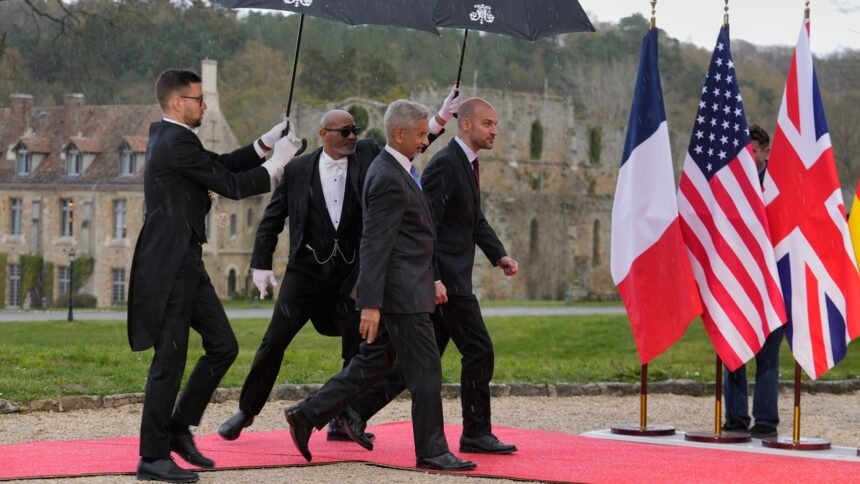
Jaishankar and Noel-Barrot met on the sidelines of the G7 meeting at the Abbaye des Vaux-de-Cernay, about 40 km southwest of Paris.
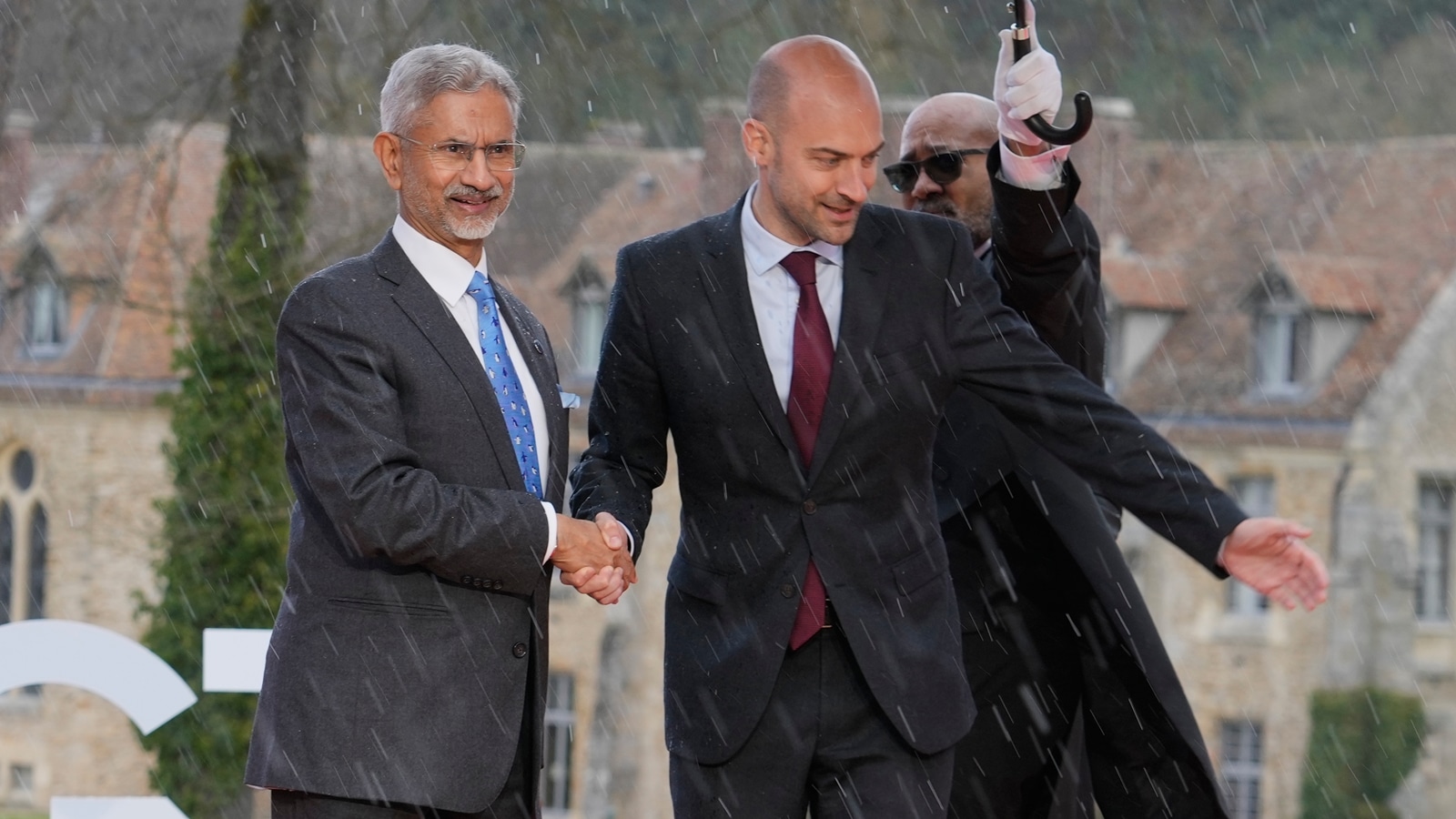 External Affairs Minister S Jaishankar with his French counterpart Jean-Noel Barrot as G7 Foreign Ministers meet near Paris. (AP)
The French readout of the meeting stated: “The Ministers held extensive discussions on the situation in the Middle East. They agreed to continue their close coordination with a view to working jointly towards ensuring the security of the Strait of Hormuz.
Both India and France have been in touch with the Iranians over the last few days – Iran controls passage through the Strait of Hormuz.
Story continues below this ad
Iranian State TV quoted the country’s Foreign Minister Seyed Abbas Araghchi saying Iran allowed India and a number of other “friendly nations” including China and Russia to use the Strait of Hormuz for commercial shipping.
“We have permitted certain countries that we consider friendly to pass through (the Strait of Hormuz). We allowed China, Russia, India, Iraq, and Pakistan to transit,” Araghchi said, adding that ships linked to “our enemies and their allies” will not be allowed to clear the waterway.
French President Emmanuel Macron and Prime Minister Narendra Modi spoke on March 19, and both leaders have also spoken to Iranian President Masoud Pezeshkian.
The Strait of Hormuz is the key channel through which 20 per cent of the global energy supply – and majority of the gas supply from Qatar – passes in large carriers. Qatar, UAE, Kuwait have all been negatively impacted by the closure of the Strait, and that has led to a global rise in prices of oil and gas, and impacted the supply of cooking gas in India and other countries.
Story continues below this ad
According to the agenda of the meeting of the G7 Foreign Ministers, under the head of ‘resolving major crises’, “G7 partners will discuss potential avenues for negotiation that could lead to a de-escalation of the conflict, whilst promoting the safety of our nationals and all civilian populations, the reopening of maritime and trade routes, and the cessation of the Iranian regime’s nuclear and ballistic missile programmes”.
The session on Iran, titled ‘The Situation in Iran and Its Implications for the Region’, will take place over lunch Friday.
With the war impacting supplies via the Strait of Hormuz, especially LNG and LPG, there’s deep concern in India. The government has been working with different partners, and Iran on opening the Strait of Hormuz. Two days ago, US President Donald Trump called up Prime Minister Narendra Modi and discussed the situation in West Asia “including the importance of keeping the Strait of Hormuz open”. Modi said, “India supports de-escalation and restoration of peace at the earliest. Ensuring that the Strait of Hormuz remains open, secure and accessible is essential for the whole world.”
The French readout on Jaishankar’s meeting with Noel-Barrot said the participation of the External Affairs Minister in this meeting “reflects the importance France attaches to closely associating India, currently holding the BRICS presidency, with its G7 presidency”.
Story continues below this ad
It also confirmed Modi’s visit to France for the summit of G7 leaders in June. “The Ministers welcomed Prime Minister Modi’s confirmation of his participation in the Evian Summit (15th–17th June).”
In this context, it said “the Ministers underscored India’s contribution to the G7’s work, in particular on major macroeconomic imbalances as well as international partnerships and solidarity.”
While India is not a G7 member, it has been invited as a partner country by France, the current chair of the powerful bloc. France has also invited Saudi Arabia, South Korea, Brazil and Ukraine for the meeting of the foreign ministers.