


4 min readUpdated: Mar 26, 2026 11:50 PM IST
The International Olympic Committee (IOC) on Thursday banned transgender women and DSD (Differences in Sex Development) athletes from competing in the female categories at the 2028 Los Angeles Olympics and beyond. Announcing the decision, IOC president Kirsty Coventry said it would ‘not be fair for biological males to compete in the female category.’
The IOC also added that athletes wanting to compete in the female category at the Olympics would have to undergo a one-time SRY gene screening. This would also apply to biological females. The SRY gene screening would be done via saliva, cheek swab or blood sample, the IOC said, adding that they are ‘unintrusive compared to other possible methods.’

The umbrella body for Olympic sports and national organisations said they ‘expect’ all international federations and National Olympic Committees, along with continental associations, to adopt and implement the policy.
Participation of athletes with higher testosterone levels, or XY chromosomes, led to a massive controversy at the 2024 Paris Olympics after Algerian boxer Imane Khelif and Chinese Taipei boxer Lin Yu-ting won gold medals in their respective categories. Both boxers were accused of failing gender tests before the Games. Khelif, in particular, was at the centre of the storm after the International Boxing Association (IBA) claimed that the Algerian boxer had failed a gender test during the 2023 World Boxing Championships in New Delhi.
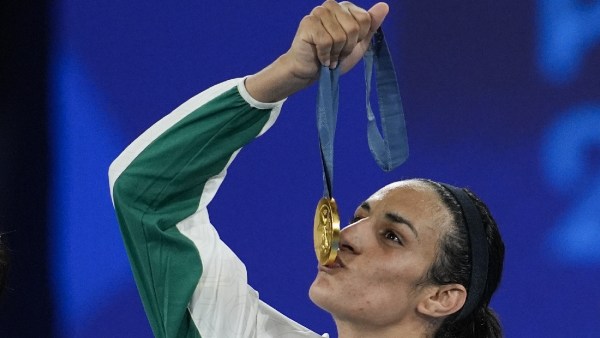 Gold medalist Algeria’s Imane Khelif kisses her medal for the women’s 66 kg final boxing match at the 2024 Summer Olympics. (AP)
For more than a decade, international sport has been grappling with the issue of transgender and DSD athletes’ participation in the women’s category. In 2021, New Zealand weightlifter Laurel Hubbard became the first transgender woman to compete at the Olympics in the female category.
The IOC announced these decisions in a new policy to ‘protect the female (women’s) category in Olympic Sport’ on Thursday. The world body said it had held ‘one-on-one consultations with impacted athletes’ and consulted the IOC’s Athletes Committee while also ‘looking at the science, the policies of international sports federations and the developments in law.
The new policy of IOC states: “Eligibility for the female category is to be determined in the first instance by SRY gene screening to detect the absence or presence of the SRY gene. Based on scientific evidence, the IOC considers that the presence of the SRY gene is fixed throughout life and represents highly accurate evidence that an athlete has experienced male sex development.”
Story continues below this ad
Coventry, who completed a year as the IOC president earlier this month, insisted that the policy is ‘based on science and has been led by medical experts’. “As a former athlete, I passionately believe in the rights of all Olympians to take part in fair competition. At the Olympic Games, even the smallest margins can be the difference between victory and defeat,” she said in a statement. “So, it is absolutely clear that it would not be fair for biological males to compete in the female category. In addition, in some sports, it would simply not be safe. Every athlete must be treated with dignity and respect, and athletes will need to be screened only once in their lifetime. There must be clear education around the process and counselling available, alongside expert medical advice.”
The IOC had established a working group to examine the latest scientific evidence and developments since 2021. The group observed that ‘male sex provides a performance advantage in all sports and events that rely on strength, power and endurance’. “To ensure fairness and to protect safety, particularly in contact sports, eligibility should therefore be based on biological sex,” the world body said.


© The Indian Express Pvt Ltd