

This is a story that has been handed down through generations instead of being jotted down by scribes in bulky old chronicles collecting dust somewhere.
It was autumn in the late 1830s in princely Tripura. Krishna Kishore Manikya of Tripura’s Manikya dynasty, which ruled the state for over 1,000 years till 1949, was reigning on the throne.
The king and his queen, Sulokkhona Devi, had visited the Durgabari temple when evening ‘arati’ was going on.
It was the year the king had shifted the state’s capital to Agartala – a city that still functions as the capital 188 years later – from the Old Agartala block that lies 15 km to the north. Though the capital had been shifted, much of the infrastructure was still being built, and the bulk of the administrative work was still being done from the Purani Haveli of Old Agartala.
These were the pre-electric power days, and the puja was being held in the light of flickering flames of torches and lamps.
Maharani Sulokkhona Devi had never seen the 10-armed idol of Goddess Durga before. The first evening that the puja started, the king and the queen were the special guests.
If the folklore is to be believed, the queen simply fainted at the sight of the powerful image of Goddess Durga, riding on her spirit animal lion, and impaling the demon king ‘Mahisasura’ with her trident.
‘Divine commandment’
Story continues below this ad
That very night, the maharani supposedly received a divine commandment where the goddess told her she would appear with two arms and the rest eight would be hidden in the back to allay the queen’s fears.
A doting husband, Maharaj Krishna Kishore Manikya immediately commissioned a second idol to be built, one with two hands on display.
So, an idol was built that year itself, symbolising the compassionate or ‘abhaya’ form of the goddess.
Tracing Durga Puja origins in Tripura
The tradition of Durga Puja can be traced back 500 years in Tripura, when the puja used to be conducted at Rangamati, another erstwhile capital city that was renamed Udaipur by Maharaj Uday Manikya in 1567.
A tradition continued
Story continues below this ad
Jayanta Bhattacharya, Head Priest, Durgabari temple, said, “Since the incident with Maharani Sulokkhona Devi, the supreme mother deity of Hinduism is worshipped during Basanti Puja, Durga Puja, and Katyayani Puja using the same idol structure that sports two arms.”
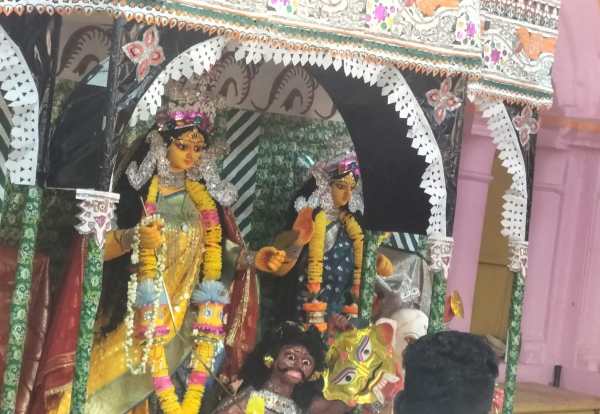 The Durga idol in Agartala’s Durgabari. (Photo Credit: Debraj Deb)
“In keeping with the queen’s ‘vision’, though two arms are seen, the rest of the eight arms are hidden behind the idol’s back, thereby maintaining the ‘Doshobhuja’ or 10-armed form,” he added.
Popular destination
Every year during special occasions, massive crowds throng the Laxminarayan Bari Road, which encircles the Palace Compound, an area originally covering 800 acres that housed the Ujjayanta Palace – the abode of the former royals, former gubernatorial residence and current state museum, Durgabari Temple, Laxminarayan Bari Temple, Laalmahal (demolished during the Left regime; the site now houses the city town hall), Wazirbari, Nazirbari, and the Swetmahal (earlier served as Governor’s residence).
Public voices
Story continues below this ad
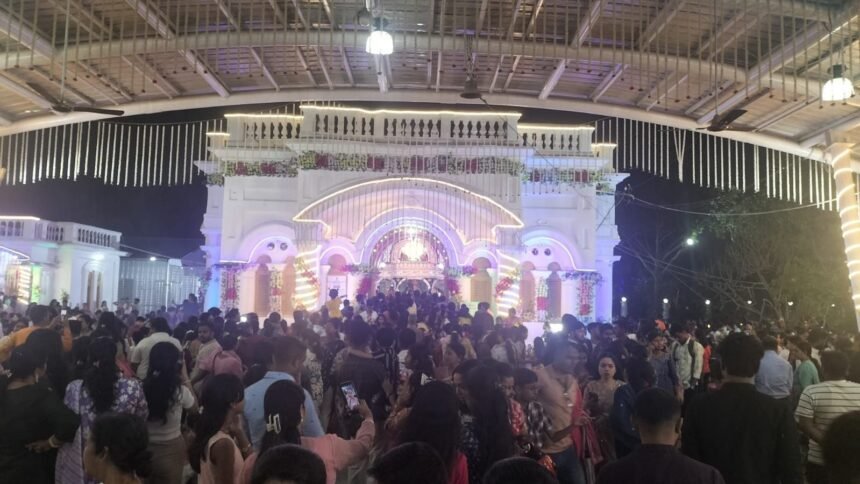
This year is no exception, with devotees taking over the entire stretch from Bidurkarta Chowmuhani to Ganaraj Chowmuhani with Durgabari in between during the ongoing Basanti Puja.
Sarmistha Das, a devotee who was spotted among the crowd trying to enter the temple, said, “We come every year to visit the deity and offer our prayers. We believe this historical place has the answers to our prayers.”
Kajal Das, a local businessman, was seen coming out of the temple. “It’s a massive crowd in there. But we come every year and wouldn’t miss it for anything. Visiting Maa (Goddess Durga) is something we have to do without fail. It’s a unique place to take our kids to.”
Rajashree Roy, a banker and mother of one, spoke in a similar tune and said visiting Durgabari during the Puja has been customary for their family since she was a kid.
Story continues below this ad
Subhankar Ghosh, a veteran musician who has lived in the vicinity of Palace Compound all his life, said the legend of Durgabari is well known to all.
Merger agreement and govt sponsorship
As per the Merger Agreement of 1949 that brought erstwhile princely Tripura into the Indian union, the state government is duty-bound to bear the expenses of 15 temples, including the Tripurasundari Temple of Udaipur, Chaturdas Devata Bari Temple of Khayerpur outside Agartala, and the Durgabari Temple, among others.
Historians’ take
Historian Pannalal Roy, who authored a series of publications on Tripura’s royal history, said that, like most of the local history of the Northeast, stories of Durgabari are entrenched in public memory, but there’s practically no written record.
Despite the lack of documentation, Pannalal Roy said puja in the Durgabari temple is unique in the sense that the prasad includes meat, fish, eggs, alcohol, and fruits, among other things.
Story continues below this ad
Roy further said, “Though the capital was shifted to Agartala in 1838, much of the administrative work was still being done from Purani Haveli of Old Agartala and not just by Maharaj Krishna Kishore Manikya but his successors like Maharaj Ishan Chandra Manikya and even Maharaj Birchandra Kishore Manikya. So, it can’t be said for certain if the royal family shifted base to Agartala from Old Agartala overnight. The story centering Durgabari might have happened in Agartala or at the Durgabari temple in Purani Haveli. So, it’s better to assume it happened sometime in the late 1830s.”
The West Tripura district magistrate is the ex officio ‘sevayeta’ of the temple.
During Durga Puja, the ‘sevayeta’ has to officially write about the preparations of the puja to the erstwhile royal family before the festivities begin, and then again submit a final written report afterwards.
The eldest member of the erstwhile royal family, ‘Rajmata’ Bibhu Kumari Devi, has to approve the preparations ahead of the puja.
Story continues below this ad
Jyotirmoy Das, a renowned writer and researcher of Tripura’s history, said that the puja at Durgabari is unique.
“During Basanti Puja, Maha Bhoja was organised for the common people in princely Tripura. The name of this feast was ‘Hosom Bhojan’. This event was held after Dasami. The king himself used to attend the event.”
Das also said that during Durga Puja and Basanti Puja at Durgabari temple, the festivities included Jatra Gaan – a kind of traditional musical folk theatre from Bengal – and Dhap Yatra – a traditional musical festival which sometimes includes Holika Dahan. He said these programs were held almost every day at Durgabari Naat Mandap, and musical maestros and jatra artists from different parts of undivided Tripura used to join the festivities.