


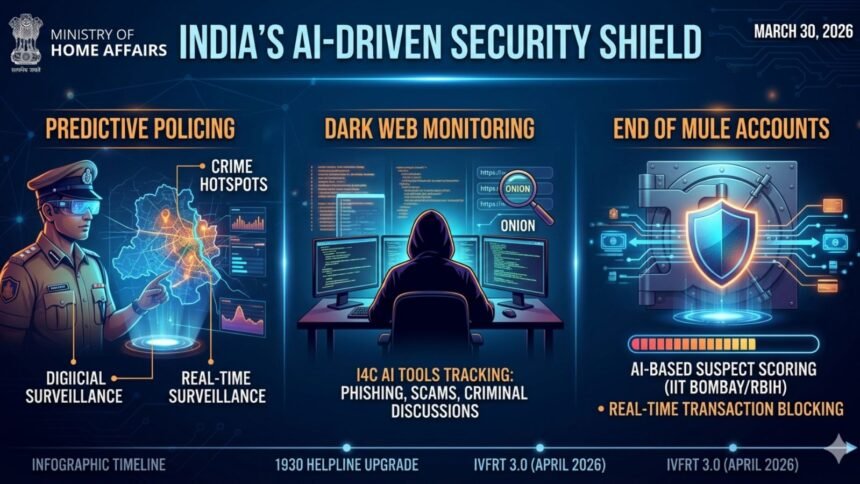
From real-time surveillance and predictive policing to behavioural analysis and crime pattern recognition, the Ministry of Home Affairs is leveraging artificial intelligence (AI) as “a critical enabler” in strengthening India’s internal security architecture, according to a Parliamentary Committee report tabled in Lok Sabha on Monday.
The MHA, as per the report titled ‘Impact of emergence of Artificial Intelligence and related issues’, by the Parliamentary Standing Committee on Communications and Information Technology, chaired by BJP MP Nishikant Dubey, stated that it is using AI to enhance operational capabilities across police forces, paramilitaries, and other agencies by enabling faster, more informed decision-making.

Apart from Dubey, the 31-member committee includes BJP MPs Kangana Ranaut and Anil Baluni, TMC MP Saket Gokhale, Shiv Sena (UBT) MP Priyanka Chaturvedi and Congress MP K T S Tulsi, among others.
Here are the key takeaways from the report tabled.
Modernising cybercrime reporting: The Indian Cyber Crime Coordination Centre (I4C), the nodal anti-cybercrime agency under the MHA, is planning to implement an AI-assisted complaint registration system for the 1930 helpline to reduce time to lodge complaints and improve user experience through guided interaction. This will be compatible with most regional and native languages.
The I4C, in collaboration with IIT Bombay, is exploring the use of AI to assign ‘suspect scores’ to mule accounts by analysing behavioural and transactional patterns. It is also engaging with the Reserve Bank Innovation Hub (RBIH) to develop a model for real-time suspect scoring for financial transactions, enabling banks to flag and potentially stop fraudulent transactions proactively as “a robust layer of defence”.
Proactive Monitoring Tool: An AI-based tool developed by CDAC Mumbai, this is currently being used to screen and verify Child Sexual Exploitative and Abuse Material (CSEAM) content in cyber tipline received via National Centre for Missing and Exploited Children before they are forwarded to agencies. The AI model is being fine-tuned, and it is proposed to be extended to crawl the open web to proactively identify CSEAM content.
Dark web: I4C uses AI-based tools to monitor dark web, scam websites, and fraud networks for tracking cybercrime discussions, phishing campaigns, and suspicious financial transactions.
Story continues below this ad
Mule hunter app: A draft MoU is under process between RBIH and I4C to enhance efficiency of the ‘mule hunter application’, an in-house AI/ML-based solution. RBIH’s Mulehunter.ai model provides AI/ML-based solutions for identifying and mitigating risks related to mule accounts, enhancing fraud detection capabilities across banking systems. The integration of the same with I4C’s NCRP-CFCFRMS/Suspect Registry will assist in faster and more accurate mitigation measures against cyber financial frauds.
Surakshini: Under the proposed initiative, a dedicated Mitigation Centre will be established to strengthen the process for removal of vulgar content. Currently, the Online Cybercrime against Women and Children (OCWC) team under I4C identifies complaints related to CSEAM and Non-Consensual Intimate Imagery (NCII) received through the National Cybercrime Reporting Portal.
The OCWC team shares URLs and links in the complaints with Social Media Intermediaries (SMIs) via the SAHYOG platform for content takedown. These requests are followed up to ensure compliance and timely removal. Once operational, Surakshini will facilitate the creation of a comprehensive hashbank for CSEAM and NCII content, allowing SMIs to proactively detect and prevent upload of such harmful content using automated hash-matching, thereby shifting from an “active takedown approach to a preventive content moderation model”.
The Surakshini dashboard will also provide end-to-end visibility into complaint status, takedown timelines, and FIR registration, helping improve coordination across platforms and agencies.
Story continues below this ad
According to the report, forensic departments functioning under the MHA, are equipped with technologies such as the Video Spectral Comparator, Projectina, advanced digital stereomicroscopes, Traso Scan, ProScope, and other specialised instruments, along with trained personnel.
Though AI-based tools are currently being deployed by them for digital and cybercrime investigations, its use in document forgery examination has not yet been operationalised since the technology is nascent and requires further validation of its efficacy, it stated.
The report also said that while the Bureau of Immigration (BoI) is currently not using AI for the immigration process, the Immigration, Visa Foreigners Registration and Tracking (IVFRT) (Version 3.0), commences on April 1, 2026. It aims at a “comprehensive transformation of India’s immigration, visa, and traveller management ecosystem by leveraging emerging technologies such as AI and ML for intelligent traveller profiling, and exploring Blockchain to enhance authenticity and security of digital records”.