


5 min readNew DelhiMar 25, 2026 07:21 PM IST
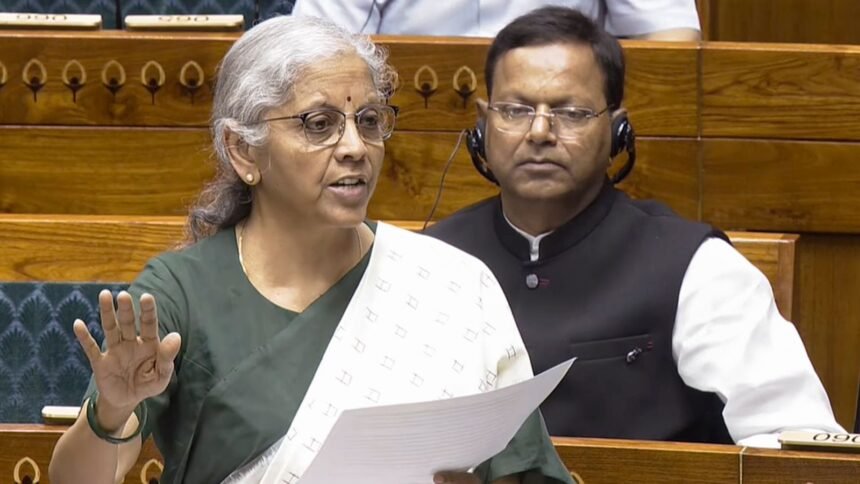
The Lok Sabha on Wednesday passed the Finance Bill 2026 with a voice vote, negating amendments moved by the Opposition members and approving the 33 government amendments moved by Finance Minister Nirmala Sitharaman.
The Bill will now go to Rajya Sabha and once the Upper House approves it, the Budget process for 2026-27 will be complete.

The Union Budget 2026-27 envisages a total expenditure of Rs 53.47 lakh crore, an increase of 7.7 per cent over the current fiscal ending March 31. The fiscal deficit for FY27 is projected at 4.3 per cent of GDP, lower than 4.4 per cent in the current fiscal.
Replying to the debate on the Bill, Sitharaman hit out at the Congress party for “giving lectures” on fiscal deficit while the Modi government has been repaying loans raised through oil marketing bonds during the Congress-led UPA government.
Responding to Congress member Deepender Singh Hooda, Sitharman said, “At the time of chhota sa [small] global financial crisis, the then UPA government was shaken. While during the Covid, a global crisis, we had retained a sense of calm … The fiscal deficit of 9.3 per cent (during Covid year) has been brought down. They could not withstand the global financial crisis which had a limited impact on the Indian economy. We managed even during Covid.”
“I want to put it on record, the actual fiscal deficit during 2008-09 would have been 7.9 per cent but they whitewashed their books by booking their loans in the books of oil marketing companies and showed the fiscal deficit at 6.1 per cent. This was wrong. Actually, the fiscal deficit was 7.9 per cent. Whatever amount they raised from the market, they showed them in the books of oil marketing companies to keep their fiscal deficit number better. We do not do this,” Sitharaman said.
“Till today, the NDA government headed by Prime Minister Narendra Modi has been repaying, with interest, the loan raised through those oil bonds. They enjoyed putting the burden intergenerationally and we are bearing the cost of loans. We inherited a total outstanding debt of Rs 1.3 lakh crore from their oil marketing bonds. From 2014 to 2024, our government has returned Rs 1.43 lakh crore including Rs 44,650 crore in principal. That is why there is a shortfall of that amount in our records for developmental activities like hospitals and schools. Where did the money go, it went to repay their loans. They are giving us lectures on fiscal deficit after keeping the fiscal deficit so bad during their time,” she said.
Story continues below this ad
Referring to Congress member Manish Tewari’s criticism of the government over rising debt, Sitharaman said, “To speak of debt in nominal terms without a correlation with the GDP will not make no sense. India’s nominal GDP rose from Rs 113 lakh crore to Rs 345 lakh crore, and debt, which Manish Tewari is saying that it has risen from Rs 56.5 lakh crore in 2013-14 to Rs 214.8 lakh crore in 2025-26, but he should take into cognizance that the nominal GDP has seen such growth and has gone to Rs 345 lakh crore.”
She said that the Central government alone cannot be responsible for debt.
“Manish Tewari should spend some time with his chief ministers in Himachal Pradesh and Karnataka and help them in bringing down debt…,” she said.
She also attacked the TMC and DMK (ruling parties in poll-bound states of West Bengal and Tamil Nadu) on various issues and complained that members of these two parties usually do not remain present in the House during her reply.
Story continues below this ad
Referring to TMC member Sougata Ray’s remarks regarding “distributive justice”, Sitharaman said that the TMC government in Bengal did not implement Pradhan Mantri Cha Shramik Protsahan Yojana, while the implementation of the PM-Kisan was delayed for two years.
Attacking the DMK, Sitharaman said that the party should firm up a view about the Centre’s Production Linked Incentive (PLI) scheme and not just criticise for the sake of criticism. She alleged that the Tamil Nadu Chief Minister has spoken against the Women’s Reservation Bill. She further said that the Centre’s GST reforms 2.0 has benefitted Tamil Nadu, as the collection has increased.