

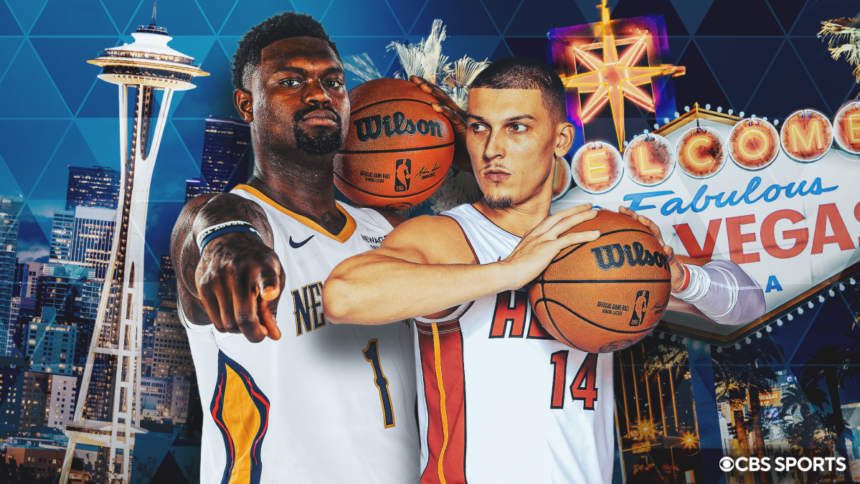
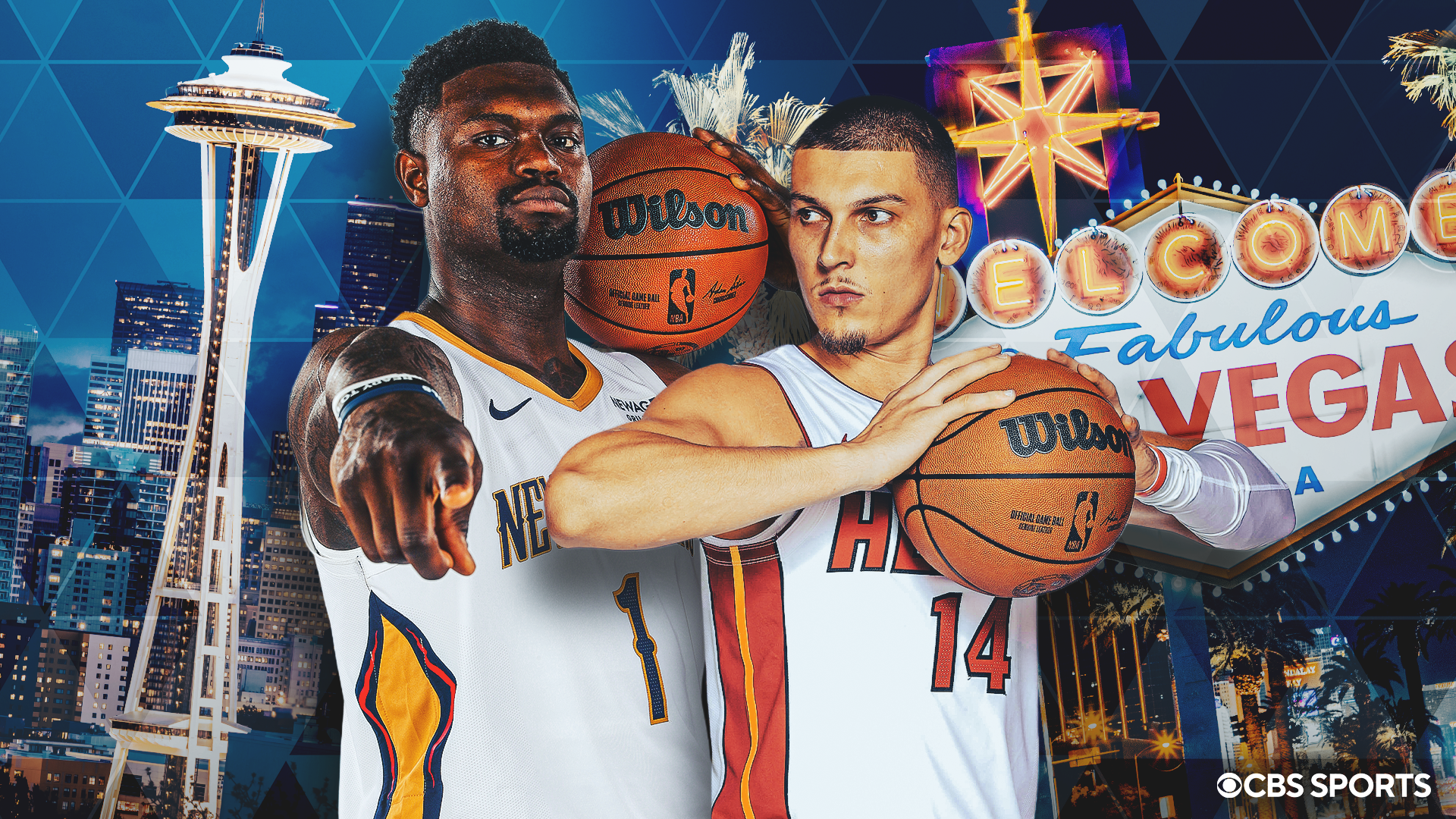
NBA expansion has been rumored for years now, but on Monday, ESPN reported that the league may soon take its first official step toward adding two new teams. Well, one new and one old, as the NBA’s owners will vote at next week’s board of governors meeting on exploring adding expansion teams in Las Vegas, a new NBA market, and Seattle, a city that had an NBA team up until its relocation to Oklahoma City in 2008.
While an official vote on whether or not to expand is unlikely to come until at least July, the momentum, according to ESPN, is building toward at least taking bids in those two potentially lucrative markets.
The expansion debate will largely be settled on financial terms. Bids are expected to come in the $7-10 billion range. From there, it will be up to the owners to decide if that is enough to justify lowering their overall equity in the league. If they ultimately decide to move forward, the next step will be to put rosters on the floor, with a reported target of the 2028-29 season.
That process would begin with an expansion draft.
How would an NBA expansion draft work?
The exact rules of an expansion draft are subject to change, but here are the broad strokes: each existing team is allowed to protect up to eight players, but must leave at least one player unprotected. The new teams can then draft players from existing teams to form their new rosters. Teams can only lose one player each, so with two new teams hypothetically drafting and 15 open roster spots per team, an expansion draft could theoretically end with one player selected from each current NBA roster.
In reality, an expansion draft wouldn’t come until the 2028 offseason if expansion teams are set to begin play in the 2028-29 season. However, with the news that expansion may be on the horizon, John Gonzalez and I decided to hold a mock expansion draft now to give you a sense of what sort of talent might be available.
We used Spotrac’s expansion draft tool to determine which players would be protected and unprotected in our exercise, as well as their projected $132.9 million cap figure for the new teams (expansion teams do not get access to the full salary cap right away, but the exact amount they receive is subject to change).
When the Raptors and Grizzlies joined the NBA in 1995, the league held a coin flip to determine which team would pick first in the expansion draft and which would have a higher pick in the NBA Draft. Memphis won and took the higher NBA Draft pick (No. 6), while the Raptors picked first in the expansion draft and seventh in the NBA Draft.
John, representing Las Vegas, won our coin toss and elected the higher NBA Draft pick, so I, representing Seattle, will pick first in this mock expansion draft. Before we dive in, here are a few notes to keep in mind:
- In a typical expansion draft, there is quite a bit of trading. If a team wants to keep an unprotected player, they can offer assets to the expansion team to draft someone else, or, if they want to get rid of an undesirable player, they can offer assets to the expansion team to take him off their hands. To streamline this exercise, we elected not to include trades.
- Expansion teams can waive players they take in the expansion draft without that player’s contract counting against their cap (though it would still count as they try to reach the salary floor). This rule did not come up in our exercise, but it’s something to remember for a real expansion draft.
- Expansion teams can draft impending restricted free agents and get their Bird Rights. However, those players would lose their restricted status and thereafter be free to sign with any team. This concept does come up in our mock expansion draft.
- You can find the full list of available players from Spotrac here. As the draft progresses, once a team has a single player selected, any other unprotected players of theirs are off limits.
So with all of that in mind, let’s begin.
The 2026 NBA Mock Expansion Draft
John Gonzalez: OK, Sam. Welcome to the first CBS Sports Mock Expansion draft between your Seattle SuperSonics and my Las Vegas Villains. I’ve been sitting on that name for a while. LeBron and Adele can buy it off me for a small (large) fee. Like the Grizzlies back in 1995, the Villains won the coin toss but have opted to draft second in the expansion draft and higher in the NBA Draft. This is my gift to Las Vegas.
Sam Quinn: The joke’s on you, John. The then-Vancouver Grizzlies made that same choice in 1995 and wound up with Bryant “Big Country” Reeves at No. 6 overall, leaving eventual Rookie of the Year Damon Stoudamire to fall to No. 7 for the Raptors. Let’s hope history repeats itself for the revived Sonics, but for now, that leaves me in control of the expansion draft.
1. Seattle SuperSonics: Lu Dort (Oklahoma City Thunder)
Quinn: The obvious starting point for this draft is the NBA champion Oklahoma City Thunder. Teams can only protect eight players in an expansion draft, but the Thunder have 14 legitimately valuable players available. Isaiah Joe and Aaron Wiggins offer valuable depth on below-market contracts. Both of them could plausibly start on the right rosters. Thomas Sorber and Nikola Topic are both recent high draft picks whose early careers have been decimated by health issues. Jaylin Williams has never played enough because of Oklahoma City’s existing front-court depth, but he’s thrived lately in a bigger role. And then there’s Lu Dort, interesting both for his 3-and-D excellence and so that I can deprive the Villains of this draft’s best villain.
In reality, Oklahoma City, with its treasure trove of draft picks, would likely negotiate with the expansion team and try to steer them towards whichever player they’re most eager to give up. But without trades, the ball is firmly in my court here. So, with the first pick in the 2026 NBA expansion draft, the Seattle SuperSonics select Lu Dort with the intention of trading him to a contender for valuable draft capital. Without an obvious building block on the board, taking a player who could fairly easily be traded for at least one good first-round pick seems like the proper opening maneuver.
2. Las Vegas Villains: Ty Jerome (Memphis Grizzlies)
Gonzalez: I dislike you, or rather, your rational thinking. I was also targeting an Oklahoma City player, though my selection would have been Williams, who is somehow still only 23. J-Will is a career 38% shooter from 3 and has stepped up for OKC while the Thunder have dealt with injury issues. He’s shooting better than 45 percent from deep on nearly five attempts per game since February. Alas, you have now locked both of us out of Oklahoma City players.
There’s a temptation here to select someone with good name ID who will sell tickets in the organization’s first year. We’re talking about the Las Vegas Villains here. The city demands a showman. Ja Morant and Zion Williamson have both been left unprotected by their respective clubs. I suspect the Grizzlies would be over the moon if Morant was taken off their hands.
And I am going to take one of the Grizzlies, just not the one Memphis would prefer. With the second pick, the Villains select Ty Jerome. You and I are both huge fans of Jerome. There’s a reason the tanking Grizzlies have only used him intermittently since he returned from injury. He’s good, which does not help their losing cause. Jerome is an EPM (Estimated Plus-Minus) darling, and I think he could be a real on-court boost for an expansion franchise that will be in dire need of quality shot-creators and playmaking. As for star power, that will have to wait. In the interim, LeBron can do all our press junkets.
3. Sonics: Wendell Carter Jr. (Orlando Magic)
Quinn: Fun fact for our less analytically-minded readers: Jerome rates as the third-best per-minute offensive player in the NBA by EPM, as John alludes. Unfortunately, that per-minute qualifier is needed because Jerome is so rarely available. I hope they have good doctors in Vegas!
As for my second choice, I’m thinking about scarcity. Shooting big men are a rarity in the NBA, and as John noted, I could have had one in Jaylin Williams. I passed there because I viewed Dort as such a potentially lucrative trade chip. I see no other such obvious trade pieces on the board, so I’m going to take a swing on Wendell Carter Jr. as my center.
Yes, yes, I know, the shooting hasn’t been there the past few years. I would argue the dysfunction of Orlando’s offense is partially responsible. I have a slightly different plan that I think should work out a bit better. We’ll get to that. For now, I’m betting on the big who made 36.4% of around 400 total 3-point attempts across the 2022-23 and 2023-24 seasons.
4. Villains: Tyler Herro (Miami Heat)
Gonzalez: Las Vegas is an entertainment town. It loves a showman. We went with a Ty with our first selection. With our second selection, we’re going back to the Ty well and picking Tyler Herro. If there’s anyone in the NBA who was born to play in Vegas, it’s him. Look at this man’s wardrobe. Not to mention the marketing opportunities with two Tys in the backcourt. “Let Tygones be Tygones” is a slogan I just came up with. All of a sudden, we’re printing Ty Fighter T-shirts and getting into copyright infringement battles with Disney and Lucas Films. You can’t buy publicity like that.
5. Sonics: Zion Williamson (New Orleans Pelicans)
Quinn: Who knows, John? Maybe these new upcoming tanking rules will include some sort of provision that allows teams at the bottom of the standings to tie games.
Speaking of those new tanking rules, who knows? Maybe it’ll make sense for both of us to be competitive early on. The pieces are certainly there. You need a defensive foundation, and there’s a pretty straightforward name available to you if you want to go that route. I, on the other hand, need someone to build my offense around. So on that front, I’ll take the resurgent Zion Williamson knowing that his contract has enough injury protections that, if he falters, I can escape easily enough. If he works out, though? I got him the spacing center New Orleans has always lacked, and in Dort, I have the perfect defensive-minded role player to pair him with. Maybe I won’t trade him after all. Play-In Tournament, here we come!
6. Villains: Julian Champagnie (San Antonio Spurs)
Gonzalez: I was wondering which of us would pluck Zion first, and I’m glad it’s you. I’m not a believer, but hard to pass up on the draw. And like you said, there’s a non-zero chance he works out.
The Villains are going with an upside play next and taking the only unprotected Spur on the board: Julian Champagnie. The Spurs have exceeded everyone’s expectations this season, much of which obviously traces back to Victor Wembanyama. But the role players have been excellent for San Antonio this season, and there’s a case to be made that Champagnie is the best of the bunch in the non-Wemby/Fox/Castle category. He’s shooting 38.4 percent from deep in just under 28 minutes per game. The Villains think he’s ready for a bigger role. Plus, he’s only 24 and very cheap on a team option for $3 million next season. We’ll get that number up and find a new deal that works for both sides.
7. Sonics: Jordan Walsh (Boston Celtics)
Quinn: And so we have our first real regret of the expansion draft. I was trying to goad you into drafting Rudy Gobert so I could snag Champagnie next. Lesson learned: no more attempted gamesmanship. The Spurs have leveled up since putting Champagnie in the starting lineup, and he would have fit perfectly onto my Zion-centric roster build.
Alas, with Champagnie off the board, the reality of my finances comes into play. I’ve spent more than half of my available cap space on my first three picks, so I’m gonna start leaning on cheaper players from this point on. I’ll grab another perimeter defender in Jordan Walsh from the Celtics. He’s got a dirt-cheap team option for next season, and I’m willing to bet based on his early-season performance that he’d get far more minutes on a team that wasn’t as deep as the Celtics.
8. Villains: Bennedict Mathurin (Los Angeles Clippers)
Gonzalez: The Celtics are maddeningly deep. Though I am curious to see if their special pixie dust on deep bench players will remain once those guys are playing on other teams.
Do you like fun, Sam? Because Vegas is all about fun. And you know who’s been fun to watch lately? Bennedict Mathurin. That guy has been an absolute bucket since being traded to the Clippers. Bennedict, welcome to the Villains. We hope.
Mathurin is a restricted free agent. As noted above, restricted free agents can be selected in the expansion draft, but their restricted status does not transfer to the new team. Back in the 2004 expansion draft, Charlotte selected nine of them, but only one ended up signing with them. It’s a risk. But we’re convinced we can sell Mathurin on being one of the faces of the franchise in Sin City. He can rock out on the strip with Tyler Herro. Maybe we get them a cushy side gig and they do a residency at Caesars or something. All above board, of course.
Quinn: I’m not sure how your guards-only roster plans to get stops, John, but I’ll admit I’m intrigued to watch them try.
Gonzalez: We play fast on and off the court, Sam. Slot machine sound effects for every bucket. This thing sells itself.
9. Sonics: Micah Potter (Indiana Pacers)
Quinn: I’m committing to a roster full of bigs that can shoot here and snagging another player with a cheap team option: Micah Potter. He’s certainly undersized and raises defensive question marks, but, well, that’s what I have Dort and Walsh for. The one thing Potter does consistently well is shoot. He’s above 40% from 3 on almost seven attempts per 36 minutes. Between Walsh and Potter, I’m liking the idea of plucking the finds away from smart scouting departments like Boston’s and Indiana’s.
10. Villains: Jonathan Kuminga (Atlanta Hawks)
Gonzalez: As you pointed out, my team is a glut of guards at the moment. Let’s put someone in the front court. Vegas is all about gambling, so we’re gonna roll the dice on Jonathan Kuminga and install him as our starting power forward. Is he any good? No one knows! But, he’s still only 23 years old. And, thanks to the Warriors ruining every possible part of Kuminga’s life until the very end, his contract has a team option for next season. If it doesn’t work out, we can always kick him to the curb
Quinn: So are you just never going to draft Rudy Gobert? Because I’m starting to envision a scenario where you take him last like the 2021 All-Star Draft. Funny, but I can’t believe you keep drafting offense over the one guy on the board who could actually give you a measure of defense.
Gonzalez: Your Jedi mind tricks won’t work here. The Villains have a theory of the case and that theory is we’re gonna Fun and Gun.
11. Sonics: Devin Carter (Sacramento Kings)
Quinn: So remember that whole bit I just said about plucking marginal finds off of smart teams? Well, I’m going in a different direction here. The Sacramento Kings drafted Devin Carter in the lottery, barely used him as a rookie and then seemed to immediately sour. Here’s my counterpoint: Have you considered what happens to guards when they leave the Kings? De’Aaron Fox is living his best life in San Antonio. Keon Ellis is thriving for a contender in Cleveland. Oh yeah, and Tyrese Haliburton almost led the Pacers to a title. I’m eager to try to correct Sacramento’s many mistakes and see if Carter might have a future in my hopefully better-managed organization.
12. Villains: Dorian Finney-Smith (Houston Rockets)
Gonzalez: So, defense… did I mention this thing gets real thin real fast? We’ll take Dorian Finney-Smith to be the one guy who might play a little D. He hasn’t looked like himself in Houston. Maybe the Vegas desert snaps him out of it as our defensive stopper.
Quinn: Worst-case scenario, only the first two years of his contract are guaranteed, so it’s an easy out if you need it.
13. Sonics: Day’Ron Sharpe (Brooklyn Nets)
Quinn: I’m not sure if I’ll keep my next pick, but I’m taking Day’Ron Sharpe on a $6.25 million team option. I just think the value is too good to pass up. He’s only dabbled with 3s, so I’m not sure he’ll make much sense next to Williamson, but he’s had a nice defensive year for the dreary Nets and we certainly need some rebounding in this front-court. Even if we explore the trade market later, I just like the player too much to let him slip any further.
14. Villains: Sandro Mamukelashvili (Toronto Raptors)
Gonzalez: Cruel. He was next on my list. You’re scooping up all the young, cheap centers. As you have repeatedly pointed out, I have no bigs. It’s time to remedy that. The Villains select center Sandro Mamukelashvili. He’s not a super rim protector but he gets by alright on defense. He’s 26. And he’s shown enough flashes in Toronto to make us intrigued.
The slight hiccup here is that he’s on a player option for next season at just $2.8 million. Like Mathurin, that means we’re taking a chance that Mamu will want to stick around, but our front office thinks we can find enough playing time (along with a raise) to make it worth his while. It’s worth the risk. You know our organization’s motto, Sam: scared money don’t make money.
15. Sonics: Spencer Jones (Denver Nuggets)
Quinn: Mamu probably would’ve been my third center if Sharpe hadn’t been on the board. Instead, we’re going with our first free agent: Spencer Jones from the Nuggets. I’m certainly afraid that he’s just a Jokić merchant on offense, but you can never have enough wing defenders in the modern NBA, so I’ll take the plunge and hope we can keep him.
16. Villains: Paul Reed (Detroit Pistons)
Gonzalez: Paul Reed. Affectionately known as “BBall Paul.” That’s back-to-back centers for the Villains. He fits in with our anything goes, there-are-no-rules basketball nihilism approach.
17. Sonics: Nae’Qwan Tomlin (Cleveland Cavaliers)
Quinn: Nae’Qwan Tomlin is next for me. We’re developing a bit of a front-court glut here, but it’s not as though the team we draft has to be the team that takes the floor on opening night. I’m just drafting for talent and contract value and assuming I’ll be able to figure it out throughout the offseason.
18. Villains: Cam Whitmore (Washington Wizards)
Gonzalez: I’m tempted to go with a two-Champagnie roster and take Justin, but instead I’ll take another Wizard: Cam Whitmore. He was the odd man out in Houston, and it hasn’t worked out for him in D.C. But I think the talent is there.
19. Sonics: Mohamed Diawara (New York Knicks)
Quinn: I’m keeping the wing train rolling with Mo Diawara. He’s yet another free agent I’ll have to try to re-sign, but come on, a rookie earning rotation minutes on a contender in New York? He’s worth the risk.
20. Villains: Sidy Cissoko (Portland Trail Blazers)
Gonzalez: I’m throwing another dart on upside. Sidy Cissoko. I’ve perhaps watched one too many late-night Blazers games.
21. Sonics: Klay Thompson (Dallas Mavericks)
Quinn: The Cissoko pick is a silent dagger for me because I’d been considering preserving money with my last several picks and drafting Jrue Holiday late, but the Blazers are off the board. That’s the second point guard you’ve accidentally sniped from me, as I had similar thoughts about Fred VanVleet. But point guard is an easy position to address on the trade market, so it’s no great loss. I definitely don’t have enough shooting outside of my centers, though, so let’s sell some jerseys. Klay Thompson.
22. Villains: Royce O’Neale (Phoenix Suns)
Gonzalez: Let’s get a functional rotation player in the mix and beef up that frontcourt a little more. Royce O’Neale.
23. Sonics: Cody Williams (Utah Jazz)
Quinn: I’m taking another swing on a lottery pick. Cody Williams has shown signs of life lately and even scored 34 points against the Kings on Sunday. If you ignore the “against the Kings” part, that’s pretty impressive!
24. Villains: Bronny James (Los Angeles Lakers)
Gonzalez: I was gonna save this until the end for the bit, but our franchise can’t risk it. LeBron in the owner’s suite and Bronny James is on (the end of) the bench. The marketing team forced our hand here.
Quinn: Cards on the table, I was about to draft Bronny just to hold him hostage in trade negotiations over you.
25. Sonics: Ousmane Dieng (Milwaukee Bucks)
Quinn: I’m going to keep grabbing upside wings heading into free agency. Ousmane Dieng has flashed enough with the Bucks for me to believe he might be an NBA player even if he never quite lives up to that lofty lottery billing.
26. Villains: Jaden Ivey (Chicago Bulls)
Gonzalez: We already have a ton of guards, but we’ll buy a Jaden Ivey lotto ticket. Probably doesn’t amount to anything, but it’s worth the scratch. He’s also a restricted free agent, so if he walks, we wish him well.
27. Sonics: Tidjane Salaun (Charlotte Hornets)
Quinn: I believe I have the cap flexibility left to take one last former high draft pick swing, so give me Tidjane Salaun from Charlotte.
28. Villains: Al Horford (Golden State Warriors)
Gonzalez: There are a lot of young guys on our team. Vegas is a big temptation. We need a vet in the locker room. Al Horford has a player option for next season, but we’re hoping he wants to retire in luxury. All you can eat buffet and tickets to any show he wants on us. That leaves either Julian Phillips or Cam Payne for you.
29. Sonics: Cameron Payne (Philadelphia 76ers)
Quinn: Cam Payne it is. We’re going to use that roster spot in other ways throughout the offseason, so we might as well just take the free agent.
30. Villains: Julian Phillips (Minnesota Timberwolves)
Gonzalez: Julian Phillips, welcome to Vegas. Maybe don’t unpack, though.
Final rosters
Below are our final rosters in draft order:
|
Lu Dort |
Ty Jerome |
|
Wendell Carter Jr. |
Tyler Herro |
|
Zion Williamson |
Julian Champagnie |
|
Jordan Walsh |
|
|
Micah Potter |
Jonathan Kuminga |
|
Devin Carter |
Dorian Finney-Smith |
|
Day’Ron Sharpe |
Sandro Mamukelishvilli |
|
Spencer Jones |
Paul Reed |
|
Nae’Qwan Tomlin |
Cam Whitmore |
|
Mo Diawara |
Sidy Cissoko |
|
Klay Thompson |
Royce O’Neale |
|
Cody Williams |
Bronny James |
|
Ousmane Dieng |
Jaden Ivey |
|
Tidjane Salaun |
Al Horford |
|
Julian Phillips |
What did we learn from the mock expansion draft?
Asset value outweighs talent
First things first, you surely noticed that the players were not drafted strictly in order of talent. Gobert has been better this season than any player that was actually drafted, and yet neither of us picked him. The immediate lesson here is that while John and I both tried to draft with somewhat coherent strategies, we were ultimately picking more for asset value than talent.
Dort wasn’t my first pick because I wanted to build a team around him, but because 3-and-D wings are so rare and precious that I knew I could swap him to any number of contenders for valuable draft capital. In my eyes, a good first-round pick would do more to jump-start my franchise than any available player. This makes sense when you remember that teams protect their eight best assets. I would eventually choose Williamson as a centerpiece for my first roster, but only some of the players I drafted make sense playing with him. For the most part, I targeted young, versatile wings and bigs that I could move later if need be.
The expansion draft is only one part of the process
The expansion draft represents only the beginning of the building process for an expansion team. Free agency, the NBA Draft and a summer full of trades follow. Neither of these rosters is complete, and that makes managing the asset portion of the draft critical. Were we mocking out a whole offseason, I likely would have saved far more money at the end of the draft to use in free agency.
The idea of gamesmanship really came into play a few times as well. I watched John select two all-offense guards with his first two choices and assumed he had to be thinking Gobert next. Therefore, I took Williamson, assuming I could get Champagnie afterward. Obviously, I was wrong. Being able to read the board and predict what the other team is thinking is critical in an expansion draft, not just to ensure that the other team doesn’t take a player you want, but so they don’t eliminate the wrong team. I was considering Jrue Holiday late in the draft, but when John took Cissoko, Portland was off the board entirely.
The lesson here is proactivity. You can’t rely on a player sliding to you because his whole team might be eliminated from the draft.
Trades will be a big part of a real expansion draft
Without trades, our exercise didn’t capture the full complexity of an expansion draft. We’re also two years away from having any idea who would actually be available. But the basic concepts here would broadly hold up.
The teams would largely draft for asset value, mostly avoiding bad contracts unless they were otherwise incentivized to take them. They’d prefer young players, but they’d make their picks knowing that there’s a lot of offseason ahead to continue to shape their rosters.