


NASA late Thursday announced an advance return of the Crew-11 team from the the International Space Station (ISS) owing to an unprecedented medical issue experienced by one of the four astronauts onboard.
It is the first time ever in the history of the ISS, operating now for over 25 years, that a trained crew of cosmonauts will be de-orbitted and brought back to Earth before clocking their full mission time onboard the floating space laboratory.

The four-person Crew-11, comprising NASA astronauts Zena Cardman and Mike Fincke, Kimiya Yui from Japan and Oleg Platonov of Russia, had docked the ISS in August last year for a six-month mission ending early February.
NASA has neither disclosed the full details of the medical issue nor identified the astronaut who has reported illness.
.@NASA is returning @SpaceX’s Crew-11 mission to Earth earlier than planned due to a crew member’s medical concern while reviewing options to advance Crew-12’s launch. https://t.co/AMIVh7zC9P
— International Space Station (@Space_Station) January 9, 2026
Infact, Crew-11 had arrived at the ISS soon after Axiom-4, co-piloted by India’s Shubhanshu Shukla, that had deorbitted after successfully completing their mission.
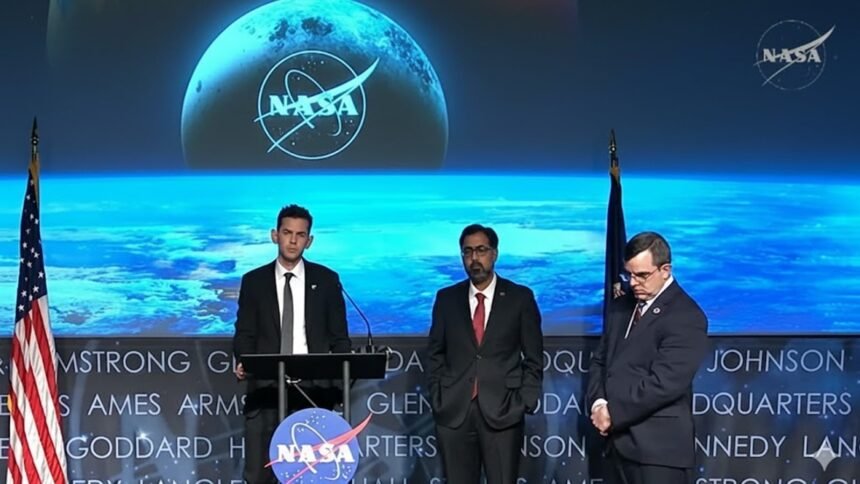
Early on Thursday, NASA initially announced the cancellation of the planned space walk by the Crew-11 team, citing a medical issue with one of the onboard astronauts. It was later in the day, the decision to cut-short the mission was announced during a late night press briefing.
“It is a serious medical condition but the astronaut is stable. From all the learnings and past experiences of training and operating the ISS, NASA has decided to prioritise the crew safety above all. NASA, in consensus with other particioating international agencies, has decided to call back Crew-11 ahead of its schedule. A detailed timeline for undocking from the ISS and splashdown are being currently worked out. It will be communicated within the next 48 hours,” said Jared Isaacman, NASA Administrator.
Astronauts undergo meticulous and rigorous trainings, simulation training for several months ahead of a space mission and are skilled to handle operational challenges including medical issues. But the ISS continues to remain a challenging space environment to operate in maknly due to the microgravity environment. ISS is a sophisticated laboratory space that ensures cosmonauts have every possible facility at their disposal during their stay.
Story continues below this ad
“There are hardwares and a host of medical suit onboard the ISS that helps crew to attend to and handle medical need. But it cannot compare with the full-equipped suit that is available in an emergency room at a hospital,” remaked Dr. James Polk, chief health and medical officer, NASA Headquarters.
Polk further said that the present medical issue with one of the astronauts was neither an injury nor the one that developed during routine operations at the ISS.
“It developed due to the microgravity environment but I cannot divulge more details about the diagnosis. All routine medical tests and procedures will be followed once the crew is back on Earth,” he said.
Polk elaborated that everybody experiences some or the other medical issue, like a tooth ache or a ear pain, while Earth.
Story continues below this ad
“And similar issues are common while living in space that too over a period of several months,” he said.
Along with the onboard medical suit, ISS teams are being continually monitored by the ground-based flight surgeons and a host of other medical teams.
After their joint assessment, Polk shared, ” The situation is being monitored by the crew surgeons. We have not proposed any major shift in the routine activities to the astronaut facing the medical issue.”
The time onboard the ISS is extremely crucial and an expensive affair and to optmise it, tight schedules and packed activities are planned for astronauts. In this case, the advancing of Crew-11 return would mean some precious time is lost.
Story continues below this ad
“But the Crew-11 has accomplished all its scientific objectives planned for this mission. Also, the ISS is capable of autonomous operations,” said Amit Kshatriya, associate NASA administrator.