


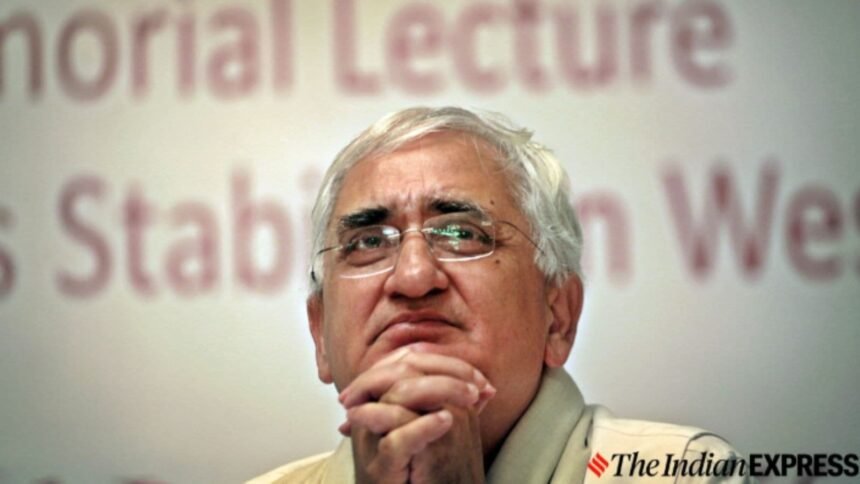
In a conversation with The Indian Express on the ongoing West Asia war and India’s foreign policy amid the escalating conflict, former Union minister for external affairs Salman Khurshid stressed the need for “course correction” by opening meaningful channels of communication with Russia and China, describing them as “two important elephants in the room”.
Here is an edited excerpt of the discussion with the veteran Congress leader, who also heads the All India Congress Committee Foreign Affairs Department.
Q: It has been almost four weeks since the conflict in West Asia escalated. Where do you see this conflict headed?
Salman Khurshid: There are no clear signs of the conflict de-escalating, or for that matter, of any of the parties being near their objectives. That is problematic. I don’t think there is any combined position that the parties are taking. Everybody has specific concerns. There are responses you get from Iran, which aren’t definitive.
It is very difficult to predict whether this will end soon…The world and India need the conflict to end. My worry is that if it leads to an attempt to choke Iran’s control of its ability to earn revenue from oil—that could have a lasting impact on the world.
Q: Since the conflict began, the US administration and President Donald Trump have been walking a tightrope on the way forward. There have been talks of the US putting boots on the ground in Iran. How can that play out?
Khurshid: It will be very difficult. The worst-case scenario could be that it is a very limited exercise of boots on the ground. But that can only be to the extent of holding Kharg Island captive and choking Iran’s supply of fuel. That is the only possible thing. But the public opinion in the US will find it difficult to support it. Let’s not forget that Trump seemingly hasn’t depleted his support among the MAGA (Make America Great Again) base. I think across the board, Trump is losing support. He will have to recoup public opinion if he has to survive the onslaught from Democrats during the midterm elections.
Story continues below this ad
Q: Congress has consistently said that India has betrayed Iran since the conflict began and Ayatollah Ali Khamenei was killed. What would you make of India’s approach over the last four weeks?
Khurshid: I have reason to believe that Iran itself has taken a somewhat sanguine view of India after the hostilities began. The assessment might have been different before hostilities began. Credit to Iran that, despite the difficulties they are facing, they are prepared and willing to understand that India’s concerns go beyond Iran—that India has to remain connected to other forces as well.
Iran would continue to hope that India is supportive of Iran, the signals of which we have given. I would imagine similar signals have gone out from the government as well. It is in the pipeline and could overnight change depending on what may happen with pressure from other sources—the US, growing pressure from within India because of prices of cooking gas… I don’t think we should think in terms of being deficient or going wrong, specifically because of what has happened.
I think this was coming for a long time, as far as Indian foreign policy is concerned. We had lost moorings in foreign policy. Moorings that the Congress believes were time-tested, strong… We continued to at least pay lip service to non-alignment, which we believe was a very significant decision we took. An element of morality and values in foreign policy, we pursued vigorously.
Story continues below this ad
We were ill-prepared in terms of our foreign policy backdrop…First, with what happened in Palestine and then what happened with the first round of conflict between the US and Iran, and then the second round between the US and Israel on one side and Iran on the other. We were ill-prepared for it. Hence, the retreat into silence is a signal of us being ill-prepared.
Q: Pakistan has emerged as a key interlocutor between the US and Iran. External Affairs Minister S Jaishankar has been quoted as saying India is not a ‘dalal’ (broker). What do you make of this mediation and Indian remarks?
Khurshid: We certainly missed an opportunity. Our self-opinionated projection as “Vishwa guru” and “Vishwa mitra”, as something recognised by other nations as well. That projecting ourselves as an emerging power—economically, politically, and militarily. We see no signs of that. The voice of India, which had an element of values in it, has gone missing. We weren’t heard or didn’t make an effort to be heard when the massacre in Gaza was happening. We haven’t been heard this time, too. It is sad.
We can say what we like about what Pakistan is doing. But nobody stops any nation from taking an initiative when something terrible happens in the world. We are justified when we are upset about Pakistan taking that initiative. We are justified because we have a very bad experience with Pakistan. When Pakistan is dealing with those who have been our friends, then where do we stand vis-à-vis our friends, and what do they think of our opinion, and to what extent can we shape their opinion if Pakistan is in between. This is troublesome for us… Since Operation Sindoor, we have seen a disturbing element where the US claims to be close to India and has been dealing with our adversaries.
Story continues below this ad
Q: The Congress leadership and Lok Sabha Leader of Opposition Rahul Gandhi have been consistently saying that Prime Minister Narendra Modi is “compromised”. Can you elaborate?
Khurshid: There is something horrible happening. We are not getting clear explanations about why India is conducting itself in the manner we have seen. We have great dissatisfaction with the US trade agreement. We don’t know what it is. We are worried about what it will do to Indian farmers, industries… You have to take your people into confidence.
Q: What did you make of Prime Minister Narendra Modi’s statement in Parliament?
Khurshid: The PM’s statement was there, but even for those of us who are familiar with foreign affairs, we are in the dark. We don’t know what India’s position is. If I went abroad and someone asked me what India’s position is, I would have no idea. I have a sense that there has been a lot of understanding and accommodation shown towards India by both sides—by the Arabs, Israel, and Iran. We are lucky that despite the conflict, India is not being pushed to the wall. That is great. But that is not because of anything special this government has done. It is because of India, for what it is.
Story continues below this ad
Our goodwill will be wasted if we don’t move ahead sensibly—everything built over decades with Iran, the Arab world for decades and Israel in recent years… We need to be connected with everybody in this conflict. We can’t take sides, but we must have courage and strength to tell our friends that they are wrong on something… I think this is an important time for us to open up channels with Russia and China. They are two important elephants in the room, and if we want to become an elephant, then we need to communicate with them in a more meaningful manner than our routine communication.