


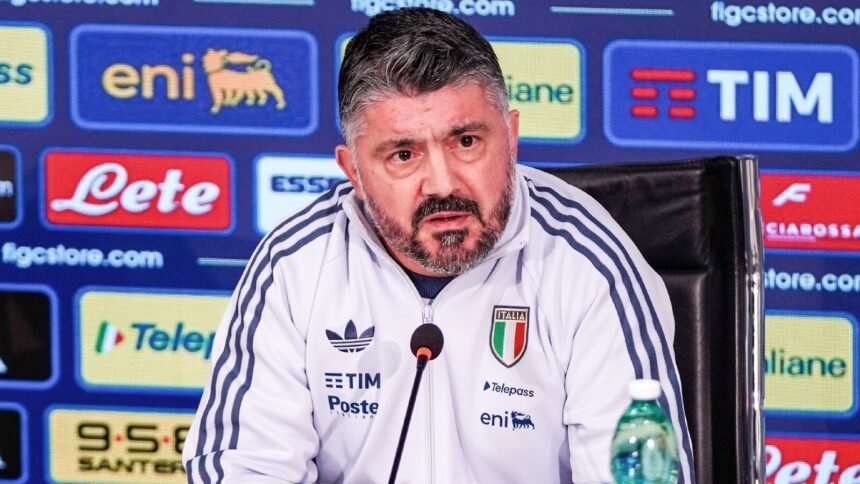
Luigi Garlando, the Italian writer, penned an open letter to Gennaro Gattuso on Wednesday, adopting the voice of a 16-year-old fan. “I can’t become an adult,” he wrote in Gazzetta dello Sport, “get my driving license, and go to vote without having seen the national team at the World Cup at least once.” Garlando distilled the quiet anguish of an entire cohort, caught between trauma, desperation and longing.
Above Garlando’s words sat a striking photograph: Marcello Lippi, Italy’s World Cup-winning coach, gripping his midfield general by the shoulder, eyes blazing, shouting, “Let’s go!” – a frozen echo of 2006, when glory felt permanent and the future unimaginable without it. “Gattuso has a strong squad and will do everything to ensure they finally return to the World Cup after such a long absence,” Lippi was quoted as saying.

When the World Cup begins in just over two months, it will mark 12 years since Italy last appeared on football’s grandest stage – a tournament they have won four times, more than any nation bar Brazil (five) and Germany (also four). Thursday’s playoff semifinal, and a potential final to follow next week, will determine whether that absence ends now or stretches into a 16-year exile.
Locked in 🔒#Azzurri #VivoAzzurro pic.twitter.com/GGLKvnUjcb
— Italy ⭐️⭐️⭐️⭐️ (@Azzurri_En) March 24, 2026
Italy enter the knockout game against Northern Ireland carrying that weight of history. One that still stings. Missing out on both the 2018 and 2022 editions via the playoffs is not merely an anomaly for a four-time champion; it is a psychological burden that shadows every decisive fixture.
On the surface, Italy’s complicated route to the World Cup can be traced back to Norway. Defeats home and away to a side featuring Erling Haaland, Martin Odegaard and several players from Bodo/Glimt’s Champions League surge ensured a second-place finish in the group.
The post-Euro 2020 glow, where they were crowned champions, masked underlying issues: an ageing core, inconsistent finishing, and the failure to seamlessly integrate new attacking options. Managers have experimented with systems and personnel, but the absence of a dependable elite striker has often left the Azzurri dominating possession without converting it into goals.
There has also been an identity shift. Traditionally built on defensive solidity, recent iterations have leaned toward a more expansive style. While often attractive, it has exposed vulnerabilities, especially in high-pressure moments where pragmatism once defined them. While the nation was once known for effortlessly producing world-class stars, it now finds itself searching for players capable of making the decisive difference at the highest level.
Strong squad
Yet this is far from a weak squad. Italy still possess quality across the pitch. Nicolò Barella brings energy and intelligence in midfield, while Gianluigi Donnarumma remains among the most reliable goalkeepers in the world. The defensive core, though evolving, continues to offer technically sound and tactically disciplined options. The issue is less about talent and more about cohesion, confidence, and efficiency in key moments.
Story continues below this ad
Up front, Moise Kean has recently emerged as a potential difference-maker, scoring four goals in his last three international appearances. Mateo Retegui, meanwhile, has contributed consistently, adding to his growing tally with a string of goals in recent qualifiers and friendlies to establish himself as Italy’s most reliable attacking outlet. Gattuso, who replaced Luciano Spalletti in June, has at least injected some urgency into Italy’s attack.
For Gattuso, the challenge will be ensuring all the moving parts align in what are, effectively, two defining matches.
When Italy last lifted the World Cup two decades ago, their team read like a roll call of legends – Gianluigi Buffon, Fabio Cannavaro, Alessandro Del Piero, Andrea Pirlo, Francesco Totti and more. Many young Italian fans have only heard stories of those players, never experienced the feeling of watching their team on this stage – something Garlando captured poignantly in his column. “There’s a group of young Italians waiting to fall in love with the national team,” he wrote, “and become great at a World Cup.”
Road to World Cup
The European play-offs will decide four of the final six places at the World Cup, with the remaining two coming via the inter-continental playoff.
Story continues below this ad
In the European qualifying, teams have been split into four separate paths, each consisting of two single-leg semi-finals and one single-leg final. The winner of each path will qualify for the World Cup.
European playoffs
Path A
Semifinals — March 26
Italy vs Northern Ireland
Wales vs Bosnia and Herzegovina
Path B
Semifinals — March 26
Ukraine vs Sweden
Poland vs Albania
Path C
Semifinals — March 26
Turkiye vs Romania (10.30 pm)
Slovakia vs Kosovo
Path D
Semifinals — March 26
Denmark vs North Macedonia
Czechia vs Republic of Ireland
(Live on Sony Sports Network 1.15am, Friday)
Inter-continental playoffs
Path 1
Semifinal — March 27
New Caledonia vs Jamaica
Final — March 31
Democratic Republic of the Congo vs winner of New Caledonia/Jamaica
Path 2
Semi-final — March 26
Bolivia v Suriname
Final — April 1
Iraq vs winner of Bolivia/Suriname