


4 min readNew DelhiUpdated: Mar 30, 2026 07:49 AM IST
The Auditor General of Canada has flagged in a report placed before the country’s Parliament last week that nations at high risk of submitting fraudulent student applications also had correspondingly low visa approval rates, with “one important exception” — India.
According to Auditor General Karen Hogan’s report, even as the total number of visas issued to new Indian students plunged from 51.6% in 2023 to 8.1% in 2025 (till September) — approval rates for students from India under the Student Direct Stream (SDS), which included a fast-track feature, jumped from 61% in 2022 to 98% in 2024.

This, despite warnings issued in August 2023 within the IRCC (Immigration, Refugees and Citizenship Canada) that the “SDS was being targeted by non-genuine students seeking entry to Canada”, the report stated. Canada withdrew the fast-track feature from the SDS program by the end of 2024.
Launched in 2018 for applicants from India, China, the Philippines and Vietnam, the SDS was labelled as a fast-track, “light touch” eligibility review program, which was expanded subsequently to another ten countries in Asia, Africa and Latin America.
The audit on International Student Program Reforms found that “almost all approved applications in the Student Direct Stream originated from India” during 2022-2024, but the IRCC was slow to act on integrity concerns, such as higher rates of fraudulent documents, reports of students not actively pursuing their studies and increased asylum claims.
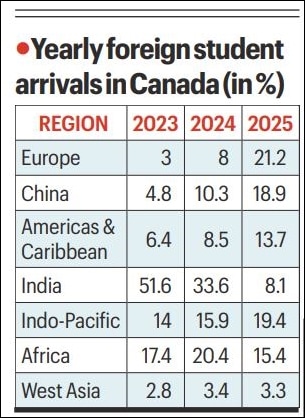
The slide in the overall number of Indian students securing a Canadian visa was triggered by a 30-35% reduction in the number of study permits offered to international students after Canada enforced a cap in January 2024 before discontinuing the fast-track advantage.
While the withdrawal of SDS reduced the risk associated with new study permit applications, warned the audit report, the very high number of student visas already issued to Indian students keeps the risk alive, as many apply for stay extensions.
Story continues below this ad
Typically, study permit extensions attract lighter scrutiny. Between January 2023 and September 2025, approval rates for study permit extensions ranged from 94% to 95%, while those for new study permits were between 38% and 58%.
“To treat all study permit extensions as low risk, other program integrity controls must be effective, both at the application stage and after the individual has arrived in Canada,” said the audit report, adding that IRCC failed to follow up on several cases when fraudulent documentation was detected after study permits were issued.
The audit examined three investigative reports that identified 800 approved study permits issued between 2018 and 2023 — 541 (68%) of those under the SDS — in which applicants had either used fraudulent documentation or misrepresented information.
“For example, in providing evidence of their previous educational experience, 710 applicants claimed to have attended educational institutions overseas that risk assessment units later found to be either non-existent or institutions selling qualifications for immigration purposes,” the report said.
Story continues below this ad
Noting that IRCC did not consider acting in any of the 800 cases, the report said: “This is a serious concern because there was no alert on these individuals’ immigration files for consideration by processing officers when making decisions on future applications. As a result, by the end of our audit period, 92% of these study permit holders either had been approved or were awaiting decisions on other types of immigration permits, including on applications for permanent residence.”
In their response, the IRCC said that it would “assess extension applications from former Student Direct Stream applicants with a renewed risk lens.” Regarding those yet to secure a visa, they said it would create info-alerts, flagging persons of concern in the event of subsequent applications.
The department said: “IRCC supports the objective of reducing over-reliance on a single market and drawing talent to Canada from a broader pool. The cancellation of the Student Direct Stream was part of IRCC’s plan to support diversification.”
The audit also noted that about 150,000 cases were flagged internally in 2023 and 2024 for possible noncompliance with the visa terms. Due to a funds crunch, only about 4,000 of these alerts were investigated — of which around 1,600 were closed as inconclusive after the students concerned did not respond to IRCC’s queries.