


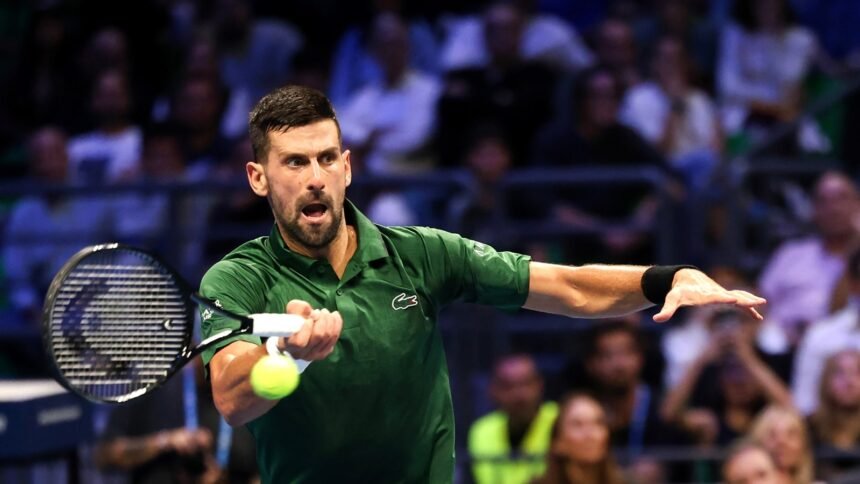
2025 was the year Novak Djokovic was forced to be a mere challenger, an outsider, at Grand Slam tournaments that he had spent two decades owning. With his sporting obituaries seemingly already written, and twilight dawning on his career, one could have expected a reflective moment away from the spotlight to ponder some big decisions ahead of the start of another gruelling season.
What more does the 38-year-old 24-time Major winner have left to prove? He has put a definitive line in the sand regarding his legacy in the sport – separating himself even from the all-time greats to stand alone at the peak. Carlos Alcaraz and Jannik Sinner are the new savants of men’s tennis; Djokovic has every right to excuse himself from mounting a challenge against champions who are closer in age to his children than to him.

But to assume as much would be to misunderstand one of modern sport’s most consistently misunderstood greats. Challenges, for the Serbian legend, are not so daunting as they are instruments to unlock the ambition that goes missing when the going gets a bit too easy.
And so, Djokovic kicks off 2026 hoping to defy odds and a battered body at his favourite hunting ground, the Australian Open where he is a record 10-time champion, which starts on Sunday.
In fact, the biggest hint that he was raring to go in 2026 was that he started the year by throwing a couple of curveballs, typical of his style.
Djokovic has ruled out the prospect of retiring any time soon. At a sports summit in Dubai last month, he called the prospect of defending his gold medal at the 2028 LA Olympics, by which time he will be 41, “a guiding star.”
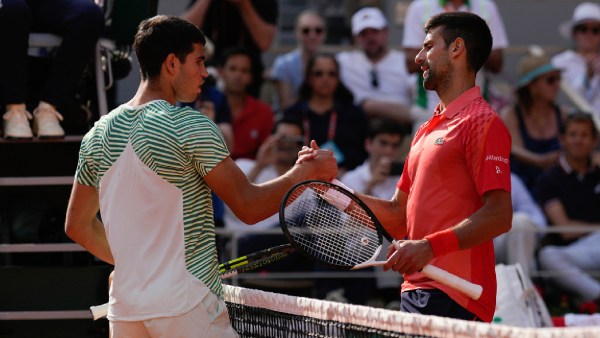 Djokovic kicks off 2026 hoping to defy odds and a battered body at the Australian Open. (FILE PHOTO: AP)
Last week, with strange timing right at the start of the year, he announced that he is no longer associated with the player association he co-founded in 2020, over “transparency, governance” issues. With murky legal issues approaching and the lack of a clear direction, Djokovic had been unhappy with “the way my voice and image have been represented.”
Story continues below this ad
On the court, he has announced he will begin work with Mark Kovacs, a former tennis player-turned-sports fitness and biomechanics expert. If there’s even a razor-thin edge to be found, the Serb is going out chasing it.
All these point to the fact that Djokovic is going nowhere. It begs an even more intriguing question: he may be yesterday’s man, but does he have enough tricks up his sleeve to play the role of disruptor? And with everything that is known about him and his two-decade-long resume of excellence, will he not thrive in such a role?
Hope floats
Outside noise notwithstanding, there is good reason for the 38-year-old to be bullish about 2026. Firstly, Sinner and Alcaraz will not continue to have banner years like the last two, sheer law of averages ought to open an opportunity. Additionally, he may have gone two years without a Major, but his game has fallen off only incrementally.
ALSO READ | Battle of the Sexes: Nick Kyrgios beats Aryna Sabalenka, but tennis lost in cold, cynical spectacle
Story continues below this ad
The greater truth is that the strength of the competition has gone up a tier or two since he last won big titles (2024 Olympics, 2023 US Open). Sinner and Alcaraz first raised the bar and then remade the template for success by ramming through their hard-hitting attacking styles. Djokovic, like the rest of the tennis tour, has been scrambled in trying to cope with this new reality. But he has done it better than anyone else.
He lost all four Major semifinals last year, three of them to Sinner and Alcaraz in straight sets. If that is cause for concern, there was a lot of cause for optimism.
The Serb put on his finest performance of the year in Melbourne, disrupting and scrambling Alcaraz’s momentum to beat the rising star despite physical woes. In Paris, in a hat-tip to Sinner, he thrashed Alexander Zverev by shrinking the high-bouncing clay with hard-court tactics, taking the ball early and on the rise and bringing the passive German to the forecourt. He schooled home favourite Taylor Fritz in New York by turning back the clock, taking on a raucous, antagonistic crowd that lit the fire to find his best tennis.
None of these results pointed to a player who is best suited to hang up his racquet. In fact, Djokovic’s game is not what should concern him going into the new year, it’s his physicality. He has survived and thrived in overly physical contests in the past but the Serb’s body seems to have rapidly deteriorated from where it was two years ago; at a much greater and more concerning level than his game. Perhaps that is what Kovacs’s inclusion is meant to address: more durability, more smoothness in his groundstrokes and greater power to counter those of Alcaraz and Sinner.
Story continues below this ad
Yes, he is firmly the third-best player in the world. But at what other time would the third-best player in the world be prompted to retire? Carrying on is the prudent choice.