


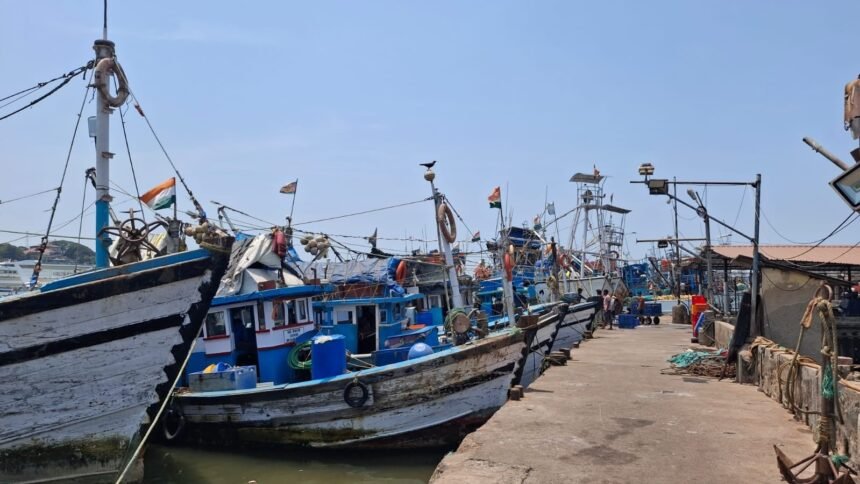
At Malim jetty on the Mandovi River in Goa’s capital, Panaji, fisherman Vijay Karapor is loading a cooking stove onto a trawler named ‘Gift of God’ for the evening’s fishing trip with his crew.
“There is a scarcity of LPG cylinders due to the conflict (in the Middle East),” says Vijay, who has been fishing in Goa’s seas for over four decades. “One cylinder is going for up to Rs 10,000 in the black market. So, we had to switch to stoves for cooking food aboard the vessel.”
As the Iran war stretches on for more than a month, leading to a surge in fuel prices and a shortage of liquefied petroleum gas (LPG), fishing operations in Mumbai and Goa have been hit, with boats docked at shores for days and fishing trips curtailed. In Goa, at least 30 per cent of trawlers at the jetty remain docked, fisherfolk say.
In Mumbai, fisherfolk, particularly the Koli community, say they rely heavily on diesel for their daily operations. “Large fishing vessels consume around 2,000 to 3,000 litres of diesel for a 14-15 day trip, while medium vessels require 700 to 1,000 litres for a 7-8 day journey. Even small boats use 20 to 50 litres for a single day’s trip,” says Devendra Tandel, president of the Akhil Maharashtra Machhimaar Kriti Samiti.
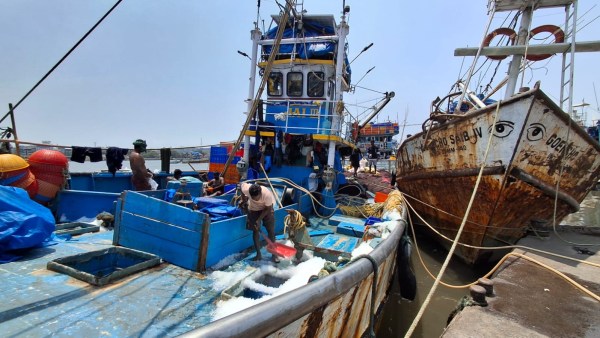 Trawlers at Malim jetty in Panaji . (Photo: Pavneet Singh Chadha)
On March 20, oil marketing companies (OMCs) increased the bulk diesel price by Rs 22 per litre, pushing rates in Maharashtra to around Rs 122 per litre from the earlier Rs 70-80 range, even as retail diesel prices remained unchanged at about Rs 90 per litre. On April 1, OMCs again raised bulk diesel prices by Rs 23 per litre.
Fuel pricing is determined by OMCs such as Bharat Petroleum Corporation Limited, Indian Oil Corporation Limited, and Hindustan Petroleum Corporation Limited, which supply diesel to cooperative societies from where fishermen procure it.
And though the Maharashtra government provides a subsidy on bulk diesel for fishermen, stakeholders across Mumbai say they are struggling to cope, with many boats remaining docked for days. “We haven’t taken out a single boat in the last seven days because of unaffordable diesel rates,” says Dilip Tare, a boat owner from Mahim Koliwada.
Story continues below this ad
Tare says that while he earlier managed to pay workers even on poor catch days by dipping into savings, the current situation has made that difficult.
At the Malim jetty in Goa, Anthony D’Souza, a boat owner, says that when the crisis began to worsen about a fortnight ago, many trawlers cut short their fishing trips. Trawlers are dependent on LPG cylinders to cook food for the crew. “For a small trawler, which has a crew of 4-5 people, a fishing trip lasts four days and requires two cylinders. The larger vessels have a big crew of about 30-40 people, and a fishing trip can last a fortnight, so the demand for cylinders is higher. The consequence is fewer fishing trips and lower fish catch and supply. This will invariably mean the fish prices will shoot up,” he explains.
The Marine Fisheries Census 2016 estimates that Goa has a fisherfolk population of 12,651 and over 850 fishing trawlers and non-mechanised fishing vessels, on average, embark on fishing trips, mainly from Malim, Vasco da Gama and Cutbona jetties. The fisheries sector contributes over 2.5 per cent to the coastal state’s GDP.
According to the Directorate of Planning, Statistics and Evaluation, Goa’s marine fish catch in 2024-25 was 1.27 lakh tonnes, estimated at approximately Rs 2,300 crore. Officials say more than a third of the catch is exported to Southeast Asia, the US, China, and Europe, with frozen fish accounting for the largest share of exports, followed by shrimps and frozen squid.
Story continues below this ad
In Maharashtra, as of 2026, the fishing community employs 3.65 lakh people, of whom 23,000 hail from Mumbai. Within the state, the industry boasts an annual turnover of Rs 9,121 crore. Marine fish landings, or the total quantity of fish and shellfish brought to ports, stood at 3.10 lakh tonnes in 2024, as per data by the Central Marine Fisheries Research Institute (CMFRI). Tandel estimates that 60-70% of the total landings are sold within the state, 10-20% across India, and 5-10% exported.
The fisherfolk community fears that if the conflict is prolonged and shipments continue to be stranded in the Strait of Hormuz, rising fuel prices and a fish shortage would threaten their livelihoods.
Harshad Dhond, president of the All Goa Purse Seine Boat Owners Association and vice-chairman of Mandovi Fishermen Marketing Co-Operative Society, says, “We have over 125 big trawlers and 50 smaller boats. The smaller boats can make do with one cylinder, but the big trawlers for seine fishing require at least three cylinders on average. We received two consignments of 90 and 150 cylinders, so the situation is slightly better than earlier. But the shortfall means that 70 per cent of boats are currently embarking on fishing trips, while 30 per cent remain docked.”
“The diesel at the jetty is being sold for Rs 138 per litre. It is financially unviable. If the crisis continues for ten days or a fortnight, fishing band karna padega (fishing will have to be stopped),” says Dhond.
Story continues below this ad
Others fear missing out on the peak fishing season. “April and May are typically on-season months for us. With rising diesel prices, we’ve had to cut back on sending vessels out,” says Pradip Tapke, a fisherman from Versova Koliwada.
Fishing activity along the West coast is banned annually from June 1 to July 31, during which fishermen rely on stock built up during the summer months. With fewer trips now, that buffer is also at risk.
Some fishermen have turned to a temporary workaround. Bernard D’Mello, a fisherman from the coastal town of Uttan, says many are buying smaller quantities of diesel at retail prices from local fuel pumps instead of procuring bulk supplies through cooperative societies. But fishermen acknowledge such measures are only stopgap solutions.
Taking note of the issue, Maharashtra’s Fisheries and Ports Minister Nitish Rane recently wrote to the Centre, suggesting measures such as reclassification of fishermen cooperative societies, a national policy to stabilise fuel costs for fisheries, and targeted diesel subsidies for the sector.
Story continues below this ad
The National Fishworkers’ Forum has also sought intervention from the Petroleum Ministry over the pricing disparity. Notably, a similar fuel price hike was earlier rolled back for fishermen in Gujarat following an appeal by the state’s fisheries minister.