

On Wednesday morning, as the Supreme Court prepared to pronounce its decision, Ashok Rana was at home in Ghaziabad, tracking the hearing in the courtroom on his phone. His younger son, Ashish, was doing the same from his office in Gurgaon.
“I couldn’t sleep last night thinking about what the court would say,” Ashok said later. “I was home tracking the hearing and Ashish was in office in Gurgaon doing the same.”
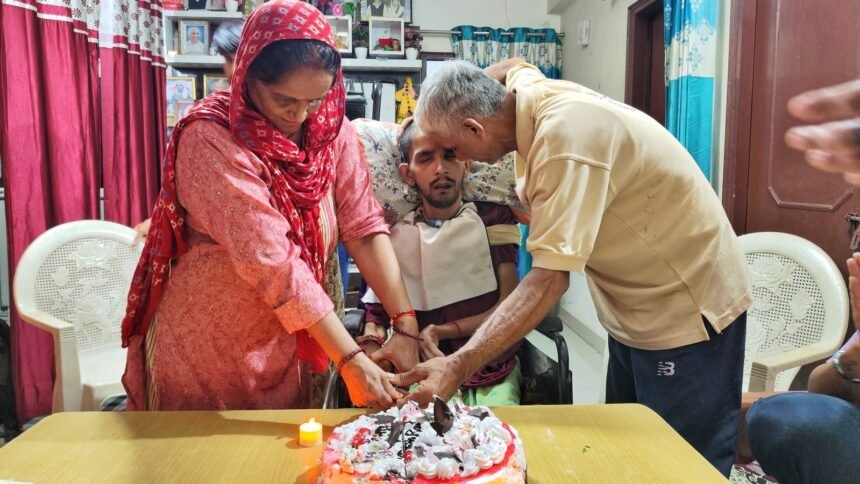
For more than a decade, the family’s life has revolved around a single room in their house where Harish Rana has been in a permanent vegetative state since suffering severe head injuries after falling from the fourth floor of an apartment in Chandigarh in August 2013.
For Ashok, the Supreme Court’s judgment brought relief mixed with grief. “The house will feel empty, so will my heart… it will feel empty without my son,” he said. He was clear about how he wanted the decision to be understood. “Please don’t call it euthanasia… Bhagwan ke godi mein hum apne bacche ko rakh rahe hain (we are only placing our son in God’s lap),” he said.
Earlier in the day, Ashok thanked the court for the order. “We are grateful for the humane directions laid down by the Supreme Court today,” he told The Indian Express. “We approached the court once we recognised that our son’s condition was irreversible and incurable.”
“The court, in an earlier case, Common Cause v Union of India, had already laid down guidelines and conditions under which medical treatment, specifically life-sustaining treatment, could be withdrawn. We only wanted these guidelines to be applied to our son’s case as well. Today, the Supreme Court has done exactly that.” he said.
He said the court has drawn a clear distinction between passive euthanasia and active euthanasia.
Story continues below this ad
“It has emphasised that this is not to be characterised in any way as ‘active euthanasia’. Active euthanasia is the administration of a lethal injection to end the life of a person. What will happen in Harish’s case is that the life-sustaining treatment that he currently receives in the form of a PEG tube will be withdrawn and he will be provided with appropriate palliative and comfort care, as nature takes its course.” he said.
“As you can imagine, this is a very difficult decision for us as a family, but we want to do what is in Harish’s best interest. We also hope that the court’s judgment and its directions will pave the way for similarly humane treatment for others like Harish and their families.”Ashok said.
The family’s legal battle has stretched over several years. In 2024, the Delhi High Court dismissed their plea for passive euthanasia. The family then approached the Supreme Court, which initially declined relief but allowed them to move the court again if circumstances required.
For the Rana family, the legal arguments have always been intertwined with the daily reality of caring for Harish.
Story continues below this ad
Crucial verdict
This is the SC’s first verdict allowing withdrawal of life-sustaining treatment for a patient in a vegetative state. The order puts into practice the SC’s recognition of a patient’s right to die with dignity under Article 21 of the Constitution. It also expands SC’s 2018 passive euthanasia framework to include home-care patients, ease approvals and cut court oversight.
As The Indian Express had reported in 2024, the family’s day begins before dawn and revolves around Harish’s care, feeding him through a gastrostomy tube, dressing bed sores, physiotherapy sessions and carefully turning his body to prevent further injuries.
Harish, once a civil engineering student at Chandigarh University who loved football, video games and weightlifting competitions, now lies still on his bed, the only sign of life an occasional cough and the slow rise and fall of his chest.
In the early years after the accident, the family moved him across hospitals in Delhi, seeking treatment and hope. Later, at home, his mother, Nirmala, became a constant presence by his bedside, feeding him four times a day through the tube and monitoring his condition through the day.
“Nirmala and Ashish were the ones who did everything, taking care of him from morning to evening,” Ashok said. “It’s not 13 days or months… it’s been 13 years that we have done this.”
Story continues below this ad
The years took a financial toll, as the family spent lakhs on medical treatment and equipment. As The Indian Express reported earlier, Ashok retired after three decades in a catering firm, and began selling sandwiches and burgers at a local cricket ground on weekends.
Even now, the family is working through the practical steps following the court’s order. “We still haven’t decided when to take our son to AIIMS. We are in the middle of figuring out the procedures,” Ashok said.