


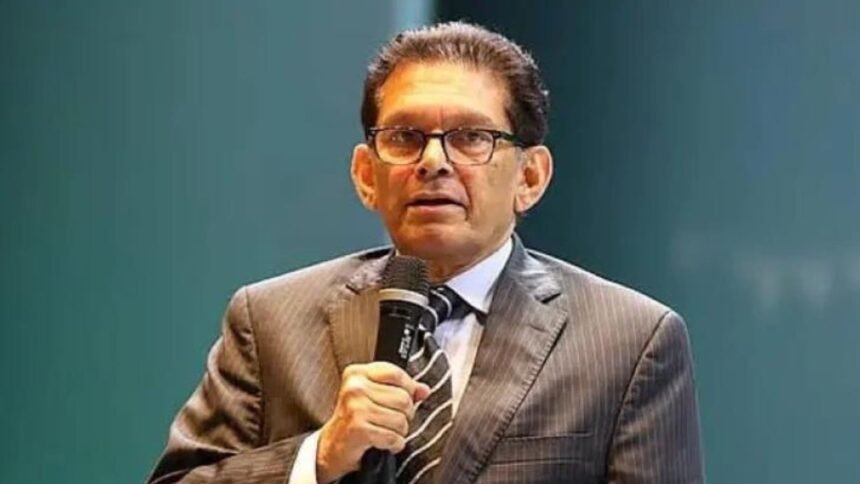
In the first high-level political outreach to Delhi by the new government in Dhaka, Bangladesh Foreign Minister Khalilur Rahman will travel to India Tuesday on a two-day visit.
The BNP led by Tarique Rahman, now Prime Minister, was swept to power in February this year, 18 months after the ouster of the Sheikh Hasina government.
Khalilur Rahman, who was NSA in the interim government led by Muhammad Yunus, will reach Delhi Tuesday afternoon and meet NSA Ajit Doval in the evening — the two had met last November when Rahman visited Delhi as NSA.
He is scheduled to hold talks Wednesday with External Affairs Minister S Jaishankar and is also likely to meet Commerce Minister Piyush Goyal and Petroleum and Natural Gas Minister Hardeep Singh Puri.
Ahead of the visit, Pranay Verma, India’s High Commissioner to Bangladesh, met Prime Minister Rahman Monday and discussed bilateral engagement with focus on “people-centric cooperation in multiple domains aligned with the national development priorities of the two countries”, the Indian High Commission in Dhaka said.
The “High Commissioner conveyed India’s intent to work together with the Government and people of Bangladesh by adopting a positive, constructive and forward-looking approach based on mutual interest and mutual benefit,” it said.
“The discussions focused on enhancing cooperation in a wide range of areas including public health, financial inclusion, women‘s empowerment, rural development, bilateral trade and investment, ease of doing business, technology partnerships, and power and energy cooperation. High Commissioner underlined that India-Bangladesh cooperation should transform their geographical proximity into new opportunities by strengthening economic and connectivity linkages, and by enhancing cultural and people-to-people exchanges,” it said.
Story continues below this ad
Ahead of the visit, Rahman told Prothom Alo, a leading daily in Bangladesh, that the discussions will focus on the “future of relations” between the two countries. “We want a normal relationship with India based on mutual respect, dignity, and interests,” he said.
The Indian Express has learnt that the energy crisis in Bangladesh, due to the war in West Asia, and supply of oil and gas are expected to be a major part of the discussions.
Besides, the two sides will want to move forward on the issues of cooperation in counter-terrorism and security, border management, river water sharing including the Ganga water-sharing treaty’s renewal, and projects that had been stalled after the fall of the Hasina government in August 2024.
From Dhaka’s perspective, lifting the restrictions on trade placed by the Indian government in the last year or so will be one of the major requests, as the two sides work towards normalising and stabilising the relationship.
Story continues below this ad
From Delhi’s perspective, security in the India-Bangladesh border areas and effective border management will be an important point of the agenda.
The two sides will be discussing the Ganga water treaty, which is set to expire in December this year, and will look to renew the pact. Dhaka will also press India on concluding the Teesta water-sharing pact, which has been stalled by the West Bengal government led by Chief Minister Mamata Banerjee for the last 14 years.
Rahman’s visit to Delhi comes weeks before Assembly elections in West Bengal where the issues of immigrants and infiltration are dominating the poll campaign.
Delhi will also want to move forward on projects which include connecting the two countries. India has strategic interest in establishing links to its North-East via Bangladesh. This has always been a point of friction and tension in Bangladesh politics. The Indian government will have to work with the new government in Dhaka and assuage concerns that such links will be beneficial for people on both sides of the border.
Story continues below this ad
For Bangladesh, another major issue is the issue of visas to visit India. India had restricted grant of visas during the Yunus-led interim government. Bangladesh too had paused visas during the elections, but resumed the visa operations in the last one month or so. Dhaka says Delhi is yet to resume full-scale grant of visas for all Bangladesh nationals who wish to travel to India for education, medical treatment, tourism, business and other official purposes.
After his meetings in Delhi from April 7 to 9, Rahman will be heading to Port Louis, the capital of Mauritius, to attend the Indian Ocean Conference on April 11 and 12.
Rahman’s visit comes a month after Bangladesh sent its top intelligence agency chief to India early March. Major General Kaiser Rashid Chowdhury, Director General of Directorate General of Forces Intelligence (DGFI), visited Delhi between March 1 and 3, and met Research and Analysis Wing (R&AW) chief Parag Jain and Director General of Military Intelligence, Lt General P S Raman.