


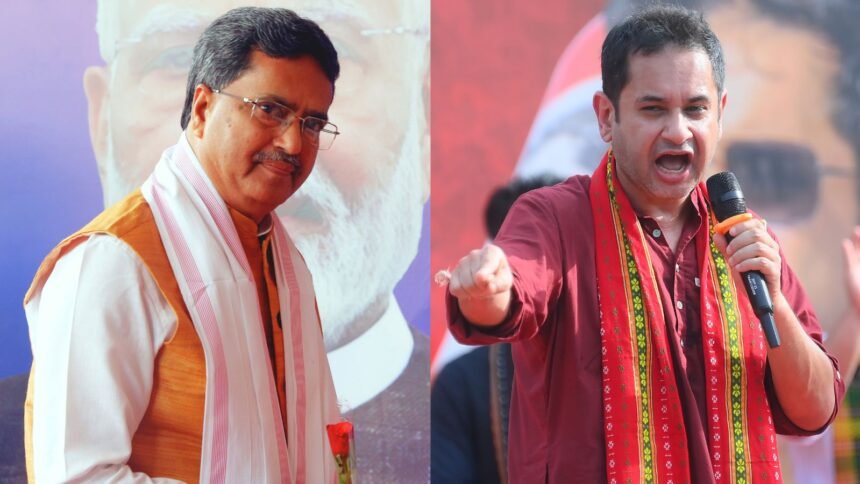
Chief Minister Manik Saha launched a public broadside against Tipra Motha supremo Pradyot Kishore Manikya Debbarma — the scion of Tripura’s former royal family — declaring that “days of royalty are over”. Pradyot hit back, saying democracy in the state had deteriorated so badly that he had to knock on the Supreme Court’s door just to ensure ADC village council elections were held after a ten-year gap.
The exchange set the tone for what is shaping up as a volatile election season in one of India’s most politically complex tribal regions.
The TTAADC is not a minor civic body. It administers roughly two-thirds of Tripura’s geographical area and directly governs the socio-economic conditions of the state’s entire tribal population. Control of the council carries outsized political weight well beyond its administrative remit — a loss or win here will shape the narrative heading into the 2028 assembly elections.
Eleventh-hour talks — and their collapse
Even as the two parties mobilised against each other, a quiet back-channel opened. Senior Tipra Motha leader and forest minister Animesh Debbarma travelled to Delhi in the middle of the ongoing Assembly Budget Session — his absence in the House attributed by acting Speaker Ramprasad Paul to “official engagement,” with no details forthcoming. Motha MLA Ranjit Debbarma confirmed that alliance talks were underway at “various different levels” in Delhi, adding: “Many things happen in politics. Nothing is permanent in politics.”
The optimism was short-lived. Pradyot shut the door in a video message to supporters, tying any alliance to written guarantees on the Tiprasa Accord — something the BJP has not provided.
“I shall never betray our people or have them downcast to form an alliance with anyone,” he said. “My alliance is with my community alone. I can’t form alliance with any party without assurances or guarantees of fulfilment of the Tiprasa Accord… Many people have money and power but I have the support of poor tribals of our state.”
Story continues below this ad
He urged ADC-area tribals to back Motha regardless of political affiliation, framing the election as one fought “not for politics but for the sake of the next generation.”
A commission stumble
Adding to the friction, the State Election Commission announced the poll date as April 13 — a day that clashed with Garia Puja, one of the most sacred festivals of Tripura’s tribal communities, as well as Biju, Buisu, and other traditional celebrations. Every political party, including the BJP, demanded a revision. The commission acted only after the Assembly passed a unanimous resolution during the Budget Session, moving the date to April 12. Many tribals viewed the original scheduling as deliberate, an affront to their religious calendar.
Four-cornered contest
With alliance talks over, the TTAADC election shapes up as a four-way fight. CPI(M) has declared candidates in 27 of 28 seats, Congress in all 28. IPFT — the BJP’s third coalition partner — has fielded candidates in 9 constituencies. Tipra Motha has announced all 28. The BJP’s list was still being finalised in a closed-door meeting at the time of filing this report.
CPI(M) Politburo member and opposition leader Jitendra Chaudhury has dismissed the entire BJP-Motha confrontation as theatre. “Neither BJP nor Tipra Motha has the basic factors for which the ADC was formed in their poll agenda,” he told indianexpress.com. “Their only wish is to grab power. So we don’t expect them to stay distanced for too long. We shall keep a close watch.”
Story continues below this ad
He had earlier called the public rift a “stage-managed political exercise” designed to mislead voters ahead of the polls.
‘The next CM will be tribal’
At a recent rally in Khumulwng, Pradyot declared: “Tipra Motha will sweep all the seats in the tribal council and go on to win the 2028 Assembly polls… a tribal leader will become the next Chief Minister of the state.”
Saha’s response was pointed. He said the ADC had been reeling under a lack of development and rampant corruption allegations, and warned that those promising a tribal CM while holding council power alone would pose a serious risk to ethnic harmony in the state.
The exchange underlines a deeper historical irony. When the BJP began its rise to power ahead of the 2018 elections, it actively championed Tripura’s royal family and attacked the CPI(M) government for denying them their due. Today, the same party deploys anti-royalty rhetoric against its own ally.
Story continues below this ad
How the alliance unravelled
The rift traces back to the tripartite Tiprasa Accord signed in 2024, designed to address systemic grievances of Tripura’s tribal communities. A year on, Tipra Motha says almost nothing in the accord has been implemented. That frustration has since spilled into street-level violence.
The BJP, meanwhile, announced it would field candidates in all 28 seats — effectively shutting the door on seat-sharing — while maintaining, somewhat contradictorily, that it still considers Tipra Motha and IPFT allies, but that those “overreaching” would not be tolerated. Pradyot responded by accusing the BJP of “buying out” leaders within the tribal political space, calling it a profound betrayal. He also drew a pointed distinction between the BJP’s central and state leadership, claiming the former favours tribal development while the latter actively works against it.
Beyond the accord, a list of unresolved disputes has piled up: tribal land rights, direct funding for the ADC, demands for greater tribal representation in the legislature, and a long-running row over the script to be used for the Kokborok language. Tipra Motha and IPFT both advocate Roman script; CM Saha has pushed for Devanagari, a position Union Home Minister Amit Shah subsequently endorsed.
Clashes on the ground
The political bitterness has translated into a series of violent incidents over the past year. BJP workers listening to PM Modi’s Mann Ki Baat broadcast were attacked in Khowai district in July. In October, a 24-hour bandh called by Tipra Motha — timed a day before a PM Modi visit — saw vehicles torched and shops vandalised in Dhalai district. A BJP party office was allegedly set ablaze in Khumulwng, the ADC headquarters, in November. Clashes followed in West Tripura’s Hezamara in January, and in Ramchandraghat during Holi celebrations in March, where a BJP worker and his mother were seriously injured.
Story continues below this ad
Both parties have also accused each other of poaching workers.
Divided opinion
Public perception cleaves sharply along community lines. Many tribals see Pradyot as a genuine fighter who takes on even his own allies for the community’s interests — while also acknowledging that some of the drama may be tactical positioning to extract concessions. Non-tribals, by contrast, tend to view his political project with growing scepticism, with some warning that his rhetoric risks deepening communal divisions in the long run.
For now, party workers on both sides are caught in the middle — mobilised against each other, uncertain which way their leaders will swing next.
“The sudden shift of gears from confrontation to cooperation,” one political analyst noted, “doesn’t automatically translate to votes shifting between parties — especially at the grassroots, where conflicts are often galvanised well beyond political loyalties.”
Story continues below this ad
The nomination deadline for the TTAADC polls is two days away. Voting is scheduled for April 12; results on April 17.