


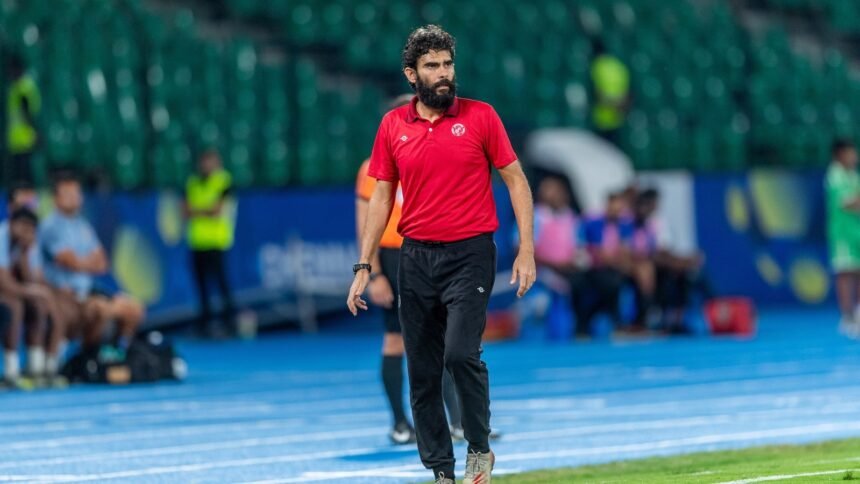
India have looked to the Netherlands, England, Croatia, the Czech Republic, Uzbekistan and, very briefly and rather disastrously, Spain to lead their national men’s football team in the last three decades. Only twice have the powers that be looked within the nation for someone to fill that role in this period – Sukhwinder Singh (2005) and Savio Medeira (2011/12); and Armando Colaco in 2011 on an interim basis. Khalid Jamil has now become the third man, and the fourth if one counts Colaco, to take over that role with the All India Football Federation (AIFF) confirming his appointment on Friday.
Colaco was among those who contributed to the decision-making process that ended with Jamil’s name being finalised. “Our Indian coaches know the players, the culture, the strong and weak points of the players. So let’s try, give him a chance and wish him all the very best,” Colaco told the Indian Express. Long an advocate for Indian coaches to be given the big roles in the country, Colaco hoped Jamil’s appointment would open the doors for others. However, to think that being Indian is the only qualification that was needed for Jamil to take the top job would be a mistake. “He has gone to different clubs and has proved himself. That is one criterion which forced us to give him a chance,” said Colaco.

Born in Kuwait City, Kuwait, Jamil was just entering his teens when his family had to shift to Mumbai during the Gulf War of 1990/91. A midfielder, he went on to spend many a year playing for Mahindra United and Mumbai FC while also making about 40 appearances for the Indian national team. While his utterly astonishing I-League title win with Aizawl FC may be what made him the subject of national headlines, it is in Mumbai that Jamil’s coaching roots lie.
“He had a lot of leadership qualities in him, that is what we identified, myself and David Booth, the English coach there,” Henry Menezes, the former goalkeeper who was Mumbai FC’s general manager at the time, told the Indian Express. Menezes said Booth wanted Jamil to start coaching the club’s under-19 side.
Jamil is known for the sheer passion he exudes on the touchline, and the fact that he seems to hardly have anything to say off it. One-word answers are a common feature of his post-match interviews in the Indian Super League (ISL) as NorthEast United and later Jamshedpur FC boss, and Menezes says that this was true of him back then as well.
“When he gets on the ground, he is a different animal. When he is outside the ground, he is the shiest person on earth. He has got two different characters like that, and that is something we picked. When he gets to the ground, he is very aggressive and authoritative,” says Menezes.
Jamil went on to take the reins of the senior team at Mumbai FC. It was a team often built on a shoestring budget and filled with unheralded players, but Jamil squeezed results out of them year after year. Survival was the only expectation they had, but Jamil even led them close to top-five finishes on occasion.
Story continues below this ad
After more than a decade of hiring foreigners, the AIFF has named an Indian as the national team coach. Khalid Jamil’s experience of working with young Indian players came in handy. The technical committee officials insisted that ‘Indian coaches need to be given a fair chance to prove themselves.’ National Teams Director Subrata Paul presented a ‘SWOT analysis of the three shortlisted coaches – Jamil, Stephen Constantine, and Štefan Tarkovič’, according to the AIFF. Jamil’s vast experience of working at all levels of Indian football and knowledge of players worked in his favour.
Incredibly, though, the powers that be at the club, long after the departure of the likes of Menezes, decided that Jamil deserved the sack for these great escapes instead of credit. “It felt like I was removed from my home,” Jamil had said in 2017. “It was painful.”
The next step in Jamil’s career took him to Aizawl, a city that had absolutely nothing in common with Mumbai. Evidently, though, shifting from the seaside to a place nearly 4000 feet above sea level made little difference to him from a footballing perspective. If anything, his stock rose towards the end of that season far more than his distance from the Arabian Sea. “He will eat, drink and sleep football,” is what Menezes said about Jamil.
Jamil had helped Mumbai avoid relegation season after season. Aizawl also had only similar expectations, and he helped them do that in his first season in charge – by winning the I-League altogether. A dogged defence is what defined his football with Mumbai. With Aizawl, he balanced that up with a higher concentration on attack. Aizawl beat Kolkata giants Mohun Bagan and East Bengal to the title in 2017, while Mumbai were relegated. A few months later, Jamil’s former club ceased to exist.
Then came two rather unimpressive stints with Bagan and East Bengal, followed by a stint as the assistant coach of the ISL club NorthEast United in 2019. Jamil went on to become the first Indian to be a permanent head coach of an ISL club in 2021 when NorthEast promoted him to that role.
Story continues below this ad
Jamil is currently the head coach of Jamshedpur FC, and it has yet to be revealed whether he will leave that role to take over as India’s head coach, with the AIFF still to complete the hiring process formally. Neither Jamshedpur nor NorthEast are among the big boys of the ISL in terms of budgets, but Jamil has led both teams to semifinal appearances. “He has a knack for getting the best out of young players, and that is exactly what India needs today,” Jamshedpur FC CEO Mukul Choudhary told this paper.
Getting the best out of players often means pulling them out of their comfort zones, which is exactly where a number of those playing for the Indian team in the recent forgettable months seem to be stuck in. What is guaranteed is that under Jamil, the players would know that not working hard is simply not an option. “He is the kind of person who has that knack of getting things done (his way),” said Choudhary.
What remains to be seen now, apart from the details of his contract, is whether Jamil would be afforded the kind of patience that some of his foreign predecessors enjoyed from the AIFF. He has a tough run of matches to start off with – India face the likes of Iran, Tajikistan and Afghanistan in the CAFA Nations Cup later this month. That will be followed by the all-important double-header against Singapore in the AFC Asian Cup qualifiers in October.
“If he has earned this place, it is because of his own work. Nobody else has pushed him up,” said Menezes. “Now, the federation has to help him. Whenever there is an Indian coach at the top, I understand that there is a little less freedom (for them to work with). That should be kept aside.”
Story continues below this ad
Know Khalid Jamil
- Born in 1977 in Kuwait City, came to India during Gulf War
- Played as a midfielder for the national team as well as Mahindra United, Air India and Mumbai FC.
- Holds the rare honour of winning the top division as player and coach – with Mahindra United in 2005 as a player and leading Aizawl to the I-League title as manager in 2017
- Has coached Mumbai FC, Aizawl, Mohun Bagan, East Bengal, NorthEast United and Jamshedpur FC
- Won the AIFF Men’s Coach of the Year Award on two occasions — 2023-24 and 2024-25