


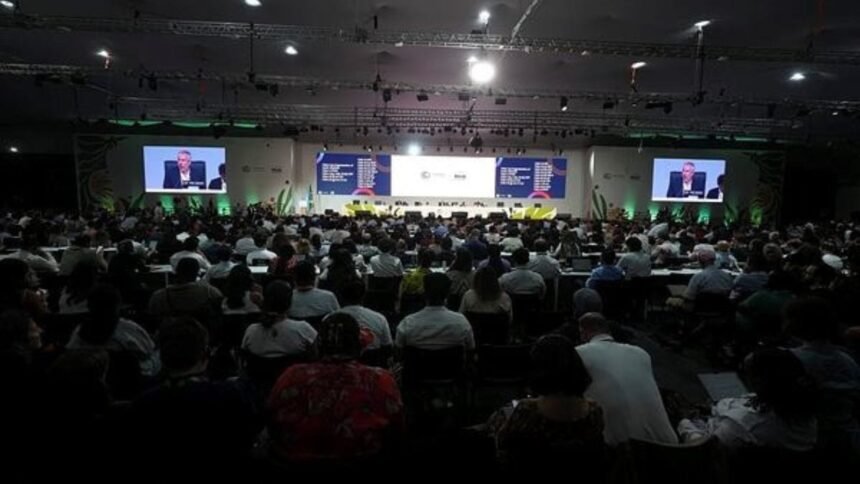
In a demonstration of the new-found assertiveness of the developing countries after having obtained a reasonably satisfactory outcome at the COP30 climate meeting in Belem, Brazil, India told the developed nations that their agenda on climate change could not be imposed on rest of the world, and that attempts to “overturn the architecture of the Paris Agreement” would not be allowed to succeed.
Speaking on behalf of Like Minded Developing Countries (LMDCs), a group that includes China and Saudi Arabia besides others, India clearly underlined the long-held position of the developing countries on climate action — that reduction of greenhouse gas emissions was primarily the responsibility of developed nations, and that the burden of this responsibility could not be shifted to the developing countries because of their own failures.

It also reminded the developed nations that along with reducing emissions, they were legally obligated to provide finance and technology to developing countries.
India said for developing countries, adaptation, and not mitigation, was the main priority. It also reiterated that developing nations were already doing “more than their fair share” and could not be expected to prioritise climate action over development imperatives.
“Adaptation is not a choice for developing countries and providing adaptation finance is a legal obligation of the developed countries. But over the last many years, we have seen attempts to dilute the legal obligations on adaptation finance. Instead, we have seen requests for proposal that change the architecture of the Paris Agreement and infringe on national sovereignties,” Indian negotiator Suman Chandra, a director in Ministry of New and Renewable Energy, said at the closing plenary of the two-week conference, after all the agreements had been adopted unanimously.
The Indian negotiator said the developing countries would not be forced to fill the mitigation gaps left by the inaction of the developed nations.
“We heard that this COP is a mitigation COP in some of the consultations but for the developing countries, it (climate action) is intrinsically tied to development. Adaptation is our priority. Our regime is not mitigation centric. We have all signed on to the Paris Agreement where it is sufficiently clear that the developed countries must take the lead and provide means of implementation support to the developing countries,” Chandra said.
Story continues below this ad
“Even with our challenges, we the developing countries are already doing more than our fair share. The facts remain that as developing countries we are eradicating poverty, ensuring energy security and achieving sustainable development which remains our overriding priority,” she said.
“As we celebrate ten years of Paris Agreement, and 33 years of the Convention, it is a request to the partners to implement what we have agreed, to not shift the goal posts, to not infringe on the policy space of the developing countries and to stop diluting equity and CBDR (Common But Differentiated Responsibility) as the cornerstone principles,” she said.
Developing countries managed to get two of their long-standing concerns onboarded for future discussions at the COP, while fending off attempts to define a roadmap on fossil fuel phase-out in the final agreement. The main political package from COP30 decided to set up a two-year work programme to discuss all matters related to climate finance, including Article 9.1 of Paris Agreement which says developed nations “shall provide financial resources” to developing countries. The developing countries wanted a focussed discussion only on Article 9.1, arguing that all decisions on climate finance till now, including a comprehensive agreement reached last year, addressed only Article 9.3 which calls upon the developed world to “take the lead in mobilising climate finance”, while ignoring the more direct provision in Article 9.1.
The final outcome also acknowledged the position of countries like China and India on unilateral trade measures like Carbon Border Adjustment Mechanism (CBAM) imposed by the European Union. It said that response measures on climate change must not constitute a means of “arbitrary or unjustifiable discrimination or disguised restriction on international trade”.
Story continues below this ad
The outcome also made a call for efforts to triple adaptation finance by 2035. But this did not come without obstructions being created by developed countries, Chandra said.
“We as developing countries, representing over half of the world’s population, would also like to tell the world that we have faced immense roadblocks from our partners in this COP on issues that are of critical importance to all of us. We would have finished the COP on time but for the continued resistance on our agreement to deliver on adaptation finance. We regret that there are being efforts to dilute the provisions of adaptation finance from the year 2030 to 2035,” she said.
“We have had some hard fights here. Although we did not get a work programme just to focus on Article 9.1 of the Paris Agreement, we believe that we have managed to secure some space to discuss the very important provision of finance from the developed countries. The same is the case in relation to unilateral trade measures. We are glad that there is space at least now to discuss trade and climate linkages,” she said, mentioning the successes that developing countries managed to achieve at COP30.