


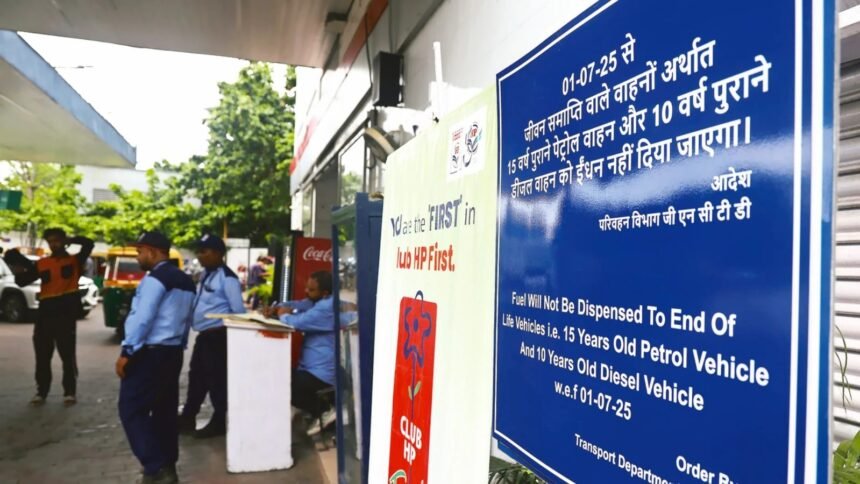
The roadworthiness of a vehicle is a technical and scientific issue that must be linked to actual emissions, the Delhi government has highlighted in an application filed before the Supreme Court as it urged the top court to review its 2018 order on the blanket ban on overage vehicles across the National Capital Region (NCR). In its application, it also sought directions to the Commission for Air Quality Management (CAQM) “to carry out a suitable broad-based study” and analyse if there is a need for the continuation of such a ban.
A Supreme Court bench headed by Chief Justice of India B R Gavai will likely hear the matter on Monday.

After the National Green Tribunal (NGT) had banned petrol vehicles older than 15 years, and diesel vehicles older than 10 years from plying in NCR on April 7, 2015, the Supreme Court had upheld the ban in an order dated October 29, 2018.
In its application dated July 25, the Rekha Gupta government has argued that “the roadworthiness of a vehicle is a technical and scientific issue that must be linked to actual emissions as tested and recorded by mechanisms as set out under the Motor Vehicles Act, and the Central Motor Vehicles Rules, among others, as opposed to blanket ban on the basis of age which is not linked to actual emissions”.
The government said that significant technological, legal, and environmental developments have taken place since 2018, which warrant a “re-examination of this decision” by an expert body to form a structured and graded plan to tackle pollution.
The blanket ban order, it pointed out, “was originally passed as an emergency measure during a period when Bharat Stage IV (BS-IV) emission standards were in force and the migration to Bharat Stage VI (BS-VI), which has much stricter and advanced norms, had not yet commenced.”
“It would be appropriate if suitable scientific studies on the feasibility, desirability and efficacy of continuing the said ban are carried out at the level of the Union of India or the CAQM,” it added.
Story continues below this ad
The government further highlighted that the ban on the vehicles in the last seven years “though undoubtedly salutary in aim was observed to have caused numerous practical hardships to the citizens of Delhi, which today, in light of the advancements in technology and enforcement now prima facie appear to outweigh the prudence and feasibility of continuance of the said ban”.
“The significant improvements in Pollution Under Control (PUC) technology, increased coverage of PUC testing, stricter monitoring of emission standards, transitioning over to Bharat Stage VI engines and various other measures” that have been implemented since the SC order “suitably address the concerns that impelled” the apex court to pass such a judgment, the application highlighted.
Calling for “a graded, balanced and technology driven regime to handle vehicular pollution,” the application underlined, “that instead of an age-based blanket ban, a scientific, data-driven framework should be developed that considers all relevant indicators to ascertain individual vehicular pollution, for example but not limited to: (i) Actual emission, (ii) Actual mileage, (iii) regular and period vehicle fitness tests and (iv) best available retrofitting options (CNG/electric conversions).”
A balanced policy, it further stated, “would ensure not only the protection of the environment through the phasing out of polluting vehicles, but would also preserve the rights of the responsible vehicle owners”.
Story continues below this ad
The application further said that there are various sources of air pollution in Delhi, apart from vehicular pollution, and that vehicular emissions constitute only one of several sources of air pollution in Delhi NCR. “Other significant contributors include stubble burning, biomass burning, road and construction dust, industrial emissions, weather and meteorological factors. As per the CAQM, the percentage contribution of the said sources to the air quality of Delhi varies significantly depending on the season,” the plea stated.
The plea cited the CAQM’s ‘Policy to Curb Air Pollution in the National Capital Region’ adopted in July 2022, which states: “…Studies show that there is considerable seasonal variation in the relative contribution of pollution sources between winter and summer”, and contended that “thus…a scientific analysis, and cost benefit analysis of phasing out vehicles on the basis of age would be an appropriate approach”.