



The first instance globally of a Western hoolock gibbon using an artificial canopy bridge over a railway line was recorded in Assam’s Hollongapar Gibbon Sanctuary recently, offering cautious optimism for the survival of India’s only ape species.
Only an estimated 120–130 individuals survive in the 21-sq km sanctuary in Jorhat through which the historic, recently electrified Lumding–Dibrugarh railway line passes.
However, while this is the first documented case of a gibbon crossing a railway line using a purpose-built canopy bridge, similar structures have been deployed globally over the past two decades to reduce the impact of habitat fragmentation. At the same time, studies caution that artificial canopy bridges are not a substitute for intact forests.
The Hollongapar sanctuary got its first artificial canopy bridge in 2015. The rigid iron structure (see photo) remained unused because its design did not accommodate the hoolock gibbon’s specialised suspensory form of movement, known as brachiation, in which the animal swings hand-over-hand through the canopy.
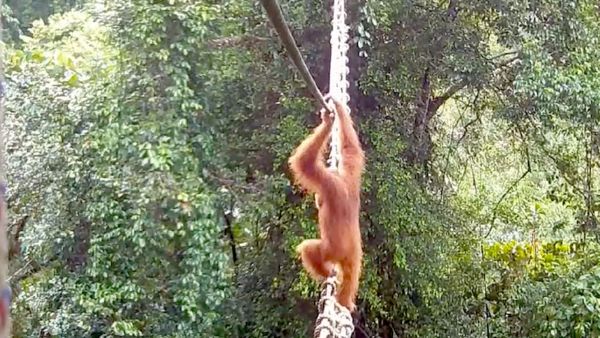 A young male Sumatran orangutan was filmed for the first time using an ACB to cross a road in Indonesia in April 2026. (Photo Courtesy: Sumatran Orangutan Society)
Later, natural canopy continuity was created through plantation efforts, and this briefly allowed movement across the railway corridor. However, storm damage disrupted this linkage.
Finally, following consultations with the Wildlife Institute of India (WII) in 2022, five double-rope canopy bridges made of low-stretch nylon, with fail-safe safety nets, were installed. Within two months of the installation, between February and March this year, a male gibbon was recorded using one of these crossings.
Bridging broken canopies
Arboreal (tree-dwelling) species rely on continuous tree canopies to move, forage, and disperse. Linear infrastructure such as roads, railways, powerlines and canals often interrupts this continuity, isolating wildlife populations in fragmented forest patches.
Story continues below this ad
Such fragmentation reduces movement, increases competition, and limits access to mates, threatening long-term genetic viability.
Artificial canopy bridges restore limited connectivity between isolated forest patches. The choice of materials ranges from steel cables, wire mesh, PVC conduit pipes, used fire hoses and mountaineering-grade polypropylene or nylon ropes to bamboo, canvas, hemp or coir, depending on local climatic conditions.
Practical, widely used
Artificial canopy bridges are now used worldwide – from Costa Rica (sloths and howler monkeys) and South Africa (Samango monkeys) to Madagascar (lemurs) and Australia (possums and gliders). They help wildlife cross canopy gaps caused by roads in Brazil, gas pipelines in Peru, canal systems in the Netherlands, and even typhoon damage in China.
Only last month, a young male Sumatran orangutan was filmed for the first time using an artificial canopy bridge to cross a road in Indonesia.
Story continues below this ad
Back in 2011, artificial crossings made of rubberised canvas and heavy-duty ropes were installed in Tamil Nadu’s Valparai to help lion-tailed macaques overcome the impact of rainforest fragmentation.
In 2017, Kerala relied on bamboo poles tied with iron twines and nylon ropes for grizzled giant squirrels and grey langurs in Idukki. This was followed by sky bridges for Malabar giant squirrels, Nilgiri langurs and lion-tailed macaques in Kollam.
In 2020, Uttarakhand used organic materials like bamboo, jute ropes, and native grass to build a 90-ft-long, 5-ft-wide airbridge suspended 40 feet above the Kaladhungi–Nainital highway near Ramnagar.
In 2023, Assam installed a few canopy bridges to help the movement of golden langurs around the Chakrashila wildlife sanctuary in Assam’s Kokrajhar. This January, a few more were put up across NH-117 after its lane expansion in Bongaigaon.
Story continues below this ad
Risks and limitations
However, artificial crossings can make wildlife movement predictable, drawing animals together and increasing vulnerability to predation. Smaller species are exposed to birds of prey on open bridges lacking the escape complexity of natural canopies.
The social hierarchy of certain species also comes into play. When dominant individuals control access to bridges, subordinate individuals may risk crossing at unsafe times or avoid them altogether. Another criticism is that forcing previously separated wildlife to use the same crossings may increase the spread of pathogens and parasites.
More critically, conservationists warn that artificial crossings help normalise infrastructure projects through forests. In Brazil, for instance, artificial connectors installed under the Reconecta project – after road networks fragmented parts of the Amazon – are often used to justify continued highway expansion.
No substitute for unbroken forests
“A few animals using these bridges may look successful behaviourally while still failing genetically, because the access is not enough to achieve a viable breeding population,” says a wildlife biologist who works in the Northeast. “In any case, they treat the symptom, not the causes.”
Story continues below this ad
For species facing a very high risk of extinction in the wild, studies indicate that artificial connectors may not be sufficient to restore viable genetic exchange without meaningful habitat restoration.
A prime example is the uncertain future of the only surviving population of the critically endangered Hainan gibbon in China. The same fate may await the scattered populations of lion-tailed macaques in the fragmented stretches of the Western Ghats or hoolock gibbons in northeastern forests.
In its social media post, hailing the canopy bridge crossing over the railway line as “a landmark moment for gibbon conservation in India”, the WII too struck a note of caution. “A proud moment for all stakeholders and a ray of hope for mitigating the impacts of linear infrastructure on India’s only ape. However, long-term solutions – careful infrastructure planning and eco-conscious siting and creating reforested corridors to connect isolated populations – remain critical for the long-term survival of exclusively arboreal and threatened species like gibbons,” it said.



