



3 min readUpdated: May 16, 2026 03:44 PM IST
The Netherlands has handed back the 11th-century Anaimangalam copper plates to India, marking a major milestone in the relations between the two countries. Considered among the most significant surviving records of the Chola dynasty, the return coincides with Prime Minister Narendra Modi’s visit to the Netherlands as part of his five-nation tour.
Addressing the Indian diaspora in the Netherlands on Saturday, Prime Minister Narendra Modi expressed gratitude for the overwhelming response by the crowd in the Hague. He said, “It’s always a delight to interact with the Indian diaspora. So much love and enthusiasm… to tell you the truth, for a while I even forgot that I’m in the Netherlands. It feels just like some festival is going on somewhere in India.”

Delighted to interact with the Indian community in The Hague. Their warmth, achievements and strong bond with India continue to make us proud. https://t.co/DVKQo1pKXw
— Narendra Modi (@narendramodi) May 16, 2026
According to the Customs Department in Chennai, the Anaimangalam copper plates comprise a set of 21 large plates and three smaller ones. These were issued to commemorate grants made by the renowned Chola ruler Rajaraja I to a Buddhist vihara (monastery) at the Chola port town of Nagappattinam in Tamil Nadu. The vihara had been constructed by Chulamanivarman, the Sailendra ruler of Southeast Asia.
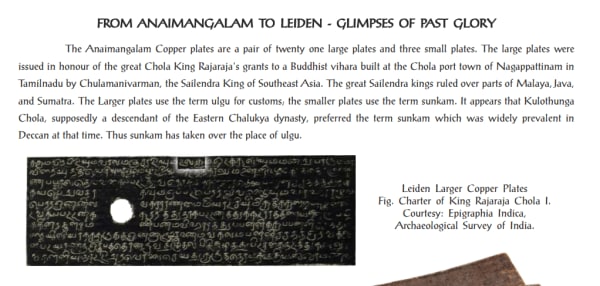 The Chennai Customs website describes the nature of the plates.
Historical references suggest that Kulothunga Chola, believed to have descended from the Eastern Chalukya dynasty, favoured the use of the term “sunkam”, a word commonly used across the Deccan region during that period.
On May 5, Ambassador Kumar Tuhin met Kurt de Belder in the Netherlands to discuss the expansion of cooperation between the two nations, including ties between Leiden University and the Archaeological Survey of India (ASI). During the meeting, he was also shown the Chola copper plates, which had been preserved there since 1862. The artefacts are believed to have been taken to Netherlands by colonial officials.
What’s on the copper plates?
The inscriptions on the plates are written in both Sanskrit and Tamil. As per Leiden University, the Sanskrit section traces the genealogy of the Chola dynasty, beginning with the mythical lineage linked to the Hindu god Vishnu. The Tamil text highlights the accomplishments of Rajaraja I, father of Rajendra I, including his donation of an entire village’s revenue to a Buddhist pagoda in the 21st year of his reign.
This gesture reflects the religious tolerance of Rajaraja I, who permitted a Malay Buddhist ruler of the Sriwijaya empire, spanning Sumatra and the Malay Peninsula, to establish a sanctuary in Nagapattinam, then a key port and trading hub on the Coromandel Coast.
However, relations between Rajendra Chola I and Sriwijaya later turned hostile. Under his rule, the Chola empire rose to become one of Asia’s most powerful dynasties, culminating in the launch of a major naval expedition eastward in 1025.



