



5 min readNew DelhiUpdated: May 9, 2026 04:53 AM IST
A year after Operation Sindoor, while there has been no official contact with Pakistan, former Army generals and retired diplomats from both India and Pakistan have met at least twice in the last three months, including once in Qatar and another Asian capital, The Indian Express has learnt.
While these are not formal “back-channels of communication,” this is the first such engagement since Operation Sindoor amid a growing consensus in official circles in favour of opening such a track with Islamabad and Rawalpindi.

It’s learnt that the need for this has been “escalated” to National Security Advisor Ajit Doval’s office and the National Security Council Secretariat has been made aware of the “willingness” from Pakistan as well.
A political call is yet to be taken in favour of a back-channel but one of the key reasons behind this rethink has been the imperative to “manage” escalation in case of another attack.
Sources said, as of now, there is an absence of established crisis-management mechanisms between the two countries. After the Pahalgam terror attack and during Op Sindoor, the only channel of communication in operation was the hotline at the level of each country’s Director General of Military Operations (DGMO.) Today, the DGMOs speak once a week, usually on Tuesdays.
Sources said Delhi’s thinking is that any back-channel communication doesn’t contradict its stated position that “terror and talks can’t go together.” This is also being seen as a crisis management mechanism led by the civilian government on the Indian side and with counterparts — who could be the military — on the other side.
In theory, Op Sindoor is at a “pause” but Delhi’s redlines are still around the “new normal” where any future terror attack will be seen as “an act of war” and military operations can resume. This necessitates a “civilian-level and political-guided mechanism,” which can be enabled by the military leaders, sources said.
Story continues below this ad
The other factor is Pakistan’s increasing leverage as a diplomatic player in the current US-Israel-Iran standoff and its Army chief Field Marshal Asim Munir’s consolidation of power.
“Right now, Pakistan has an active role in the Iran talks with US Vice President and President Trump’s interlocutors travelling there. Trump has given his whole-hearted support to Pakistan’s leadership including Munir. In this context, if there’s another attack inspired or abetted from across the border, it will be a challenge for New Delhi to navigate the global discourse to put pressure on Islamabad,” said a source.
“So we need to have our own points of engagement.”
There’s an acknowledgment in South Block that India may have won the war last May but Pakistan made significant gains in the battle of perception, not least because of the manner in which it had wormed its way into Trump’s inner circle.
Story continues below this ad
That’s why a back-channel is vital, said the source. “Trump is here for three years, we are both nuclear powers, any communication between Delhi and Islamabad also helps us firewall ourselves against any direct Trump intervention in the eventuality of any bilateral flashpoint.”
India and Pakistan have had a history of back-channel communications.
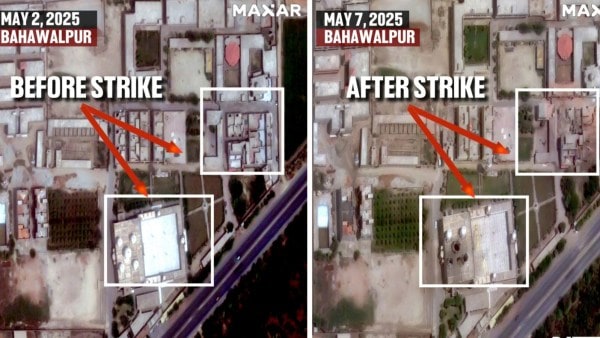 Before-and-after photo of Markaz Subhan Allah in Bahawalpur, which served as the primary hub for Jaish-e-Mohammed (JeM).
Between 2015 and 2018, NSA Doval held several meetings with his then Pakistani counterpart, Pakistan’s NSA, Lt Gen (retd) Nasser Khan Janjua, away from public glare and primarily in Bangkok.
Later, in early 2021, it emerged that Doval had also been in touch with then Pakistan NSA Moeed Yusuf (who held the position of special assistant to then PM Imran Khan on security affairs) in a third country, and he also had a channel open with then Pakistan Army chief Gen Qamar Javed Bajwa.
Story continues below this ad
Lieutenant General Muhammad Asim Malik, the serving head of Pakistan’s Inter-Services Intelligence (ISI), was appointed as Pakistan’s National Security Advisor (NSA) on April 30, 2025. He is the 10th NSA of Pakistan and the first active ISI chief to hold this position, combining key intelligence and national security roles.
His appointment has fused the military and civilian power centres, allowing the military led by Field Marshal Munir to be in direct control.



