



Reorganising itself into a more agile and functional fighting force, more so post Operation Sindoor, the Indian military has made large-scale emergency procurement of modern weapons and technology to change the way it fights future wars.
The acquisitions over a year include a variety of drones, loitering munitions, counter-unmanned aerial systems, standoff weapons, including guided munitions and missiles. Several radars and electronic warfare equipment have also been procured through the fast-track route.
According to officials familiar with the developments, Operation Sindoor and ongoing conflicts abroad have provided key insights into how future wars will be fought, and the measures being discussed and implemented by the Indian armed forces are in line with the evolving realities.
Defence Secretary R K Singh, speaking at a security summit organised last month by news agency ANI, said Operation Sindoor, the Russia-Ukraine war and the West Asia war have shown the importance of standoff weaponry, of a layered and strong air defence system, of sufficient stockpiles of munitions and missiles and “of ensuring that your radars are mobile and your artillery is also mobile”.
Underlining that these lessons have been applied to refine Indian defence procurement strategies, Singh said the majority of the Rs 30,000-crore emergency procurement contracts, signed after Operation Sindoor, were intended to acquire drones, counter-drone systems, loitering munitions, various types of radars, and electronic warfare equipment.
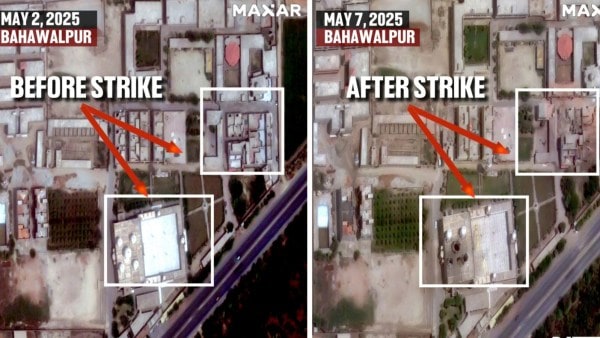 Before-and-after photo of Markaz Subhan Allah in Bahawalpur, which served as the primary hub for Jaish-e-Mohammed (JeM).
According to officials, Operation Sindoor showcased the efficiency of air defence systems — like the S-400 missile systems in providing a sky shield against incoming aerial threats and achieving the longest-ever surface-to-air kill from a distance of 300 km — and also demonstrated the criticality of standoff weapons, particularly long-range beyond visual range missiles, and precision-guided artillery rounds.
The weapons used by the Indian Air Force during the strikes on targets in PoK and Pakistan included Scalp cruise missiles which allowed fighter aircraft to attack ground targets from standoff ranges. Additionally, the operation featured the use of Hammer smart weapon systems, BrahMos missiles and guided bomb kits. The Army utilised artillery guns and Excalibur precision-guided artillery rounds.
Story continues below this ad
India also used a variety of loitering munitions to target Pakistani military installations, doing away with the need to physically cross borders while maintaining the ability to strike deep inside enemy territory.
During the hostilities, Pakistan deployed the China-supplied PL-15E beyond-visual-range air-to-air missile (BVRAAM), providing India insights into its capabilities.
India is said to be acquiring the R-37 long-range air-to-air missile from Russia and plans to induct the homegrown Astra BVRAAM and variants to enhance its arsenal of standoff weapons. And 216 Excalibur precision-guided 155mm artillery projectiles are being bought from the US.
Other than large-scale fast-track procurement of modern technologies and weaponry, the Indian military, particularly the Army, has also been reorganising itself into smaller, lethal functional units equipped with modern weaponry for future wars.
Story continues below this ad
The Army is raising Ashni platoons, Bhairav battalions, Rudra brigades, Shaktibaan regiments, Divyastra batteries and is working towards establishing integrated battle groups.
According to officials, the Ashni platoons will be specialised drone platoons, integrated into infantry battalions, while Bhairav battalions are high-mobility light commando battalions.
The Rudra brigade is an all-arms integrated brigade-level combat formation. Shaktibaan regiments will focus on unmanned systems and precision firepower, and the Divyastra battery will be primarily a drone, loitering-munition battery.
In the wake of the West Asia war, India is looking to raise a conventional missile force. According to the Defence Secretary, earlier the idea was to use it for only strategic purposes, but with that paradigm shifting now, India will adjust accordingly.
Story continues below this ad
A senior official said these changes will mean fewer forces can dominate large areas, allowing a large number of reserves for any offensive and other tasks.



