



Seven days. Two large steps of change. 10 behind-the-scenes sessions and a few drills he would hold dear moving forward.
Shortly before the IPL 2026 season began, a week in Bengaluru may have just changed the trajectory of Nitish Kumar Reddy’s bowling prospects.
There are only two wickets to show for now, but a rapid spurt in speed – gaining up to six miles per hour in seven days – has resulted in rekindled confidence with the ball. Nitish’s IPL uptick will be closely monitored by the Indian team management, which has earmarked the 22-year-old as a preferred seam all-rounder option across formats.
Nitish, who had a limited bowling presence in the IPL last year – only five overs – shone in Sunrisers Hyderabad’s first win of this season with figures of 2/17 against Kolkata Knight Riders. “I wanted to work on my bowling, but it’s just the injuries which I went through last year. Thankfully, I got a little bit of time before the season, and I did pretty well in one week of training with a specific person,” the Andhra all-rounder said after the win.
English influence
That person was Steffan Jones, the renowned English fast-bowling coach who has worked with multiple Indian stars in the past through his brainchild PaceLab academy, including the current SRH bowling coach Varun Aaron.
A direct social media text prompted Jones to fly down to Bengaluru. “Nitish got in touch with me through Instagram, and I stopped by for a week before the IPL. We did a seven-day camp with him. Just one-to-one training, involving a mixture of lots of bowling, lots of drill work and some strength work,” Jones told The Indian Express.
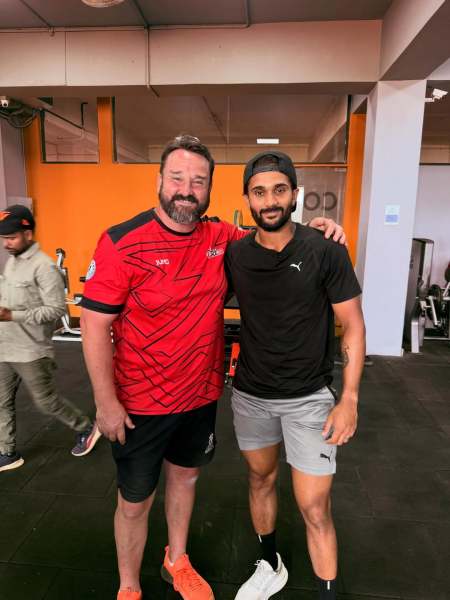 Nitish Reddy and Steffan Jones worked together for a week in Bengaluru ahead of the IPL 2026 season. (Instagram/Steffan Jones)
Nitish only had one thing on his mind while approaching Jones. “Speed.”
Story continues below this ad
“Anyone who approaches me wants more speed and more technical advice,” said Jones.
The two got down to work with Jones instantly measuring Nitish’s erring metrics through his scientific and data-driven coaching background, supported largely by his sprint-resistance machine, commonly used by Olympic athletes, and weighted balls, heavier than the regular cricket ball.
Nitish’s angular run-up, lacking purpose and pace, was among the limitations since his international debut in 2024. Last year, he sustained four different injuries – quadricep and knee concerns, a side strain and a neck spasm – before returning each time to the Indian side with minimal scope and effect with the ball.
A tangled running technique hampered Nitish’s momentum.
“He has a very solid repeatable action, but he spent too long on his back leg, his ankles collapsed on the back foot, which then meant he had poor alignment on the front leg. We increased his run-up by about two large steps. Based on the assessment of the sprint resistance machine that I use, he was not arriving backfoot contact (at the crease) at optimal speed.
Story continues below this ad
A discernible change is observed in Nitish’s bowling. The running appears sturdier with a straightened run-up, the load-up of the delivery targeted more towards the batter, cutting the previously side-on angle. They arrived at the optimal result as Jones increased the depth of Nitish’s run-up, helping him attack the crease faster.
“So getting him to run further and faster, getting off the back foot and then spending more energy and time on the front leg, which he was able to do because he’s probably one of the best athletes going around,” described Jones.
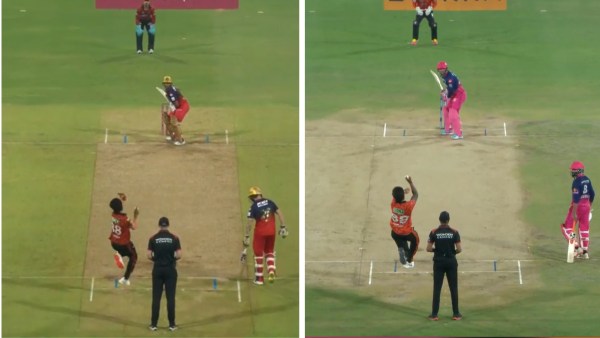 Nitish’s angular load-up in IPL 2025 (on the left) compared to his straightened run-up in IPL 2026. (JioHotstar screengrabs)
Nitish internalised the movements after Jones put some “constraints” and “cones” down to straighten the running. “He just constantly drilled that, and now I see he’s doing that in the game. He’s attacking the crease. He’s got a great running style. He will slightly cross over now and again, but it’s still not hampering his speed and transfer of energy towards the batter,” Jones explained.
Jones’ drills are anything but old-school fast bowling training, involving long hauls in the nets. “Lots of sprinting and jumping, resisted bowling with heavier balls, lots of medicine ball throwing, backfoot contact work, including some hopping.”
Story continues below this ad
He stressed specific work on the ankles. “We did isometric pushes just to strengthen the ankle. It’s a big thing with all Indian bowlers. Their ankles aren’t compliant because of the environment and the way they’re brought up, the way you sit, etc.”
Varun Aaron’s role
While their time together allowed for 10 sessions, Jones said that his empirical insights required Nitish to hold the drills for 15 more “exposures”.
“That’s why the relationship with Varun Aaron was really important,” said Jones. “He let Nitish do my stuff. I’m sure that Aaron does my stuff as well because I had coached him in London before. I had to get a total of 25 exposures in before he was available for selection for the first game. It is that specific.”
The TV screens clocked Nitish at a high of 139.5 kph during SRH’s previous outing against Rajasthan Royals. It is a deceiving metric that Jones wouldn’t go by. He is confident Nitish will push north of 140 kph with more sessions together.
Story continues below this ad
“It doesn’t matter what speed he arrived at. It was six miles per hour quicker when he left, and that is now translated to the speed increases on TV, but those are different to what the radar gun would do,” said Jones.
“The simple fact is Nitish is bowling six miles per hour quicker on my own pocket radar within a week.”
The green shoots of Nitish’s hard work behind the scenes are slowly appearing, and with nine more league matches to go, there is sufficient time for them to grow into something bigger. For Indian cricket’s sake, that could well be the biggest takeaway from IPL 2026.



