



Bhuvneshwar Kumar said it with the quiet pleasure of someone making a point too good to argue with. “Since last year, you have bowled more bouncers than me.”
Krunal Pandya laughed. “Why should fast bowlers have all the fun? Spinners also should have fun.”
Before Sunday’s game against Mumbai Indians, Krunal had debuted a new haircut — braids, paired with a fresh tattoo, chosen after he polled his Instagram followers on four options and went with the winner. He had been saving it for the right moment.
He always is. Not a spinner who occasionally surprises, but one who has spent the last two years dismantling the category itself.
***
On Sunday night at Wankhede, Suryakumar Yadav was sweeping cleanly. Krunal had already shown him everything: the bouncers, the side-arm angles, the higher release. Then he went back to basics. Leg-stump line. The sweep’s ideal arc. But he slowed it, made it dip early. Suryakumar could not get under it. Holed out to deep backward square leg.
Back-to-back breakthroughs when #RCB needed it the most 👊
🎥 Krunal Pandya doing the damage 👏
Updates ▶️ https://t.co/X76bJjmq1j#TATAIPL | #KhelBindaas | #RRvRCB | @RCBTweets pic.twitter.com/KSXAgY6dgv
— IndianPremierLeague (@IPL) April 10, 2026
The bouncer to Venkatesh Iyer in the 2025 IPL opener was the public announcement. Venkatesh walked in without a helmet. A left-arm spinner, 12th over, full house. The expected ball was a length delivery, maybe a quicker one. Krunal bowled a bouncer. Venkatesh asked for his helmet. Next ball, dragged one back onto his stumps.
“It was a very well-thought-out plan,” Krunal told ESPNcricinfo. “At the start of the season I told our spin-bowling coach Malolan that I want to get a wicket on my bouncer — that’s my goal this year. And in the very first game, I had the opportunity.”
The bouncer has since become a settled weapon. Against Will Jacks at Wankhede the previous year, he trusted a read — “He’s not expecting a bouncer over here” — and bowled it. Virat Kohli took the catch at deep square leg. This season, Ravindra Jadeja had to duck under two in the same tight over. Shivam Dube swayed away from a couple before top-edging a 119 kph bumper. And last night, Krunal bowled a bouncer at his own brother. Hardik let it fly past him. The logic applies to everyone. No exceptions.
Story continues below this ad
“Funnily, since then, I’m seeing the trend — so many spinners have started bowling bouncers, around the world, including in practice sessions.” He does not say it with pride. Just as a fact about a game that has quietly moved.
As he showed with Surya’s wicket, a bowler with every variation got the wicket with the one batsmen think they know best. Not just bowling the unexpected ball, but making the expected one feel forgotten. That is the real trick.
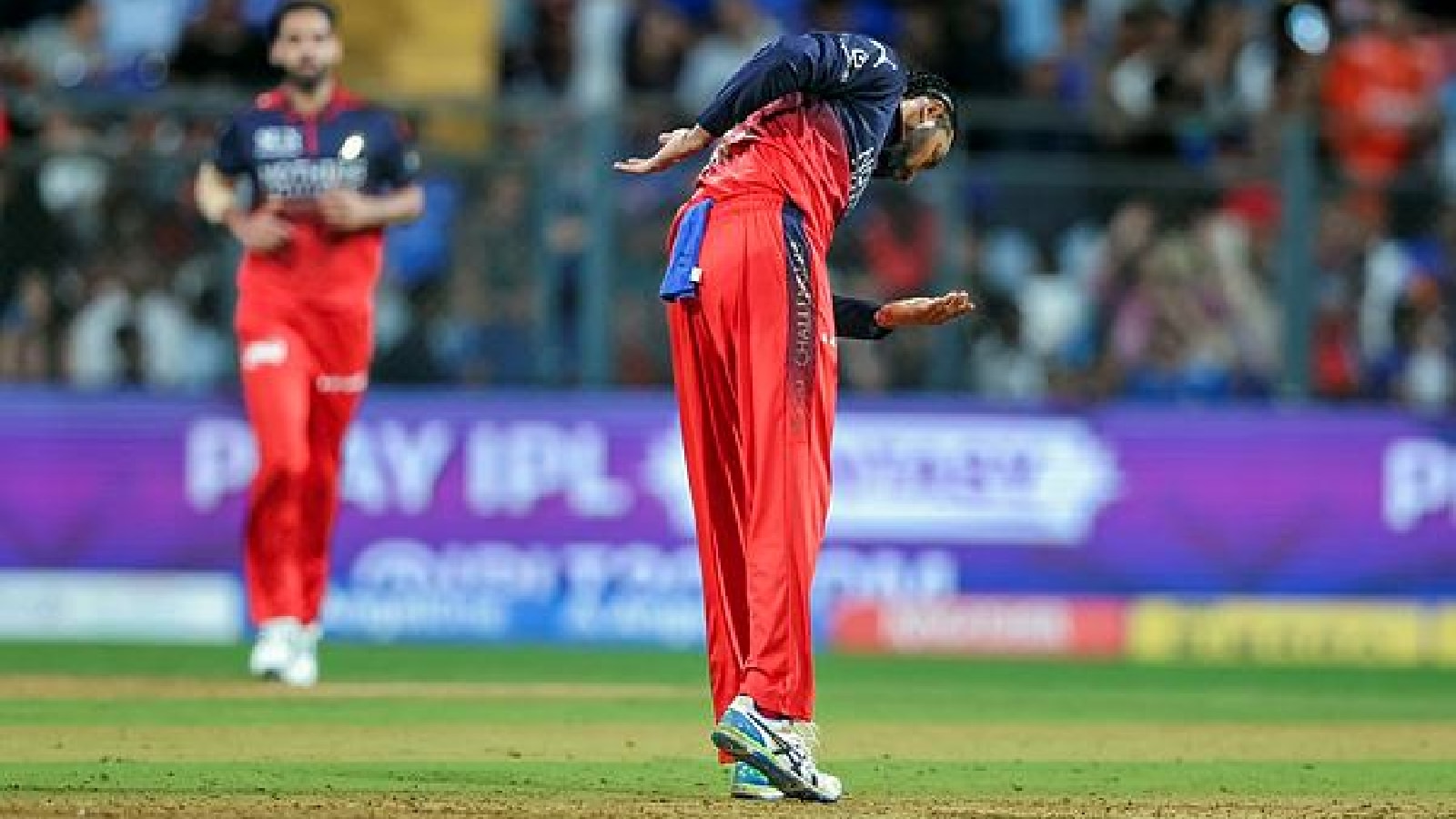 Royal Challengers Bengaluru’s Krunal Pandya celebrates the wicket of Mumbai Indians Suryakumar Yadav during their Indian Premier League 2026 match at Wankhede Stadium, in Mumbai on Sunday. (ANI Photo)
***
A spinner does not accidentally bowl a bouncer. The action changes first. The options come after.
Story continues below this ad
“Back then I used to be at the corner of the crease, longer stride. Now I have become much taller in my action, so I have that bounce.” The pace swing — from 84 to 118 kph within an over — follows from that. So do the low slingy releases from a collapsed knee, the side-arm angles that skid off a different plane entirely.
But he does not rehearse any of this in the nets. Not the bouncer. Not the yorker.
“The only thing I do day in, day out with my bowling is one-stump bowling, classical left-arm spin bowling, getting my body behind the ball.” The foundation is repetitive, almost stubbornly so. The variations are left to the moment.
“I am an instinct player, but I do my research really well. I like to prepare and know things in advance — and then I let my instinct take over in the game.”
Story continues below this ad
In the 2025 final against Punjab Kings, he bowled Prabhsimran Singh with an 84 kph classical left-arm spinner’s delivery — slow, dipping, the ball Prabhsimran was not watching because Krunal had spent the tournament conditioning batsmen to expect something else. The variation was the old delivery.
“People associate a lot of my bowling with me doing different things, but if you see the majority of balls I bowled last year were classical left-arm spin deliveries.”
 Krunal Pandya of Royal Challengers Bengaluru bowls during Match 11 of the TATA Indian Premier League 2026 between Royal Challengers Bengaluru and Chennai Super Kings at M Chinnaswamy Stadium, Bengaluru, India, on April 5, 2026. (CREIMAS)
***
”What I’ve realized is that to have longevity in any field you have to get better and evolve. You can’t have the same thought process,” he said in a RCB podcast.
Story continues below this ad
The game has moved. The batsmen have moved even faster. “What sort of batsmanship was there in 2016 and what it is in 2026 — it’s very different. You see youngsters who are twenty, twenty-one — they come ready. So fearless.”
He is a finger spinner on flat pitches, in an era of deep batting, against players trained to attack spin by default. “I don’t hide away from saying it’s not easy — it’s bloody tough. I feel the heat. I feel the pressure. But I think: how can I be calm, how can I be in the present moment.”
Rajat Patidar understood what he had. After the 2025 final, he explained simply why, when the game tilted, he always turned to Krunal. “Whenever I feel the game is slipping, I always bring KP bhai on.”
***
The survival is not accidental. It is built — through a taller action, a low slingy release from a collapsed knee, a borrowed bouncer, and at the core, a classical delivery simple enough to repeat under pressure. The one batsmen stopped watching for.
Story continues below this ad
“I am glad that there are finger spinners who will survive and can do well in this format,” Krunal has said. “Because for a finger spinner… it has become very difficult.”
Bhuvneshwar Kumar was right. Since last year, Krunal has bowled more bouncers than him.
But that is not why it works. It works because, after everything, batsmen still do not know when the old ball is coming.



