

4 min readNew DelhiApr 8, 2026 06:13 AM IST
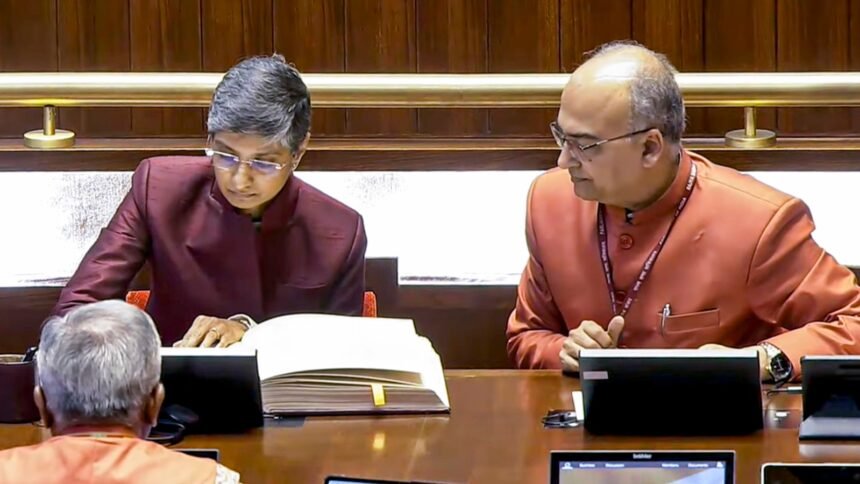
Senior Advocate Menaka Guruswamy was sworn into the Rajya Sabha as a Trinamool Congress member on Monday, becoming the country’s first openly queer Member of Parliament.
Guruswamy, 51, with a legacy of defending civil liberties, sees her move into the political arena as the next logical step in a career defined by challenging the status quo. “My life has been about interpreting and defending constitutional values,” Guruswamy tells The Indian Express, in her first interview after taking over as MP. “After the Supreme Court, Parliament is the next arena for that.”

She views the legislature fundamentally as a deliberative body, rather than a space for “show of muscle”. Her primary legislative agenda, she says, will be “safeguarding the Constitution”, ensuring that new Bills are not “bulldozed” through. Thoughtful legislation, she says, requires scrutiny by parliamentary committees and stakeholder consultation. “When you have a less thoughtful Parliament, you pay the price in terms of bad laws. A diminishing Parliament is an indicator of a diminishing democracy,” she says.
Guruswamy sees the Opposition’s role in this context as one involved in checking the constitutional calibre of new legislation, and believes the Trinamool shares these values.
In recent days, she has indicated that she takes her role as a TMC member seriously.
Earlier this year, while representing the party in petitions relating to the Enforcement Directorate’s raids on I-PAC, the political consultancy that works for the TMC, Guruswamy caught attention for her strong objection to Additional Solicitor General S V Raju referring to Chief Minister Mamata Banerjee by her name.
Last month, Guruswamy was present alongside Banerjee at a protest in Kolkata by the TMC against the controversy-ridden Special Intensive Revision (SIR) exercise for revision of electoral rolls in West Bengal. She has also appeared in the Supreme Court on behalf of the Bengal government in its case against the SIR. Criticising the “haste” behind the exercise, Guruswamy says it is “symptomatic of the current Union government’s functioning”.
Story continues below this ad
Apart from larger constitutional issues, Guruswamy wants to focus on the common person as an MP. “What is the government’s job generation programme for the average Indian – who is in her 20s?” she asks.
In the legal sphere, Guruswamy enjoys a formidable reputation in constitutional, commercial and white-collar criminal law. In 2019, the Supreme Court designated her as a Senior Advocate.
She has taken up cases defending the Right to Education Act provision, and in 2011, successfully argued against the Salwa Judum. The militia was controversially sponsored by the Chhattisgarh government to take on the Maoists, and the case Guruswamy argued eventually resulted in the disarming of the tribal youths enrolled for it.
In 2012, she was made an amicus curiae by the SC in another significant case, involving over 1,500 alleged extrajudicial killings by security forces in Manipur. Her recommendations led to a Court-mandated CBI probe. In 2024, Guruswamy successfully argued before the SC to uphold the constitutional validity of the UP Board of Madarsa Education Act, 2004.
Story continues below this ad
Last month, she secured from the apex court permanent commissions and pensions for eligible women officers in the armed forces. She is slated to argue for women’s entry into the Sabarimala temple before the Constitution Bench that is currently hearing the matter.
Above all, Guruswamy is recognised for her pivotal role in the battle against Section 377 of the Indian Penal Code, a colonial-era law that criminalised same-sex relations, even consensual. In 2018, she was part of the team that persuaded the Supreme Court to strike it down. Following the verdict, she and her co-counsel, Arundhati Katju, publicly announced their relationship. She later represented petitioners seeking marriage equality in 2023.