


4 min readNew DelhiUpdated: Mar 28, 2026 04:36 PM IST
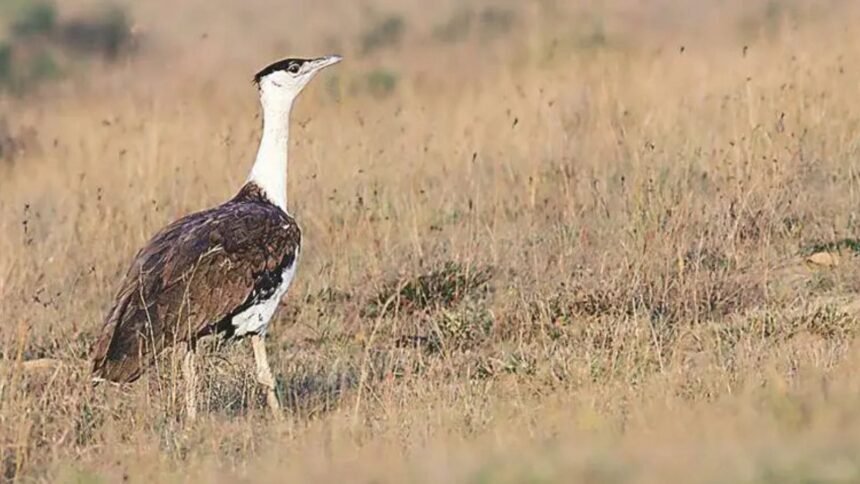
The conservation of the critically endangered Great Indian Bustard (GIB) bird got a shot in the arm as Gujarat saw the birth of a GIB chick for the first time in a decade. The egg hatched on March 26.
Union Environment Minister Bhupender Yadav announced the birth of the chick on X on Saturday. “In a major trans-state conservation effort, a captive-bred GIB egg from the conservation breeding program in Rajasthan was transported by road over 19 hours in a handheld portable incubator and was replaced in the nest on March 22.

This chick was born following the ‘jump-start’ method in which a female GIB in Gujarat incubated a fertile egg that was transported hundreds of kilometres from Rajasthan, replacing an infertile egg.
This is a significant development for GIB conservation as Gujarat has only three surviving female GIBs in the grasslands of Kutch, leaving no possibility of having a fertile egg in the wild, the Environment Ministry said in a statement.
“It took an arduous 770 km road journey to transport an incurvated egg to the desired nesting site in Kutch, which was undertaken without a break by creating a halt-free corridor from Sam (Rajasthan) to Naliya (Gujarat),” the ministry’s note stated.
“The female completed incubating this fertile egg and hatched it on March 26. The field monitoring team found the young chick being reared by its foster mother,” Yadav posted.
Gujarat sees a GIB chick after a decade, through a novel conservation measure – the jumpstart approach, coordinated by the Ministry, State Forest Departments of Rajasthan and Gujarat, and Wildlife Institute of India.
Envisioned by PM Shri @narendramodi ji in 2011 to conserve… pic.twitter.com/oE2DYTZBUF
— Bhupender Yadav (@byadavbjp) March 28, 2026
These females are found in and around Naliya and Kutch Bustard Sanctuary in Abdasa tehsil.
Only an estimated 150 or fewer GIBs survive in the wild in the country, predominantly in Rajasthan. The large bird is a key indicator species of the grassland habitat. The GIB has faced population decline over the years due to hunting, habitat loss, and in recent years, due to collisions with energy transmission lines that criss-cross their habitat in Rajasthan and Gujarat.
Story continues below this ad
Under the Project GIB, the Rajasthan Forest Department and the Wildlife Institute of India established conservation breeding centres, where eggs collected from the wild are incubated artificially. The chicks are hand-reared in the breeding centres. Chicks that have attained adulthood at the centre have mated and given birth to the next generation. The number of birds in the conservation breeding centres at Sam and Ramdevra in Rajasthan has now reached 73.
The conservation breeding centre has helped to overcome the problems of predators’ hunting of GIB eggs in the wild and the slow breeding cycle, wherein female GIBs lay only one egg per year.
The Indian Express was the first to report last July that a Supreme Court-appointed expert committee had recommended the ‘jump start’ method as one of the key conservation measures to revive the GIB’s population. In its report to the SC, it had said that the female GIBs in Gujarat have been laying infertile eggs due to the lack of any breeding male GIBs. In this situation, it recommended that swapping the infertile eggs with fertile ones from Rajasthan’s facilities would be a “rapid approach” to increase the GIB population in Gujarat.
The seven-member expert committee was tasked with prescribing measures to mitigate GIB deaths from power lines while balancing conservation goals with renewable energy development, and recommending any other conservation measures for the GIB’s survival. Last December, the SC had accepted this recommendation.