

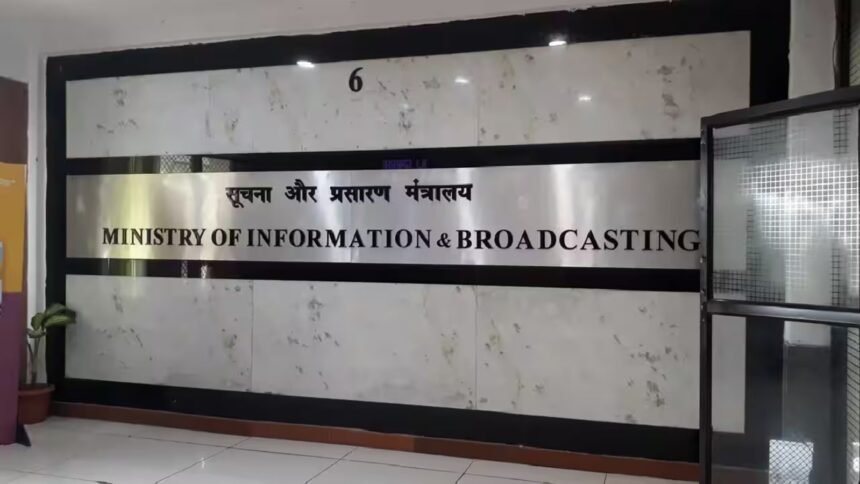
The proposal by the Ministry of Information & Broadcasting (I&B) to post Indian Information Service (IIS) officers at 40 Indian missions abroad has not found favour with the Ministry of External Affairs (MEA), The Indian Express has learnt. The I&B ministry, in a fresh proposal, is learnt to have scaled down the number of such posts to 10.
As reported by The Indian Express on March 18, the I&B ministry had sent a proposal to the MEA for creation of a new global outreach unit within the Press Information Bureau (PIB), starting with 40 cadre posts for IIS officers in foreign missions to handle media and communications, with the aim to project India’s growth story and counter adverse narratives.

The MEA is learnt to have returned the proposal, citing technical issues including lack of language expertise and overlap on certain key areas that diplomats are already tasked with.
The I&B ministry is now learnt to have sent a fresh proposal last month, scaling down the number of such posts to 10 to start with, in global capitals and business hubs where there is a growing interest in the India story, including Washington DC, London, Brussels, Moscow, Beijing, Tokyo and Dubai.
Sources said the new proposal, too, may not find favour with the MEA’s administrative wing which deals with human resource policies — including creating government posts abroad — since the key skills required for such tasks, including language expertise and exposure to local landscape, are the core mandate of the Indian Foreign Service (IFS).
Additionally, there may also be some technical issues pertaining to the Vienna Convention on Diplomatic Relations, which provides diplomatic immunity to officials at the mission, since the I&B ministry’s proposal makes a case for IIS officers to also work as correspondents for Prasar Bharati, besides handling press and communication work at the embassy.
A source said diplomats are posted at missions to handle the press wing for several reasons. “The idea is not only to communicate to the press, but also to be the eyes and ears of the ambassador/ high commissioner, and convey information back to them,” said the source, adding, “The press wing in a mission is a political wing since a lot of political judgement is required at all times.”
Story continues below this ad
The intent of the I&B ministry’s proposal, according to government sources, is to strengthen India’s communication capacity abroad without creating a parallel structure to the MEA’s External Publicity (XP) division, which handles foreign media. A source said that IIS officers — trained in public communication, media strategy and countering misinformation — would be tasked with managing India’s global image. However, the purview of the new initiative would not include foreign policy, defence and national security issues.
Their focus would be on pushing India’s growth story, commerce potential, and projecting India’s soft power, said sources. The I&B ministry is also learnt to have proposed empanelling foreign media houses for government advertisements, and diaspora engagement for creating content. However, the MEA contends that it already has a specialised wing for diaspora engagement.
Earlier, there was no comment from the MEA when asked about its response to the proposal.
At present, communication and media management is handled by IFS officers. It is usually a first secretary or counsellor who manages press briefings, interacts with foreign media, and communicates the government’s position. The I&B ministry has proposed posting joint secretary-level officers to head the press wing at the missions, according to sources.
Story continues below this ad
According to sources, the idea is to highlight India’s growing economy, trade potential, culture and heritage, tourism and infrastructure development as the country’s global stature rises. A need has also been felt to counter false narratives and misinformation by presenting the facts and perspectives from India first-hand to the foreign media, sources said.
According to sources, while the need to expand New Delhi’s global outreach has been felt for several years, in the wake of Operation Sindoor, it was felt that handling misinformation and countering fake narratives would be a key concern in the times to come. It was therefore felt that a coordinated inter-ministerial approach could be more impactful, said sources.