


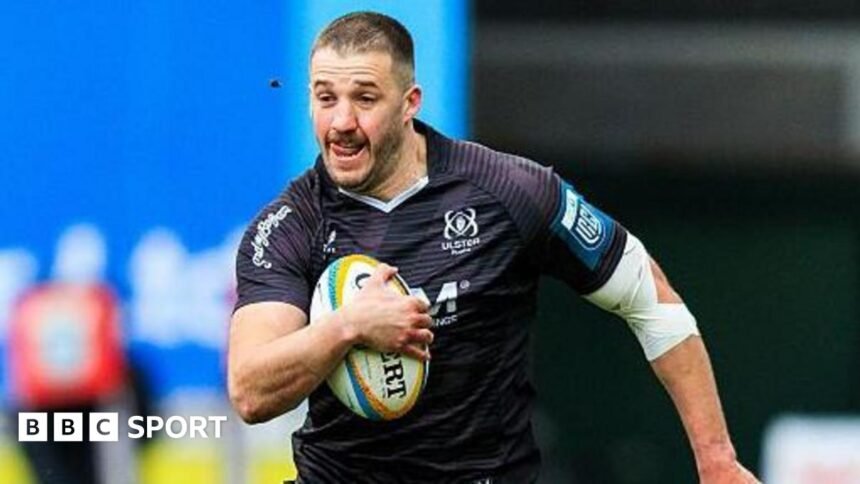
Stuart McCloskey says he hopes Zebre’s Simone Gesi “doesn’t get banned for any length of time” following his red card in Ulster’s 28-12 United Rugby Championship (URC) win over the Italian club on Saturday.
Gesi was sent off for clawing the eye of the Ireland international, but McCloskey is not interested in further retribution.
Instead, the 33-year-old centre feels “those things happen” in the heat of battle and the red card will suffice in terms of punishment.
“The eye is fine,” McCloskey told BBC Sport NI.
“You have to give a statement after these things, [but] I thought it was fairly accidental.
“I don’t think there was any malice in it. Those things happen sometimes and I hope he doesn’t get banned for any length of time. I think a red card will suffice for it.”
McCloskey was making his first appearance for Ulster following an impressive Six Nations campaign in the green jersey of Ireland which culminated in a nomination for player of the tournament.
While Ireland claimed the Triple Crown with victory over Scotland on the final day, the championship was won by France thanks to a last-gasp penalty by France’s Thomas Ramos which snatched victory for Les Bleus against England later in the day.
“Ramos is Ramos” is how McCloskey summed up that dramatic evening which was the final act of a Six Nations he felt was “one of the best tournaments in years”.
“I wish we had gone on and won it but what a final day for the fans,” he reflected.
“If you gave us that scenario at the end of the day and said, ‘Ramos will have a kick from 40 metres out in front of the post to win it’, I think we would have taken the odds of that.
“It was an amazing performance and an amazing game. I don’t think anyone thought he was going to miss it.”