


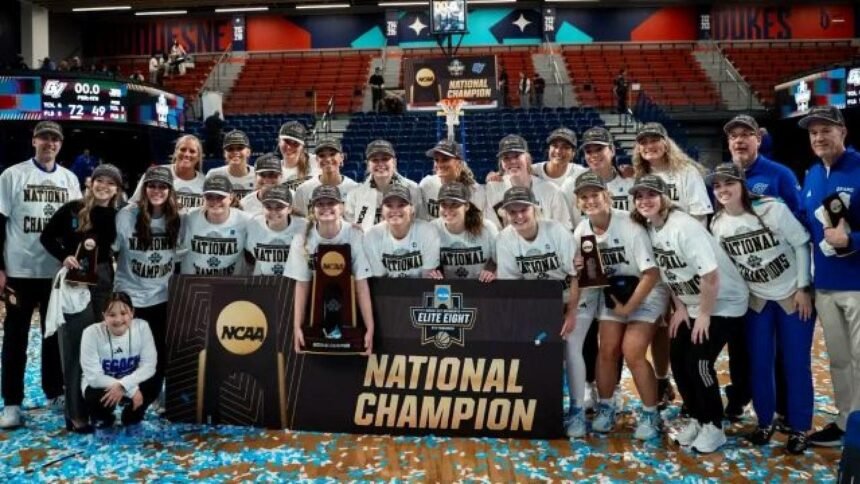
It’s like déjà vu all over again. For the second time in as many years, Grand Valley State ends the season atop the DII women’s basketball world, including the final Power 10 rankings of the season.
It was a wild tournament, full of surprising upsets. It was a tournament that saw just three No. 1 seeds make the DII Women’s Elite Eight, two fewer than last year, and a No. 8 seed run all the way to the quarterfinals. That made these final rankings very difficult, perhaps more difficult than past years. Do you look at how teams finished when the whole DII women’s basketball world was watching? Or do you look at how they handled the gamut of DII women’s basketball all season long, when maybe people were more focused on their regions than on the big picture?
I choose the latter, which will likely cause some disagreement out there. These are the final Power 10 rankings of the 2026 season. Remember, these rankings are mine and mine alone. There is no voting panel, nor does the selection committee have any input. This takes the metrics that get teams into the tournament into account, pairing it with what is happening on the court. It should be said that making the DII Women’s Elite Eight doesn’t guarantee a spot in the Power 10, nor does where a team finishes overall determine a team’s ranking. These Power 10 rankings are looking at the season as a whole, and in the regionalized style of DII, sometimes the Elite Eight doesn’t paint a clear picture of which teams were, in fact, among the best.
The final DII women’s basketball Power 10

No. 1 Grand Valley State | Previous: 1. This was an easy pick. The defending champions allowed more than 59 points just once in the entire tournament, winning their tournament games by an average of 26.0 points per game. The Lakers finish the season 36-1, losing that one game by a mere point to tournament-bound Wayne State (MI). Paige VanStee, MacKenzie Bisballe and Nicole Kamin all shone on the national stage, but this was a team effort as everyone chipped in, whether the box score indicated it or not.
No. 2 Indiana (PA) | Previous: Also considered. The national runners-up hovered right around the Nos. 8-11 spot in these Power 10 rankings for much of the season. However, the Crimson Hawks defeated Gannon — which was highly ranked at No. 4 in the final Power 10 rankings before the tournament — in the PSAC championship and snuck by a very tough and nationally ranked Winston-Salem State to win the Atlantic Region championship. Taking down Colorado Mesa was no easy task in the national semifinals, either. IUP made program history by finishing as national runners-up for the first time and had a superstar in Nyshae’ Weaver. They have the metrics and several signature wins to back up this lofty rise to No. 2.
No. 3 Colorado Mesa | Previous: 6. This was very close between Colorado Mesa and Texas Woman’s. Texas Woman’s had a better KPI, but I don’t necessarily trust that as a determining factor. The Mavericks did lose to West Texas A&M, a team Texas Woman’s beat twice, but the Mavs also beat Texas Woman’s when it mattered most, in the South Central finals. The Mavericks then went and beat Minnesota Duluth to advance to their first-ever national semifinals, so this team was plenty good, as their 37-2 record suggests. One last Olivia Reed Thyne appreciation post: The RMAC all-time great scored 143 points (28.6 per game) and pulled down 70 rebounds (14 per game) during the Mavs five-game tournament run.
No. 4 Texas Woman’s | Previous: 3. The Pioneers had a fantastic season but fell just short to Colorado Mesa in the South Central, losing that tightly contested ball game 75-70. Along the way, they racked up plenty of signature wins, including those two against the Buffs, Lubbock Christian, Wayne State (MI) and Pittsburg State. The Pioneers have gone 98-9 over the past three seasons, so they are proving they have the staying power to contend each and every season. They also have the metrics, with the No. 1 RPI in the South Central and No. 3 KPI in all DII.
No. 5 Alabama Huntsville | Previous: NR. There are teams that performed better, metrically speaking, but not many. What the Chargers did in the tournament solidified the fact that, at the end of this day, this was the No. 1 team in the South Region. They made program history, reaching their first-ever DII Women’s Elite Eight, and once there, they didn’t dodge the spotlight. Instead, they beat one of the winningest programs in tournament history to advance to the semifinals. Lili Wilken finished as the Gulf South’s top scorer, so there was plenty of star power to go with a solid team resume.
No. 6 Winston-Salem State | Previous: Also considered. This is where it gets tricky. We don’t want to let a tournament run define a season, but the bottom line is, until the CIAA tournament started, it wasn’t crystal clear how good this team was. The historic turnaround from seven wins to 28 is part of it, but the way the Rams dismantled Fayetteville State — a tournament regular lately — in the CIAA championship, and then Gannon — a top 10 team for pretty much the whole year — showed that this team could hang with anyone. They had IUP on the ropes and were a late turnover away from making the Elite Eight. Don’t be fooled, this was easily one of the best teams in DII.
No. 7 Minnesota State | Previous: 2. This is where it gets even trickier. The Mavericks had three losses all season, but two of them were the last two games of the year. First, the Mavs were upset in the NSIC championship, and then, the 2026 DII Cinderella, Minnesota Duluth, pulled off the lone No. 8/No. 1 upset in the tournament. So, why is this team, one that didn’t make it out of the first round, so highly ranked? The Mavericks still had the best RPI in the Central Region and had a top-five KPI, finishing better than any other DII Women’s Elite Eight team outside of the national champion and national runner-up. They also had All-American Natalie Bremer, who was a force the entire year. This team checks plenty of boxes worthy of a top 10 ranking.
No. 8 Gannon | Previous: 8. Like Minnesota State, despite that loss to Winston-Salem State in the tournament, Gannon still finished with better overall metrics than every other team in the Elite Eight, minus GVSU and IUP, and as I said, I won’t let one game define a team’s season. The Golden Knights were a top 10 team for pretty much the entire year, and battled with some very good teams like IUP, Union (TN), Northern Michigan and Daemen, proving they belong.
No. 9 Cal Poly Pomona | Previous: Also considered. There was only room for one team from the West Region, and the Broncos were very close to Central Washington for that spot. Since the metrics were so tight, we went to the head-to-head, and the Broncos took down the Wildcats to return to the DII Women’s Elite Eight for the 15th time in program history. Sydney Nelson is one of DII’s very best, and she was huge in that West Region championship, going for 29 and 15 in arguably her biggest game of her All-American season. This team was elite in the tournament, and now elite in the rankings.
No. 10 (tied) Concordia-St. Paul, West Texas A&M | Previous: Also considered and 9, respectively. I can see this raising questions. After all, West Texas A&M was upset in the first round. The bottom line is they had a .621 RPI in a region and conference that sent five LSC teams to the tournament. The Buffs were top 10 all season long, and it feels like their KPI was unfairly hit for losing to a UT Tyler team they had beaten twice in the season, including in the LSC tournament. Concordia-St. Paul upset Minnesota State to win the NSIC and went to the Central Region finals, where their dance was ended by the belle of the ball. The Golden Bears’ metrics (No. 2 RPI in a tough Central and No. 8 KPI in DII) merit a ranking this high.
First five out (in alphabetical order
- Carson-Newman: The Eagles, unfortunately, didn’t stand a chance in the DII Women’s Elite Eight (who did?), getting the Lakers in the quarterfinals, but they upset the No. 1 and No. 2 teams in the Southeast Region to get there.
- Central Washington: The Wildcats were already discussed, and we already know they just missed the top 10. Asher Cai rarely missed, earning All-American and NCAA.com First Team All-DII honors.
- Holy Family: Metrically, Bentley was the better team in the East Region. Defensively, in DII, you could argue that there was no team better. The Tigers led DII, allowing just 50.9 points per game, and nearly pulled off the upset of the Elite Eight, taking IUP to the wire.
- Lenoir-Rhyne: The Bears were the No. 2 seed in the Southeast Region but split with the No. 1 seed (Lincoln Memorial) during the regular season, so it was very close. It felt like this team underperformed and was actually much better than the numbers say.
- Minnesota Duluth: Okay. I know I said the tournament doesn’t matter in the final rankings, but what the Bulldogs did was legendary. They took down a top 3 team in DII in a game they controlled pretty much the entire way, took down the MIAA tournament runner-up, and then Concordia-St. Paul to reach the Elite Eight. That’s a top 15 worthy in my eyes.
Also considered (in alphabetical order): Bentley, Daemen, Ferris State, Fort Hays State, Lincoln Memorial, Northwood, Nova Southeastern, Union (TN), Wayne State (MI), Western Washington
NCAA.com honors

Player of the year: Olivia Reed Thyne, Colorado Mesa. Talexa Weeter was very hard to overlook here, but Reed Thyne has the numbers to back this up. She was second in DII in scoring (22.9 per game), sixth in rebounds (11.7) and second in double-doubles (24). Plus, she was the leader of a team that made the semifinals and, despite not winning it all, was arguably the single-most dominating player in the tournament.
NCAA.com All-DII First Team: Natalie Bremer, Minnesota State; Asher Cai, Central Washington; Olivia Reed Thyne, Colorado Mesa; Talexa Weeter, Fort Hays State; Lili Wilken, UAH.
NCAA.com All-DII Second Team: Taylor Hinkle, Holy Family; Olivia Hodges, Western Washington; Olivia Lee, Union (TN); Reese Schaff, Central Missouri; Nyshae’ Weaver, Indiana (PA).
Coach of the year: Tierra Terry, Winston-Salem State. Grand Valley State’s Mike Williams is an obvious choice here, but what Terry accomplished was nothing short of remarkable. The Rams were 7-20 last year, and in Terry’s first season, she led the Rams to a 28-4 record, their first-ever CIAA championship, and was one-basket-in-the-final-seconds away from the DII Women’s Elite Eight. If you watched what this team did to Gannon and IUP in the tournament, you know they were good enough to wreak havoc had they made it further. The Rams weren’t simply a feel-good story… they were, and could remain, the real deal.