

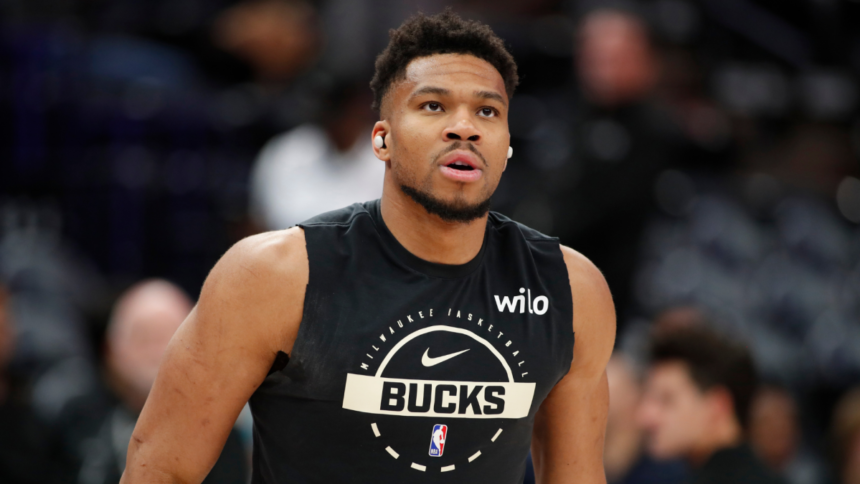
Giannis Antetokounmpo has struggled to remain consistently healthy this season. He missed two lengthy stretches earlier in the season due to calf strains, has played just 36 games, and if the Milwaukee Bucks have their way, he won’t play again this season. Milwaukee reportedly hopes to shut Antetokounmpo down due to the hyperextended knee and bone bruise he suffered in his last appearance on March 15, a relatively standard practice for teams who are no longer realistically in the hunt for a playoff spot.
But there’s one problem: Antetokounmpo wants to play regardless of where Milwaukee sits in the standings.
The standoff has seemingly grown contentious enough that the NBA Players Association had to get involved. On Tuesday, it released a statement blaming the league’s current boogeyman, the tanking crisis, on Milwaukee’s efforts to end Antetokounmpo’s season.
“The Player Participation Policy was designed by the league to hold teams accountable and ensure that when an All-Star like Giannis Antetokounmpo is healthy and ready to play, he is on the court,” the NBPA said in its statement. “Unfortunately, anti-tanking policies are only as effective as their enforcement; fans, broadcast partners, and the integrity of the game itself will continue to suffer as long as ownership goes unchecked. We look forward to collaborating with the NBA on meaningful new proposals that will directly address and discourage tanking.”
It doesn’t make sense for Giannis Antetokounmpo to play again this season; good luck convincing him of that
Jack Maloney
Now, broadly, when teams shut players down late in a lost season, tanking is the most common motivation. However, in Milwaukee’s case, two important things should be noted:
- The Bucks do not control their own first-round pick. They will wind up with the lesser of their own pick and the New Orleans Pelicans‘ pick as one of the last remnants of their 2020 trade for Jrue Holiday. For the Bucks to move into the top four, they would need both their own pick and New Orleans’ pick to jump. That is becoming less likely by the day because the Pelicans have no motivation to lose (their pick goes to the Atlanta Hawks) and have started to win. They are now in eighth place in the lottery standings.
- The Bucks, at this moment, have very little room to benefit from tanking. They are currently tied with the NBA’s ninth-worst record. The team with the 11th-worst record, the Golden State Warriors, has a five-win lead with only weeks remaining, so the Bucks don’t have to worry about getting caught by anyone in the Play-In picture. Meanwhile, the team in eighth is New Orleans. Milwaukee’s placement in comparison to New Orleans is irrelevant. The Bucks get the lesser of the two picks that those two teams produce. If they finish next to one another in the standings, the order is irrelevant. Either way, the Bucks have won four more games than the Pelicans. The only team the Bucks are really tanking against is the Chicago Bulls. Both the Bucks and Bulls have 29 wins. There is some benefit to finishing with a worse record than the Bulls, but at that point in the standings, it’s minimal.
So, can we say definitively that the Bucks are not tanking? No. They still have some motivation to tank, even if it’s minimal. As long as the incentive exists, tanking is a rational behavior. But the time for the sort of egregious tanking the NBPA’s statement hints at was two months ago, when the Bucks had a record comparable to teams like the Utah Jazz, Memphis Grizzlies and Dallas Mavericks, who have all tanked their way out of Milwaukee’s area in the standings.
The Bucks resisted the urge to try an all-out tank at a point when several of their competitors embraced the idea. There are frankly at least half a dozen more egregious examples of tanking out there this season than Milwaukee, so the Bucks really don’t deserve to be called out like this.
Why do the Bucks want to shut down Giannis?
If tanking isn’t the primary motivation for Milwaukee’s attempts to shut down Antetokounmpo, what is? The answer is deceptively simple: the Bucks don’t want him to get hurt. That’s especially true in his case because durability has become a bit of an issue in recent years. He has played 70 games just once since the COVID-19 pandemic came in 2020. He missed time in both the 2023 and 2024 seasons. This year, he’s had those two calf strains, an injury teams are especially cautious with nowadays after Tyrese Haliburton’s Achilles tear, as well as that hyperextended knee and bone bruise.
Any plans the Bucks have for the 2026-27 season rest on Antetokounmpo’s health. If he ultimately elects to sign a contract extension this offseason, they will obviously need him at full strength if they plan to win anything next season considering they have a 12-23 record in games he’s missed this year. If he decides not to extend in Milwaukee and the Bucks are therefore forced to pursue a trade (as owner Wes Edens acknowledged would come without a new contract), his trade value is contingent upon his health. Given his age and injuries, as well as the maturation of several possible suitors, his trade value has already declined this season from where it would have been last summer. A serious injury would be absolutely devastating on that front.
Bucks owners say Giannis Antetokounmpo will either be extended or traded this offseason
James Herbert
This is an important distinction to draw in debates about tanking and shutting down players. Tanking creates an incentive to lose. However, removing that incentive to lose does not necessarily create an incentive to win. That’s where the Bucks are right now. They have little to gain by losing right now. However, they have nothing to gain by winning.
They are eight games out of a Play-In spot with 11 games left on their schedule. They’re not making the playoffs. The rest of the season is functionally meaningless. Therefore, they are incentivized to prioritize next season, when the games start to matter again. Tanking and shutting a player down both prioritize the future, and those two decisions can overlap, but they don’t always necessarily do. In this case, the Bucks are prioritizing next season by trying to limit the risk of an injury. If they happen to lose games in the process, fine, but they have little motivation to do so.
NBPA taking a stance in the tanking debate
What is motivating Antetokounmpo’s desire to return to the court is less clear. It might be a simple, competitive urge. It might be a signal that he understands he is unlikely to be a Buck next season and wants a chance at a proper goodbye to Bucks fans. Typically, players are willing to take the longer view on these things. After all, teams shutting down big-name players is relatively routine and doing so usually doesn’t come with statements like this from the NBPA.
The real takeaway here is that the NBPA seems as keen on tackling the tanking crisis as the league is. That’s not necessarily surprising, but it’s notable in that some players actually can benefit from tanking. Think of it this way: Antetokounmpo’s place in the NBA is secure, but the place of whoever would fill his 30-35 minutes if he sits out might not be. When a team shuts down its best players, it opens the door for younger players — often two-way or former G-Leaguers — to get minutes and prove that they belong in the league. That isn’t to suggest that tanking is a net positive, but merely to point out the complications the union faces in taking a stance like this.
If nothing else, that suggests that if the NBA needs cooperation from the NBPA on any anti-tanking measures it considers this offseason, it will have a willing and eager partner. After all, if what the Bucks are doing is considered such an unacceptable degree of tanking that it requires a statement like this, then worse tanking efforts currently being undertaken by other teams also cross that threshold and becomes such a significant league-wide issue that both the players and owners are on board with addressing it.