


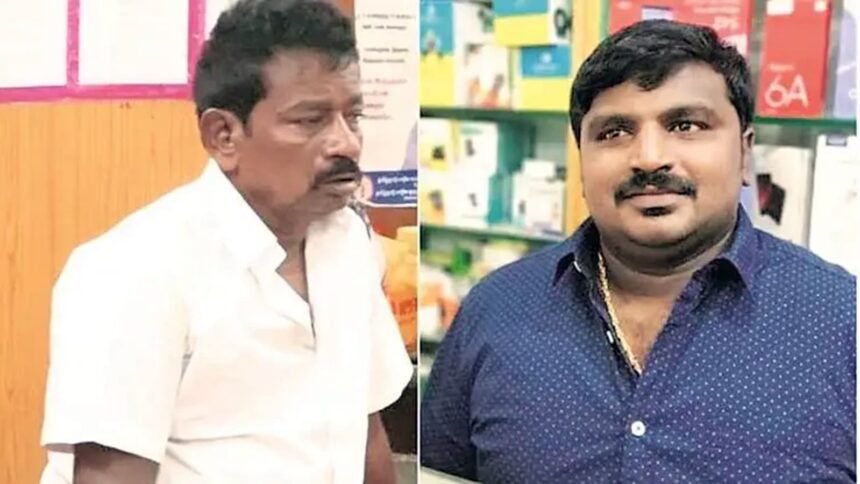
Nearly six years after the custodial torture and deaths of a father and son in the southern Tamil Nadu town of Sattankulam set off national outrage, a sessions court in Madurai on Monday convicted all nine surviving accused police personnel.
Judge G Muthukumaran of the First Additional District and Sessions Court said the sentence would be pronounced on March 30.
The convictions come after a long and bruising legal journey. P Jayaraj, a trader, and his son, J Benicks, were picked up during the Covid-19 lockdown in June 2020 and died days later after what investigators described as hours of brutal torture inside the Sattankulam police station.
The CBI, which took over the case in 2020, charged 10 policemen. One of them, Special Sub-Inspector Pauldurai, died during the trial after contracting Covid-19. The remaining nine, including the then station inspector S Sridhar, two sub-inspectors, two head constables and four constables, were prosecuted by the agency.
The case had become, almost from the beginning, more than a local crime story. It was a test of whether the Tamil Nadu Police could be held to account for a method of violence that critics said had long been normalised in whispers, official evasions and routine remand proceedings.
According to the CBI chargesheet, Jayaraj had not, in fact, violated the lockdown rules under which police had detained him. Investigators said he was picked up from his shop near the Kamaraj statue at about 7.30 pm on June 19, 2020, and taken to the police station “in pursuance of a criminal conspiracy hatched by the accused”. When Benicks rushed to the station and objected to his father being beaten, the two were wrongfully confined and assaulted through the night, the CBI said, to “teach them a lesson on how to behave with the police”.
The CBI said the father and son were then made to clean the blood from their own wounds. The next morning, a sanitation worker was made to clean blood from the station floor to destroy evidence. A false case was then registered against them, according to investigators, and a “fit for remand” certificate was obtained despite their severe injuries. Their blood-stained clothes were discarded in a hospital dustbin.
Story continues below this ad
The Indian Express, in a weeklong series as the case unfolded, had reconstructed that passage from detention to death through witnesses, relatives, police accounts and court records, bringing into public view the texture of what had happened.
One of those reports described how Jayaraj, 62, was taken into custody after allegedly making critical remarks about a police patrol team that had insisted shops close early during the lockdown. Another report captured the logic of revenge that appeared to animate the violence — the son’s attempt to intervene when his father was being beaten, officers said, had “provoked” the police team.
‘In bad shape’
The details were devastating not only for their brutality but for their ordinariness. Family members, who waited outside the station through the night, saw the men the next morning in “bad shape”. Jayaraj’s veshti and Benicks’s pants were soaked in blood. Relatives were told to bring dark-coloured lungis. They were bleeding so heavily that they struggled to keep their clothes in place.
Then came one of the case’s most haunting images. According to S Joseph, Jayaraj’s brother-in-law, the two men were not properly brought before the magistrate and examined for injuries before the remand. Instead, he said, the magistrate appeared upstairs and remanded them with a gesture. “When Jeyaraj and Benicks were brought to the magistrate’s court, functioning out of his residence (in those days), around 11.45 am,” Joseph told The Indian Express in 2020, “they were visibly injured, with blood seeping through their clothes.” The two, he said, were made to stand near the entrance, surrounded by policemen. “The magistrate appeared on the first floor, waving his hand at the policemen,” Joseph said, adding that he heard an officer shout, “Kovilpatti (name of the sub-jail), remand.”
Story continues below this ad
There was no dramatic cover-up, no elaborate staging. A glance from a balcony, a wave of the hand, a remand in minutes — two injured men sent onward into the system.
They were lodged in the Kovilpatti sub-jail and later taken to the government hospital after their condition worsened. Benicks died on June 22 after severe bleeding and haemorrhage. Jayaraj died the next day.
HC takes cognisance
The deaths triggered protests across Tamil Nadu and beyond. Traders shut shops, human rights advocates condemned the police brutality, and questions quickly spread about the wider police system and the scope of cruelty.
The Madurai Bench of the Madras High Court took suo motu cognisance of the case on June 24, 2020. The court ordered a judicial inquiry and, expressing distrust of the local police, directed the CB-CID to step in until the CBI formally took over. The judicial magistrate who inspected the station reported that the Sattankulam police had not cooperated and had tried to create an intimidating atmosphere. Documents were delayed and CCTV footage for the day of the incident was unavailable, though storage capacity existed. However, a woman head constable later told the court that the father and son had been tortured through the night.
Story continues below this ad
The High Court found prima facie material to invoke murder charges. It also initiated contempt proceedings against police personnel who failed to cooperate with the judicial inquiry. At one point, the judges took pains to ensure protection for the woman head constable, S Revathy, whose statement became crucial.
In March 2021, the High Court asked that the trial be completed within six months, while cautioning that “justice delayed is justice denied” and “justice hurried is justice buried”. But the trial stretched on. The court later granted repeated extensions, citing vacancies and other constraints. By 2025, the High Court was told that key witnesses, including the judicial magistrate and the investigating officer, had been cross-examined over dozens of hearings, and that the defence strategy appeared aimed at delaying the proceedings.
The inspector, Sridhar, even sought to turn approver. The plea was opposed by the CBI and the victims’ family and was dismissed.