


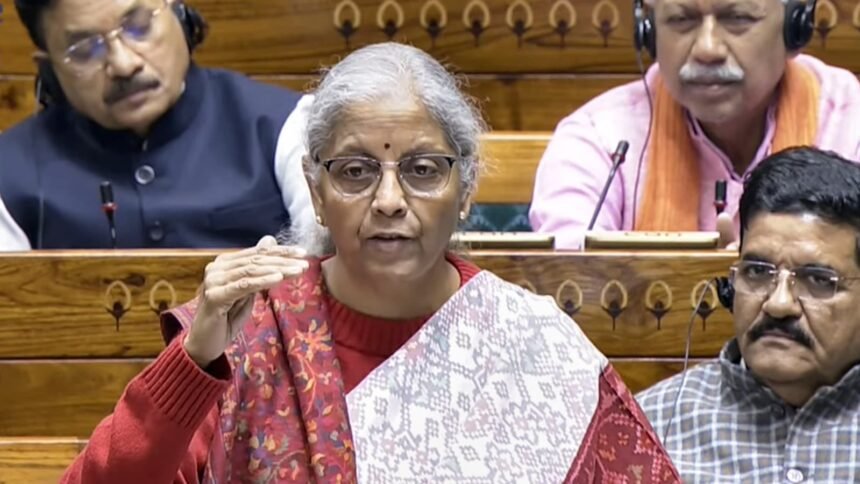
Finance and Corporate Affairs Minister Nirmala Sitharaman on Monday introduced the Corporate Laws (Amendment) Bill, 2026, which seeks to amend the Limited Liability Partnership Act, 2008 and the Companies Act, 2013, in the Lok Sabha. The Bill has been referred to a 31-member Joint Committee of Parliament for a detailed analysis.
The committee, comprising 21 Lok Sabha Members to be chosen by Lok Sabha Speaker Om Birla and 10 Rajya Sabha Members to be selected by Chairperson and Vice-President C P Radhakrishnan, will submit its report on the last day of the first week of the Monsoon Session.

The Amendment Bill, which aims to streamline the regulatory processes for companies, decriminalise minor offences by shifting from criminal penalties to monetary fines in order to reduce the compliance burden on businesses, was referred to the the House panel amid questions from the Opposition MPs in the Lok Sabha.
The Bill also proposes to tweak norms for convening hybrid annual or extraordinary general meetings, unpaid dividends, investor protection framework, along with the introduction of a framework for conversion of specified trusts (registered under SEBI / IFSC authority) into Limited Liability Partnerships (LLPs) and an increase of profitability threshold for applicability of corporate social responsibility (CSR).
The eligibility threshold for CSR is now being proposed to be hiked to Rs 10 crore profits from Rs 5 crore at present. Companies are required to spend 2% of the average profit from the last three years on CSR initiatives at present.
The Bill also proposes to provide exemption to small companies from CSR provisions, requirements related to auditor appointment, reduction in additional fees, among others. The Bill seeks to increase the time period for transfer of unspent CSR amounts relating to ongoing projects to the unspent corporate social responsibility account with the scheduled bank to 90 days from 30 days.
The Opposition claimed the Bill threatens to undermine the constitutional balance between the Legislature and the Executive, dilute parliamentary oversight and concerns regarding arbitrariness, accountability and the rule of law.
Story continues below this ad
Opposing the introduction of the Bill, Congress’s Chandigarh MP Manish Tewari alleged that it “reduces Parliament to enacting a skeletal framework” contrary to the principles laid down by the Supreme Court in the Hamdard Dawakhana versus Union of India case, 1960.
“The Bill enables sub-delegation of legislative and regulatory powers to authorities such as the National Financial Reporting Authority (NFRA)…permits the Central Government to identify class or classes of companies for different regulatory treatments across multiple provisions,” Tewari said.
Trinamool Congress MP Saugata Roy said the Bill seeks to dilute corporate social responsibility. “When the Companies Act was placed in a new form in 2013 and after that four or five amendments were made, this was one of the most welcome measures…corporate social responsibility, where companies would spend 2% of their profit for social purposes. This Bill seeks to dilute that provision altogether,” Roy alleged.
“The other thing the government is doing is strange. When (late) Arun Jaitley was the Finance Minister, he used to add a clause of imprisonment to every violation of Companies Act. Now the Government is working in the reverse direction,” he said.
Story continues below this ad
Once the Bill is approved, companies will be able to hold Annual General Meetings (AGMs)/Extraordinary General Meetings (EGMs) through videoconferencing, with at least one mandatory physical AGM required to be held in three years.
Welcoming the proposed amendments, Anjali Malhotra, a partner at Nangia Global, said: “These amendments aim to decriminalise more offences, enhance ease of doing business, enhance the role of RDs (regional directors) and NFRA (National Financial Reporting Authority) to strengthen governance, and align India’s corporate framework with global best practices.”
One of the key features of the Bill is rationalisation of capital-related provisions, including changes around buyback norms, including but not limited to periodicity which are likely to provide companies with greater flexibility in capital structuring while maintaining necessary safeguards, said Amit Maheshwari, Managing Partner, AKM Global.