


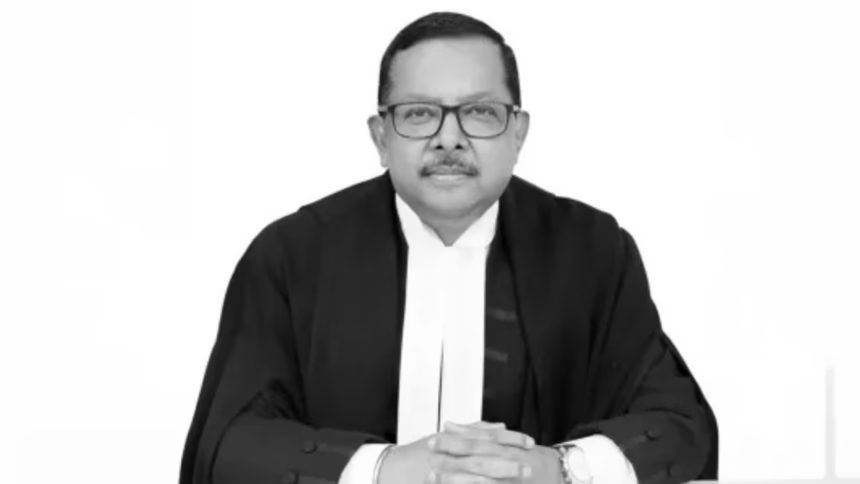
Justice Ujjal Bhuyan of the Supreme Court has said there should be more space for debate in “Viksit Bharat”, dissent should not be criminalised, and that there should be more tolerance towards diverse views.
Justice Bhuyan was speaking at the Supreme Court Bar Association’s (SCBA) conference in Bengaluru on the topic of the judiciary’s role in “Viksit Bharat” on Sunday.
Justice Bhuyan said criminal cases and FIRs have been recklessly registered in recent times. He pointed to the “registration of cases for trivial matters such as public demonstrations and agitations, sometimes even by students”, adding that FIRs are registered over memes and social media posts.
Justice Bhuyan also raised concerns about the prolonged detention of people under laws like the Prevention of Money Laundering Act (PMLA) and the Unlawful Activities (Prevention) Act (UAPA). Referring to data provided in Parliament by the Ministry of Home Affairs and the low conviction rates under these two laws, he said, “A vast majority of persons were arrested but could not be convicted, indicating that arrests may have been premature and unsupported by evidence. This contributes to pendency and backlog.”
He added, “Why should an accused be confined to jail for years and years together, even five years or six years, without charges being framed, without a chargesheet being filed? Can it go on like this? This cannot be a model of Viksit Bharat, certainly not. This can’t be a model.”
Justice Bhuyan also admitted that many within the judiciary suffer from the “more loyal than the king” syndrome, resulting in people continuing to languish in jails for months and months together.
Viksit Bharat by 2047, a goal set by the executive
Justice Bhuyan lauded the goal of “Viksit Bharat by 2047”, as set by the political executive. He said, “I have doubts whether the judiciary, though an organ of the state but certainly distinct and separate from the political executive, should join this bandwagon. The judiciary will have to discharge its responsibility, keeping in mind the foundational principles of the republic, which are reflected in the Preamble of the Constitution.”
Story continues below this ad
“Judiciary must remain judiciary—judiciary can neither be an eternal critique nor a cheerleader. The judiciary must remain judiciary, that is the role assigned to it by the Constitution and by the people,” he added.
Justice Bhuyan also highlighted that the Supreme Court is meant to be more than a legal body. He said the judiciary has to serve as the moral compass and constitutional consciousness of the nation. It has to check the misuse of power by the legislature and by the executive, safeguarding democracy and individual rights, by being independent, he added.
He said, “The judiciary has neither the purse nor the sword. The only asset it has is the goodwill of the people. That is the core of the judiciary’s strength.”
Nobody should be left out of the development project
Justice Bhuyan highlighted the need to be inclusive while reaching the goal of a developed nation. He said, “Inclusive development for all. And nobody would be left out of the development project. Particularly, the sections of the population who have suffered historical wrongs.”
Story continues below this ad
Further, he said, “The development model that we have chosen for ourselves is clearly guided by the vision of our Constitution. Governance in developed India or Viksit Bharat shall be on the basis of the directive principles of state policy as enshrined in Part IV of the Constitution.”
Justice Bhuyan also said that parents cannot insist that their children will not have food prepared by a Dalit woman. That cannot be a Viksit Bharat model. We cannot have situations where Dalit men are made to stand in the corridors, and people urinate on them. The respect of the individual must be protected.”
On the independence of institutions
Justice Bhuyan also highlighted that the directive principles as set out in the Constitution state that there should be equal distribution of wealth, there should be no disparity in income, and the country must overcome the acute inequality in income distribution that the country is facing today. In a developed society or a developed nation, the institutions must have functional autonomy, investigative agencies, as well as the media should be able to discharge their duties without any political interference or control,” he said.
Women’s participation in the judiciary
Justice Bhuyan said that a lot of women are entering the judicial space. However, it has not been replicated in the higher judiciary, the constitutional posts. He said, “Out of 25 high courts in the country, there are only two women chief justices at the Gujarat and Meghalaya High Courts. These are areas we certainly need to discuss. While India becomes a developed nation.”
Story continues below this ad
PMLA cases
As of March 31, 2025, the total number of Enforcement Case Information Reports recorded under the PMLA Act was 7,771 and the number of arrests made was 1031. Trial has been concluded only in 47 of the cases.
UAPA cases
As per information furnished in Lok Sabha, 1948 people were arrested under the UAPA in 2019, but only 34 were convicted.
In 2020, 1,321 people were arrested and only 80 were convicted.
In 2021, 1,621 were arrested and only 60 were convicted.
In 2022, 1,631 persons were arrested and only 41 were convicted.
In 2023, 2,941 persons were arrested and only 118 were convicted.