

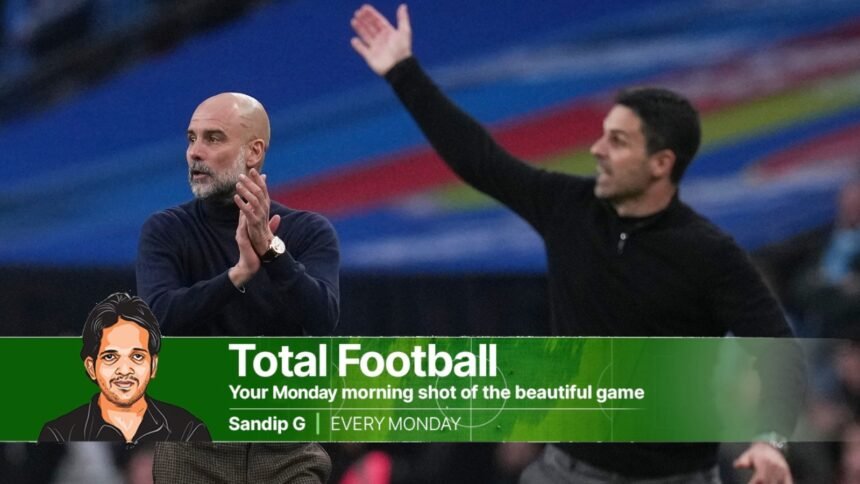
The referee brandished a yellow card at Pep Guardiola. He was oblivious to it, because he was beside the fence, celebrating with the fans the second Nico O’Reilly headed brace. It probably did not matter to him, as he turned back from the revelries and was informed about the card. All that mattered were the goals, the trophy and the glory. Every time O’Reilly slammed into the Arsenal nets, Guardiola rejoiced with the spontaneity of a child. He bounced like the Energizer bunny, clenched his fists and swiped in furious joy.
He would later say with sass and savvy, “I wanted another yellow card, that was the target.”

“If I cannot celebrate against that team with the way we are playing, then when?” He is often measured in celebrations, not least in the Carabao Cup, a trophy arguably not as prized as the league bowl or the Champions League crown.
But sometimes it is about the little moments in life, the backdrop and the bearings that enhance the value of something seemingly insignificant. The Carabao Cup might not nudge out the more glittering trophies stacked in his crowded mantle piece, but it mattered a lot to Guardiola. Perhaps, he knows he has set his mind on leaving the club and seeking a different shore, maybe he has a premonition that this could be the last trophy he could lift for the club he had defined, painted an identity and heritage on. Maybe, it was just the outpouring of a football visionary who loathes to lose. Maybe, it was just the moment.
Maybe, it was an act of defiance. Guardiola is the most important figure in the club’s history. He wouldn’t fade quietly into the shadows but rage against the dying light, live to fight one more day. It was not the triumph of Guardiola the intellectual but Guardiola the street-fighter.
This was another tactical coup, one of the thousands he had stirred. He lined up in an attacking (not the ultra one in the thrashing of Real Madrid) 4-2-2-2, with Antoine Semenyo and Erling Haaland upfront and Jeremy Doku and Rayan Cherki behind the pair. The full-backs over-lapped at high pace. The orchestra strummed falsetto notes in the first half, but they clicked in unison in the second instalment. Not as note-perfect as Guardiola’s finest, which is a dizzyingly lofty space, but one where the virtues of desire and determination shone brighter than the technical prowess.
The key to unlocking Arsenal’s resolute defence was the pace the wingers and full-backs burned. It was a fascinating pattern, wherein Jeremy Doku and Semenyo created width with pace and trickery. The left-back Nico O’Reilly would underlap. The right-back Matheus Nunes didn’t, with Semenyo letting Cherki drift in with his delightful feet that glazed on the ground. Nunes veered into midfield, to offer both creativity as well as defensive sturdiness. Both full-backs are midfielders by trade, and hence the spatial awareness and comfort on the ball. At the heart of the midfield, Bernardo Silva latched onto the second balls, with tigerish ferocity. Erling Haaland did not score a goal, did not look like scoring one either, but his physical presence was immense. Their indefatigability guaranteed that Arsenal barely got a sniff until the match went too deep.
Story continues below this ad
Whether it carries repercussions into the league when it resumes next month is uncertain. The international break could destress Arsenal, nine points ahead of City, and offer time away to regroup. But one of their remaining seven games is against City, who have a game in hand. Should City win both, the difference would be only three points. The past stumbles could return to haunt them. The climax could be tense and fractious. But Guardiola under no presumption that the Carabao Cup triumph is a precursor of positive tidings. A one-off cup final can’t define the season.
Neither would Arteta feel a sense of foreboding, an unravelling lurking uneasily in the corner. The quadruple is gone, but he could still complete a treble, land his club’s first league since 2004 and the maiden Champions League. What could worry him is the fatigue and flatness of the front three. Even if they win all they could, the forward line doesn’t induce sleepless nights for defenders. They are an eminently functional unit that has punched above their weight, but the day, the night or evening their defence creaks, they could look forlorn. Apart from the exceptional William Saliba, and Gabriel, none of their colleagues put in a satisfying shift. The only tactical faux pas more baffling than sticking with Piero Hincapie at right back despite his travails was not picking first-choice David Raya instead of the blundering Kepa Arrizabalaga.
It, though, was fascinating to see two managers swapping their traditional roles. Guardiola was the outsider here, and Arteta the favourite. Arsenal looked well-oiled, the best iteration under him; City looked disjointed, the midfield chaotic and arguably his most fallible group in the era of trophy-storming juggernauts. Guardiola celebrated fervently like managers not expected to come second best; Arteta walked with an air of gruffness, as though this was a passing storm in his steady tea cup. Perhaps, it was the moment the two managers needed to whip up the perfect storm for a tempestuous final lap in the Premier League race.