


The Chhattisgarh Assembly on Thursday passed a Bill that the government said was aimed at preventing illegal conversion, with provisions for up to life imprisonment in cases of “mass” conversion.
The Chhattisgarh Dharm Swatantraya Vidheyak, 2026 (Freedom of Religion Bill, 2026) was presented by Home Minister Vijay Sharma. Opposition Congress MLAs walked out of the proceedings after the Speaker rejected their demand to refer the Bill to a Select Committee for consultation before introduction.
Under the new Bill, a person who desires to convert from one faith or religion to another must submit a declaration to the competent authority, which is the District Magistrate or any officer specially authorised by the District Magistrate, who is not below the rank of an Additional District Magistrate.
“Once the information is received, the competent authority shall, within seven days, publish the details of the proposed religious conversion on its official website maintained by the competent authority under this Act and display the notice of the proposed religious conversion in the offices of the Tehsildar, Gram Panchayat and the local police station and ensure that the notice contains the name of the applicant, his present religion or faith and the proposed religion,” the bill states.
The Bill empowers authorities to verify the authenticity of conversions, investigate complaints, and summon records. Objections can be filed within 30 days, following which the authority will conduct an inquiry and pass an order within a stipulated period.
Several other states also require those undergoing conversion to notify authorities in advance, with some, such as Karnataka, also requiring DMs to make a public call for any objections.
Under the Chhattisgarh Bill, converting to one’s “ancestral religion” will not be treated as conversion under the Bill.
Story continues below this ad
According to the Bill, marriage shall not automatically constitute religious conversion. Further, if a person changes their religion to that of their spouse, then such a conversion will be deemed illegal if it is solely for the purpose of marriage or if it is not in accordance with the provisions of the Bill.
“Sixty days prior to the proposed date of marriage, a declaration in the prescribed format shall be submitted to the competent authority. The competent authority will publish the declaration on its official website. The competent authority shall investigate whether such a marriage amounts to illegal conversion,” the Bill states.
It requires the priest or cleric performing the act to submit a declaration of the “intention” of the person to convert to the competent authority, which shall maintain a record to this effect.
Every person aiding in religious conversion shall, within 60 days of the end of each financial year, submit to the competent authority information on the total number of conversions initiated and completed during the financial year, details including the name, age, sex and address of the person(s) who were converted and a certified financial account detailing all funds received (domestic or foreign), as per the Bill.
Story continues below this ad
It also states that the state government shall take appropriate steps to withdraw or cancel any financial assistance, grant or infrastructure support provided to any person who contravenes the provisions of the Bill. The legislation also restricts the acceptance of foreign or domestic funds if they have been accepted with the objective of violating provisions of the Bill.
Punishments
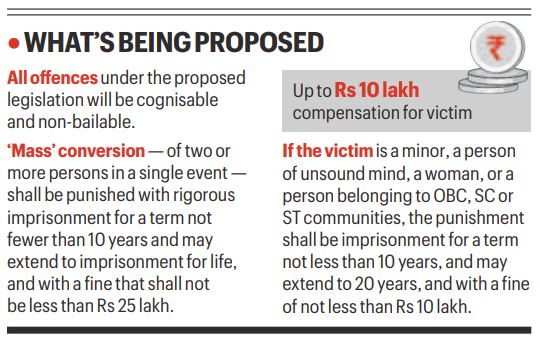
All offences under the proposed legislation will be cognisable and non-bailable.
“Mass conversion”, defined as conversion of two or more persons in a single event, shall be punished with rigorous imprisonment for a term not fewer than 10 years and may extend to imprisonment for life — imprisonment for the remainder of the person’s natural life — and with a fine that shall not be less than Rs 25 lakh, according to the Bill.
A similar law in Rajasthan also has provisions for life imprisonment in cases of mass conversion. In Uttar Pradesh, certain aggravated cases of illegal conversion, such as conversions linked to use of force or trafficking, can lead to life imprisonment.
Story continues below this ad
If the victim is a minor, a person of unsound mind, a woman, or a person belonging to OBC, SC or ST communities, the punishment shall be imprisonment for a term not less than 10 years, but which may extend to 20 years, and with a fine of not less than Rs 10 lakh.
The Bill provides for compensation to victims of illegal conversion up to Rs 10 lakh.
Probe and trial
Cases under the Bill will be investigated by an officer of the rank of a police sub-inspector. The cases will be tried in a special court, and if a special court is not designated, they will be tried in a sessions court.
Further, the trial in these cases will be completed within six months of filing the chargesheet, as per the Bill.
Story continues below this ad
A note by minister Sharma on the Bill says, “The Chhattisgarh Freedom of Religion Bill, 2026, will replace the Chhattisgarh Freedom of Religion Act, 1968, currently in force in the state of Chhattisgarh. The Chhattisgarh Freedom of Religion Act, 1968, only requires notification to the District Magistrate after conversion. The Chhattisgarh Freedom of Religion Act, 1968, makes forced religious conversion a cognizable and bailable offence. Forcible religious conversion is punishable by simple punishment.”
“Due to the geographical situation, social and economic conditions of Chhattisgarh and the development of technology and means of communication in society with the passage of time, the provisions of the existing Chhattisgarh Freedom of Religion Act 1968 have become inadequate in the present scenario to effectively control the use of force, greed and fraudulent practices for conversion from one religion to another, hence it has become necessary to enact a comprehensive law,” the note says.