


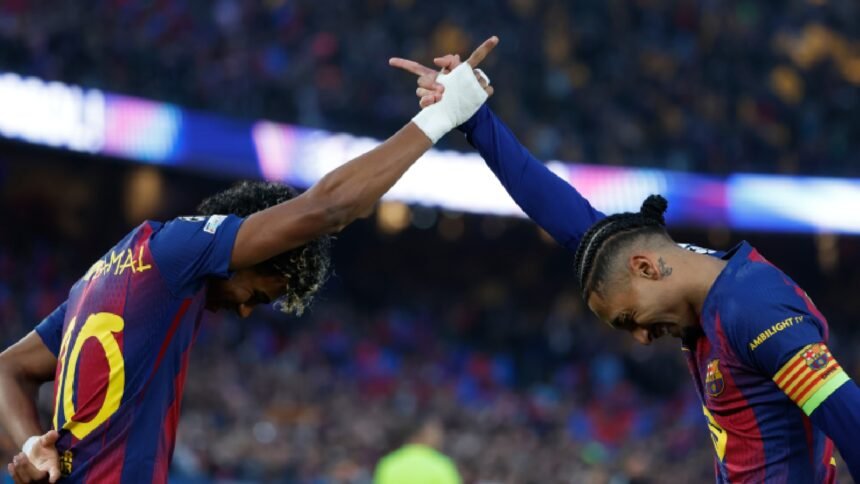
Every time Barcelona scored a goal in their 7-2 thrashing of Newcastle United, wingers Raphinha and Lamine Yamal retreated to a corner of the ground, slapped their palms twice before raising both arms aloft and bowing their heads. It’s a ritual they had begun last December, and which the Brazilian described as “the way they greet each other.” Even in the canteen and dressing room.
It’s a metaphor of the thrilling union they have stitched up under Hansi Flick as well as Barcelona’s transformation from the Cruyffian ideals of control and organisation to chaos and cinema. Raphinia was involved in six goals, netted a brace, assisted a pair, won the penalty that Yamal converted at the stroke of half-time and essayed the free kick that Marc Bernal nudged in. Yamal, besides his goal, conjured numerous svelte flicks, a gorgeous back-heel, the half-turn that resulted in Barcelona’s second goal and glided along the turf with the lightness of a dancer. In spite of an injury-stalled season, they have struck 40 goals and conceived 24 others.

But they are a pair beyond quantification, in the fascinating contrast of their game and background. Yamal was the prized one, the boy who belonged, the son of African migrants who Lionel Messi bathed when he was a toddler for an advertisement, who made heads turn at the La Masia Academy, who broke most youngest-to records and who Spain’s coach claimed was “touched by the wand of God”. He was a star, a Euro champion and touted as football’s future by 16.
Le contrôle de Yamal sur le but de Raphinha contre Newcastle juste hallucinant 😱🔥pic.twitter.com/5KJ42FSTPQ
— 𝙔𝙖𝙢𝙖𝙡 𝙂𝙖𝙡𝙖𝙭𝙮 🌌 (@Yamalgalaxy_19) March 18, 2026
Raphinha, son of an Italian immigrant, a street musician, grew up in the crime-inflicted, impoverished Restinga, a neighbourhood in Porto Alegre. He reached Barcelona after trials and tribulations in Portugal and England, searched endlessly for a sense of belonging. At Camp Nou, he was the unprized one. Flick’s predecessor Xavi wanted to sell him and buy Yamal’s friend Nico Williams; the club entertained offers from the Middle East. At 27, he deliberated on quitting the sport. “I saw people asking me to leave,” he said. “That I wasn’t good enough for the club. I was struggling mentally,” he would say.
Flick’s phone call changed it all. “Before you make any decisions,” Flick told him, “come and train.” He did, and in months became the club’s captain and a Ballon d’Or contender last season. Some of the board members were left bemused; they wanted the team to be built around the slender boy from La Masia. Flick would say: “Raphinha is the most important player in the team.”
Soon, the audience and the board-izens would know why. He, like Yamal, is not a traditional touch-line hugging winger that cuts back like a knapsack (though he certainly could), but one who slips between the lines, dribbles at high speed, pulls the centre-backs, can find narrow pockets of space and conjure the pass of ideal weight to the target man, and is alacritous, often pulls the trigger himself. Shaped by Marcelo Bielsa at Leeds United, he presses like a man possessed, makes defensive contributions (of two players, Bielsa once insisted) and is industrious without the ball. Flick once likened him to a machine.
Special from Lamine Yamal 😮💨
Best assist? 🅰️
#UCLassists | @Lays_football pic.twitter.com/hJdHCBpdP4— UEFA Champions League (@ChampionsLeague) March 18, 2026
The magician is Yamal, the boy who slips through defences like a ghost. He architects Barcelona’s transitions with not so much as a touch as a caress. He is the figure his teammates’ eyes gravitate toward. Every move is made with him in mind; every pass with the purpose to find him. He twists and spins past his markers, he finds angles that no one sees and scores goals that dizzy. The first goal was a classic instance of him orchestrating quick switches of play. He was tussling the ball with a pair of Newcastle defenders at the centre of the pitch before he turned brilliantly to leave both clutching at thin air and thrust upfield at pace, splitting Newcastle’s defence and feeding the ball to Fermin Lopez, who tangoed with Raphinha. Later in the first half, he turned up his explosive pace after a back-heel and burned past three Newcastle shirts. He fed the Brazilian whose shot the goalkeeper repelled.
Raphinha facilitates him to shine brighter by dropping into the rivals’ defensive lines, creating space for Yamal to rove in the channel between the centre of the pitch and right wing. They operate close to each other, interchange positions, and curiously, both are primarily left-footers. When Yamal throws defences off-kilter, Raphinha attacks the spaces that open up.
Both have different personas. Yamal swaggers; a halo flickers. He has the unbreakable spirit of Cristiano Ronaldo; he even shows his dejection when Robert Lewandowski, twice his age, misses chances. Raphinha’s self-belief can be fragile. He can be moody and depressed. Dismayed by the Ballon d’Or snub, he said: “I think I deserved much more recognition after last season.” Flick would say, “he is someone who needs a bit of love.”
Story continues below this ad
He has found love in Yamal, and their bromance is firing Barcelona towards Champions League glory.