


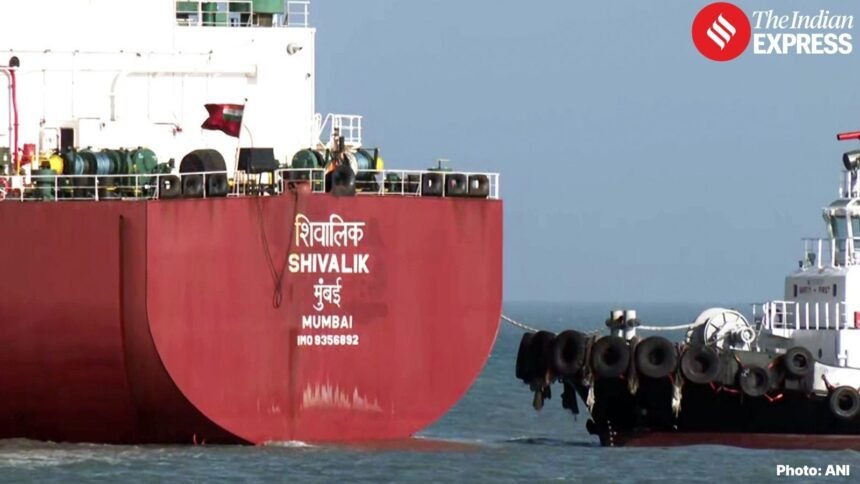
It was close to 2 am on March 14 when MT Shivalik sailed past the final stretch of the conflict-hit Strait of Hormuz and entered the safer waters of the Gulf of Oman. Captain Sukhmeet Singh (39) looked at the Chief Officer and Second Officer on the navigation bridge, and said, “We are out of danger now — tell everyone and tell them to inform their families too.”
The two officers shook hands with their captain, said, “Thank you, sir,” and, overwhelmed, stepped forward to hug him.
Within minutes, the Chief Engineer joined them on the top deck. Together, the senior officers of MT Shivalik paused to take in the moment they had visualised repeatedly over the previous two weeks while anchored near Dubai — as the conflict in West Asia escalated rapidly after the US and Israel attacked Iran.
“For two weeks, we were sitting on board a fully loaded tanker in the midst of the war zone. It was not easy,” Sukhmeet told The Indian Express, recalling those tense days.
After the officers dispersed, Singh took out his phone and hit speed dial. His father Gurmeet Singh, mother Sukhwinder and wife Sandeep Kaur had been anxiously waiting for the call in Punjab’s Adampur. None of them had slept that night.
When Gurmeet (69) heard his son’s voice and the news, all the pent-up tension dissolved into tears. Sukhwinder and Sandeep immediately understood — MT Shivalik had cleared the Strait of Hormuz, carrying 46,000 metric tonnes of liquefied petroleum gas (LPG) and 27 lives to safety.
Through those dark days, Sukhmeet said, his family had only his brief daily calls to rely on. “I am okay. All is fine,” he would say. Recalling that phone call, his father Gurmeet, a former Indian Navy and Merchant Navy seafarer, told The Indian Express: “It was the first time since February 28 that we smiled and laughed, even talked properly to each other.”
Story continues below this ad
MT Shivalik, owned by the Shipping Corporation of India (SCI), had begun loading LPG in Qatar on February 26, as it had done many times before. But two days later, as it prepared to sail, the US and Israel struck Iran.
The vessel was first asked to move to Ras Laffan port and then to Mina Saqr in Ras al Khaimah, UAE. Even there, safety was uncertain as Dubai came under missile and drone attacks.
“We could see missiles coming from Iran and hear explosions every day. And here we were, fully loaded with LPG, in the middle of it all. Obviously, the crew was worried and would come to speak to me often. We knew there was only one way out — to sail,” Sukhmeet said.
“I would pep up the men by telling them how closely the company and the Indian Government were monitoring their safety and doing everything possible to ensure we could leave the strife-torn waters as soon as possible,” he said.
Story continues below this ad
Back home, Gurmeet said his son took care to avoid causing worry, especially for his 11-year-old daughter. “He would usually just say everything is okay. But once, when I pressed him, he admitted the sky would often be lit up with missiles…,” he said.
“I told him that nothing was more important than keeping the crew’s morale high. He said he was meeting them three to four times a day and talking to them. He was also full of praise for the Government and the company for their constant support and encouragement,” Gurmeet said.
On March 13, the orders finally came for MT Shivalik to sail through the Strait of Hormuz: a 10-hour passage out of troubled waters.
“As mariners, you often face challenges at sea, but this was different. What helped most was the support from everyone on shore and my crew on board — both deck and engine teams. They were wonderful. Despite the anxiety, they showed remarkable resilience and team spirit,” Sukhmeet said.
Story continues below this ad
According to Captain Alok Mishra, CEO of Mundra Port, the tanker is expected to remain there for a few more days until it completes discharging its cargo.
While some crew members who have completed their contracts have applied for sign-off, Sukhmeet, who joined the vessel in December 2025, plans to continue “for some more time” and is “waiting for the next loading point”.
Following MT Shivalik, SCI’s Nanda Devi reached Kandla through the Strait of Hormuz on March 17, while Great Eastern Shipping Company’s crude oil tanker Jag Laadki arrived at Mundra on Wednesday. All were given safe passage by Iran and later escorted by the Indian Navy.
It has been reported that at least 22-24 Indian-flagged ships, including tankers, are currently operating or waiting west of the Strait of Hormuz, with around 600 crew members on board.