


Two people were killed in police firing in the early hours of Tuesday amid arson and unrest in Meghalaya’s West Garo Hills district, which is seeing tensions over opposition to the participation of non-tribals in the upcoming Garo Hills Autonomous District Council election.
Meghalaya DGP Idashisha Nongrum confirmed that two people died after the police opened fire when agitated groups gathered at Chibinang late Monday night, while curfew was in place.
The West Garo Hills district administration has now imposed a curfew on the entire district until 12:00 am on March 13. The order issued by DC Vibhor Aggarwal states that “incidents of violence, and disturbance of public peace have been reported in various parts of the district, posing a serious threat to human life, public safety and property.” The state government has also suspended mobile internet services in the district.
The immediate trigger
The tensions over the GHADC polls, due to be held on April 10, had been simmering in the region and escalated on Monday, the first day for candidates to file their nominations. Matters came to a head when Esmatur Mominin, a Bengali Muslim Trinamool Congress leader and a former MLA from the Phulbari constituency, was assailed when he went to the DC office in Tura to file his nomination. Mominin and his supporters faced opposition from Garo groups.
The area of the fatal incident, Chibinang, is where Mominin’s house is located and where large numbers of his supporters had gathered after the morning’s incident.
Rajabala MLA Mizanur Rahman Kazi said that the tensions are currently in the plain belt areas of the district, such as Phulbari, Rajabala and Chibinang, where the population is mixed, and Bengali Muslims are in large numbers.
“There has been arson in Chibinang, and as of Tuesday afternoon, it is still tense. But the situation is being brought under control and central security forces have been deployed here,” he said.
Story continues below this ad
The larger issue
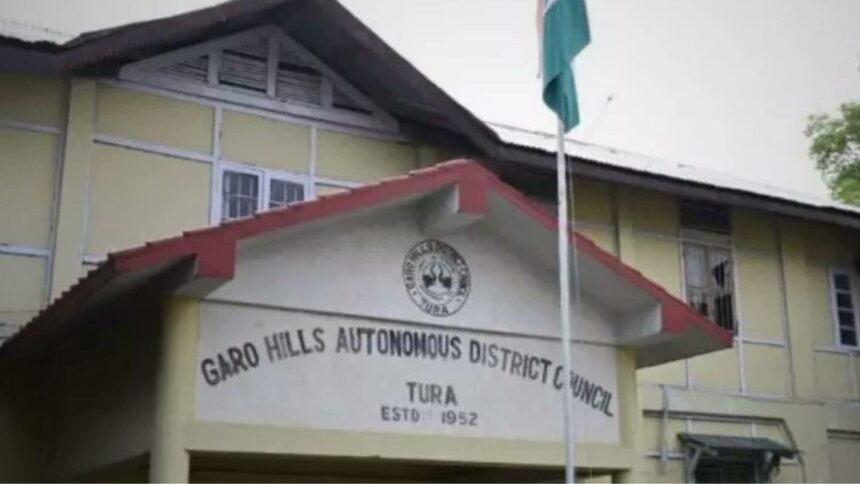
The GHADC is one of three autonomous district councils in Meghalaya with jurisdiction over the districts of East Garo Hills, West Garo Hills, South Garo Hills, North Garo Hills and South West Garo Hills. It is based in Tura, the headquarters of the West Garo Hills. The council has 30 members, and elections are held for 29. With the mixed population of the Garo Hills, particularly in the plain belt in the region’s bordering area with Bangladesh, two of its current members are Bengali-origin Muslims.
On February 17 this year, a notification issued by the Chief Executive Member of the GHADC declared that the council’s executive committee resolved that its members should “possess demonstrable status” as members of Scheduled Tribe communities recognised in Meghalaya.
It stated that this is required for “effective administration of tribal affairs and preservation of customary laws” since the GHADC had been constituted under provisions of the Sixth Schedule of the Constitution “for ensuring self-governance and safeguarding the customs, traditions, usages and socio-political identity of the indigenous tribal communities of the Garo Hills.” It stated that candidates for election to the GHADC will have to produce a valid Scheduled Tribe certificate.
According to cabinet minister Marcuise Marak, an MLA from the East Garo Hills district, this notification is not officially in operation.
Story continues below this ad
“This notification should have been issued after it had been given assent by the Governor, but it is currently sub judice, as some parties have approached the High Court. So the High Court is examining the matter, and it is not currently operational,” he said.
However, this move received the support of Garo pressure groups, with the Garo Students’ Union holding protests in the past to push for the requirement of ST certificates for the election. On Monday, another Garo pressure group, the Achik State People’s Front, accused the state government of deliberately “dragging its feet” on this issue.
“Once the GHADC has lawfully notified its Rules, the constitutional and administrative process requires that such Rules be forwarded to the Government of Meghalaya for examination and onward transmission to the Governor of Meghalaya for assent. This is not a matter that can be swept under the carpet or pushed to the back burner. It is a constitutional duty that must be carried out with seriousness, diligence, and respect for the spirit of tribal autonomy… Constitutional processes cannot be treated as optional, nor can the autonomy of tribal institutions be compromised for the sake of political calculations,” said its General Secretary Bernita Marak.