


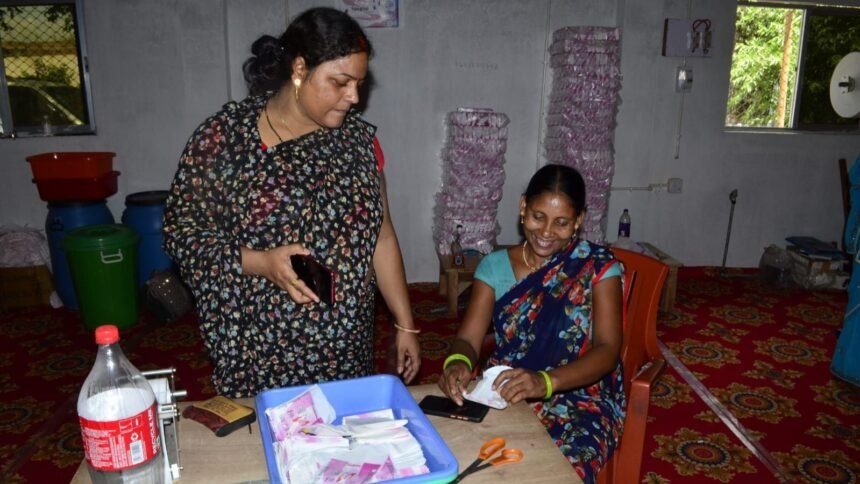
At Danwa village in Bihar’s Bhojpur district, mornings begin with the hum of a machine inside a small production unit that begins work early. Inside, a group of around nine women carefully operate the machine as it presses layers of cotton into sanitary pads. The packets, sold under the brand ‘Sangini’, are stacked neatly nearby, ready to be distributed to the local community.
The initiative, led by village mukhiya Sushumlata Kushwaha, was born out of a simple conversation over menstrual health in rural areas.
“It was just before the Covid-19 pandemic… One day, during a women’s self-help group (SHG) meeting, we had a discussion on menstruation when someone had their period and was looking for some cloth. As the conversation unfolded, many of the women revealed that they were still using cloth, or worse, cloth with ashes, during their periods. It was shocking to me because I had been using sanitary pads ever since I got my first period. I couldn’t believe that even today, so many women were using cloth,” says Kushwaha.
In response, she sought support from the then District Magistrate Roshan Kushwaha to inquire about establishing a unit that could produce affordable sanitary pads locally.
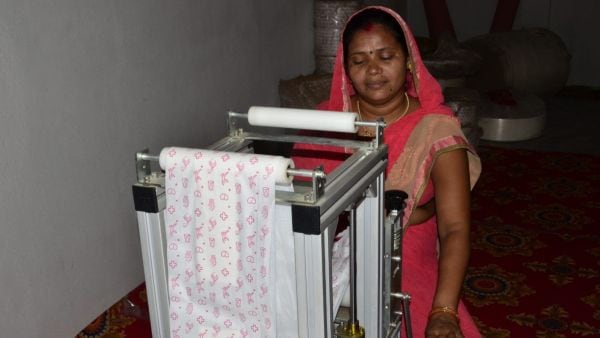 Inside, a group of around nine women carefully operate the machine as it presses layers of cotton into sanitary pads. (Express Photo)
“In 2022, the state government launched the Industrial Innovation Scheme to provide livelihoods for migrant workers who returned to Bihar after the Covid-19 pandemic. So, DM sir informed me about it, and we were able to secure a fund of Rs 10 lakh,” Kushwaha recalls.
She adds that the initiative has since slowly gained traction, providing a healthier, more affordable alternative to cloth and improving menstrual hygiene awareness.
Danwa’s sanitary pad unit is one of several grassroots initiatives led by women mukhiyas across Bihar, where elected women leaders are increasingly shaping local governance through projects focused on health, livelihoods and environmental sustainability. From climate-friendly development initiatives in Samastipur to youth-led yoga sessions in Lakhisarai, women representatives are tackling issues and experimenting with solutions to everyday rural challenges.
Story continues below this ad
4,200 women mukhiyas
Bihar has one of the highest levels of women’s participation in grassroots governance in India after the state government, under Chief Minister Nitish Kumar, expanded reservation for women in Panchayati Raj institutions to 50% in 2006.
Today, around 4,200 women serve as mukhiyas and thousands more as ward members and other local leaders, transforming governance across the state.
While the reservation has certainly boosted women’s participation in the public sphere, it has also come with its own set of challenges — many of these leaders still face significant social barriers, including scepticism about female authority in rural politics, with male relatives often seen as the real decision-makers, even when women hold official positions.
“The 50% reservation has opened doors, but the journey is still long. In the villages, people are often reluctant to accept women in leadership roles, believing that decisions are made by male relatives behind the scenes. But I must say things are moving in a positive direction. When I first became mukhiya in 2016, women weren’t even attending village meetings. Today, they are much more aware and involved than men about policies and governance,” explains Sushumlata Kushwaha.
Story continues below this ad
The holder of a Master’s in Social Work, she says that though the initial cost of setting up the unit exceeded the loan amount, she knew “this was something that needed to be done to help the women in her village and community”.
“We started the unit with a manual machine that cost Rs 3 lakh, and then later upgraded to a semi-automatic one for Rs 11 lakh. The machine, developed with IIT Bombay’s support, was set up in 2022 and now produces between 4,000 and 4,500 pads a day, employing nine women in the process,” says Kushwaha.
The sanitary pads are sold at Rs 23 per for a packet of six, making them significantly more affordable compared to commercial brands.
“The pads have created awareness around menstrual health, and slowly, women have started to embrace them. Usage is not to the level we expected, but it’s growing with time… Women and girls who have used pads once are getting them regularly… We are continuously trying to make them more accessible to girls and women who might otherwise be forced to rely on unsanitary options,” says Kushwaha, adding that support from the government would help further speed up the process. “Local schools, SHGs and even nearby panchayats now distribute the pads, helping normalise the conversation about menstruation,” she says.
Story continues below this ad
A local schoolteacher adds, “I used to see so many girls in my class skipping school because they couldn’t manage their periods. Now, many of them come to school every day without any fear.”
Other initiatives
Meanwhile, in Samastipur district, another Mukhiya, Prema Devi, has focused on climate resilience and environmental sustainability. In her Motipur panchayat, initiatives such as biogas plants, water conservation efforts, and the creation of an “amrit sarovar” (a water conservation pond) are improving the village’s infrastructure and the lives of its residents.
“When I first came to this panchayat, I was shocked at how underdeveloped it was. There were no roads, no electricity, no water systems, nothing,” says Prema, who, like Kushwaha, assumed leadership in 2016.
Today, three villages in the panchayat and more than 200 families who are involved in animal husbandry benefit from biogas plants, she says. “We’ve been able to create a change… we’ve built amrit sarovars and have planted trees to recharge groundwater. The villagers are now more aware of climate-related issues.”
Story continues below this ad
She adds that biogas plants have reduced families’ dependence on firewood and expensive LPG gas, helping both the environment and the community’s health. Prema also led the creation of a model Gramin Haat (rural market) in her panchayat, benefiting 380 families, who now earn a living from it.
Her efforts have not gone unnoticed. “Motipur was awarded the Nanakji Deshmukh National Gramin Gaurav Award among many others,” she says.
Similarly, in Lakhisarai district, mukhiya Julie Devi is encouraging teenage girls to take charge of the health and wellness of their community. In Nongarh panchayat, young girls conduct daily yoga sessions.
“I felt it was important to empower our youth, especially young girls, to lead such initiatives. They are the future of our community,” says Julie Devi, who has actively supported these sessions since they began. Today, several villagers, including children, the elderly, and women, regularly participate in the morning sessions, which focus on breathing exercises and physical postures.
Story continues below this ad
In Samastipur district, another mukhiya, Baby Devi, has worked to ensure women’s voices are heard in local governance. Through regular mahila sabhas (women’s assemblies), she encourages women to discuss issues ranging from education to domestic violence, and to voice their opinions on policy matters.
“Earlier, when I would call women for meetings, they would hesitate to come. But now, they come in large numbers, eager to participate in decision-making,” says Devi. In addition to empowering women through political participation, Baby Devi has also introduced skill training programmes, such as tailoring and beauty services, providing women with a means to earn an income and gain economic independence.
For Sushumlata Kushwaha, a mother of three including a nine-month-old baby, the workday often stretches late into the night, after her children have fallen asleep. As the elected mukhiya, her days are filled with meetings, field visits and calls about village issues, while the nights are spent preparing for the next day. Balancing home and public responsibilities is not easy, she says.
“If you are a wife or a mother, being a homemaker comes first before professional responsibilities. You have to find the balance between the roles.” After a small pause, she adds, “But, if women can carry a child for nine months and bring life into the world, there’s nothing they cannot do.”