

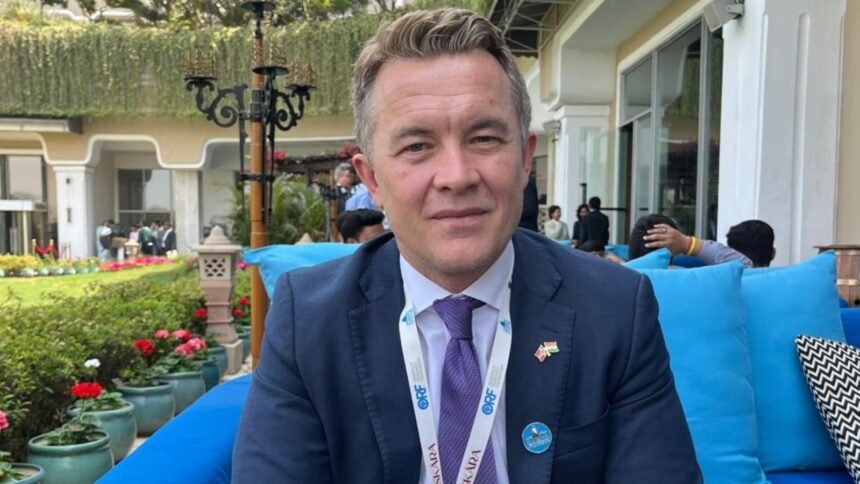
Norway’s Deputy Foreign Minister Andreas Motzfeldt Kravik, who was in Delhi for the Raisina Dialogue, has been at the job since August 2023. In an interview with The Indian Express, he sat down to discuss bilateral ties with India, the conflicts in the Middle East and Ukraine, US President Trump’s moves, China’s role and standing in the world order, and the Nobel Peace Prize. Edited excerpts:
What is the trajectory of bilateral ties with India you have seen in the last three years as minister?
India is really ascending. The Indian politicians and stakeholders approach issues with lots of self confidence, willingness to assert themselves. We are operating on the assumption that no problem can be resolved without the participation of India. As an example, reforming the WTO is one of our top priorities…for that we have to bring India on board.
India and Norway are plugged into the global economy, geopolitics, and we’re discussing this in a symmetrical way. We are here to listen, to offer our perspectives, and to learn. There’s lots of interest in Norway for engaging more with Indian counterparts. In the context of green technology and the blue economy, we have cutting-edge expertise that can be scaled in India. You have competencies, expertise and insights that we need to learn from. So, this is really a win-win relationship, which is deep, multifaceted, and something we attach a lot of importance to.
It’s been two years since EFTA was signed. What has been achieved all this while?
Well, I think, it entered into force only recently. We’re seeing an uptick in exports and things are moving forward. At least I’m hearing good things about this agreement from Norwegian companies. It gives predictability for countries to trade with each other. We’re seeing more interactions between Norwegian and Indian enterprises, that’s a good thing, but we are not satisfied. We want to see more. There’s a lot of potential.
Coming to geopolitics, because it’s the week of turmoil in the Middle East, how do you see these attacks by the US-Israel combine and Iran’s response?
Story continues below this ad
First, I just want to take a step back and say it’s extremely unfortunate. If there’s anything that the Middle East does not need now is another war which risks destabilising the region, causing havoc on civilians … economic problems not just for the countries involved, but also for third countries. So, it’s a very precarious and serious situation. Our sympathies lie, obviously, with the Iranianians who have been brutalised by a repressive and authoritarian regime, over so many years. Also, we don’t think that the attacks by Israel and the US on Iran were in line with basic tenets of the UN Charter. We have flagged that publicly; we’ve also been public about concerns about Iran attacking third countries, which again is very unfortunate. There are global implications … we are seeing a price surge and oil-gas stocks going down. This is a huge challenge for India, because you’re in the process of modernisation, and these kinds of events will set things back.
Do you have a prognosis of how long this war will go on?
I want to be careful in terms of predicting the future, because it’s extremely difficult, especially these days, where there are so many things happening, but I hope that in the course of the next few days or weeks, the parties will find a way forward which can stop the hostilities.
Norway had a role in the past, in the Oslo peace process, and you think there is history that you can take advantage of and reignite that role?
Story continues below this ad
Norway has for many years been involved in various peace processes, and we still are. This is an important part of our foreign policy. And we have also had deep conversations with the parties to this conflict, the US, Iran and Oman to create space for diplomatic solutions. We hope that there will be opportunities for diplomatic outcomes in the not too distant future. We are always interested in contributing to non-violent outcomes to conflicts.
In your neighbourhood, the war between Russia and Ukraine has been on for four years now. How close or far are we to end the war?
There have been serious negotiations between the parties, also involving the US and the Europeans. And, from our vantage point, our starting points here are relatively clear. We have condemned to the fullest extent possible the Russian attack. We think it’s a blatant violation of the UN Charter … the core principles of international law, that one country cannot, by way of military means, annex the territory of another country. But we understand that at some point there needs to be a negotiated settlement. And we will support Ukraine in whatever outcome they can accept the peace that they arrive at.
How do you see President Trump’s approach in the Russia-Ukraine war and also in the wider disruption of the international order?
Story continues below this ad
Trump has an unusual approach to diplomacy. His approach is transactional and sometimes there’s a lot of dynamics. There are many things happening at the same time, and they’re moving with rapid speed. We have a robust relationship with the US, and we are in regular touch with them at all levels. And I speak to my American counterparts quite frequently. We are working very closely with the US in the context of Israel, Palestine, Gaza, trying to find solutions to that conflict … having productive conversations in the context of Ukraine-Russia. So, we have a multifaceted, deep relationship with the US. But obviously there are certain topics we are not fully aligned on. And I guess that’s natural between democracies.
On China’s role in the world order, how do you see its rise?
For us, we will collaborate with China where we can, and then we will decouple where we must. For us, it’s been important to try to avoid dependencies and to ensure that we can retain our autonomy in critical areas. That requires us to balance different considerations at all times, we are determined to work very closely with our European partners … and also the US. We’re just not going to find solutions to global problems without the participation of China. For instance, we are determined to contribute to resolving the climate crisis. That requires us to collaborate with China, which is investing massively in green technology. We need to work with China in order to navigate what is a very difficult geopolitical landscape.
President Trump talked about the Nobel Peace Prize not being given to him, what is your response to that?
Story continues below this ad
I guess my response to that is quite boring. The Norwegian Peace Committee is an autonomous body. They decide based on the parameters laid down by Nobel himself. And this is not something that the government has an influence on. In fact, the Prime Minister, the foreign minister, myself, we find out who receives a Nobel Peace Prize only when it’s publicly announced.