

The indigenous Light Combat Aircraft (LCA) Tejas Mk 1A undertook its first public sortie at the Hindustan Aeronautics Limited (HAL) facility in Nashik on Friday, a move that Defence Minister Rajnath Singh called a “shining symbol” of India’s growing self-reliance in defence.
The event also marked the formal inauguration of the third production line of the LCA Mk 1A and the second production line of the indigenously made Hindustan Turbo Trainer (HTT)-40 basic trainer aircraft.

In his address, Singh said India once imported 65-70 per cent of critical military hardware, but is now manufacturing 65 per cent of the equipment on its own soil, highlighting the government’s resolve to increase domestic manufacturing to 100 per cent in the years to come.
“We not only reduced import dependency, but also strengthened our commitment to indigenisation. Whatever we used to buy from abroad, we are now manufacturing it domestically, be it fighter aircraft, missiles, engines and electronic warfare systems,” he said. “We have now set a target of increasing defence manufacturing to Rs 3 lakh crore and exports to Rs 50,000 crore by 2029,” he added.
The inaugural flight of the LCA Mk 1A is a step forward towards its delayed formal induction into the Indian Air Force (IAF), which has been facing a decline in its fighter squadron strength. The newly inaugurated production line in Nashik has the capacity to manufacture eight aircraft every year, and can be increased to 10. HAL is expected to produce a total of 24 aircraft annually.
The Nashik facility will also house the second production line for the indigenous HTT-40—a basic trainer aircraft that will replace the Pilatus PC-7 Mk II trainers in the IAF fleet. The unit will also manufacture 15 Su-30 MKIs, of which 13 would be for the IAF. Two will remain with HAL.
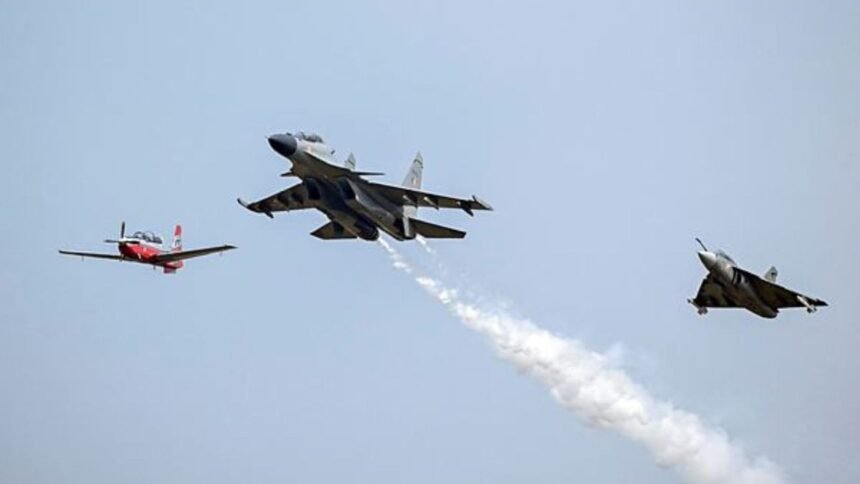
An aerial display by the LCA Tejas Mk 1A, an HTT-40 and Sukhoi-30 MKI was carried out at the ceremony. HAL Chief Test Pilot (fixed wing) Group Capt KK Venugopal (Retd) piloted the LCA Tejas Mk1A sortie. The LCA Tejas Mk1A received a water cannon salute.
‘India must stay ahead in this new race’
Story continues below this ad
In his address, Singh highlighted the need to stay ahead of the curve as Artificial Intelligence, cyber warfare, drone systems and next-generation aircraft are shaping the future, and wars are being fought across multiple frontiers. “India must always stay ahead in this new race, and not lag,” he said, exhorting HAL to make its mark in the fields of next-generation aircraft, unmanned systems and civil aviation, and not limit itself to LCA Tejas or HTT-40.
During Operation Sindoor, Indian forces not only demonstrated valour and commitment but also displayed confidence in indigenous platforms, he said.
“HAL provided support at various operational sites 24 hours a day during the operation. It ensured the Indian Air Force’s operational readiness by carrying out prompt maintenance on fighter jets and helicopters,” he said.
Singh added: “The Nashik team performed the crucial task of installing the BrahMos missile on the Su-30, which destroyed terrorist hideouts during the operation. This proved that when it comes to national security, we can make our own equipment and protect ourselves with it.”
‘Statement of India’s design and manufacturing excellence’
Story continues below this ad
Sanjeev Kumar, Secretary, Defence Production, described the inauguration of two production lines as a symbol of India’s growing technological confidence, industrial strength, and strategic foresight. He said the LCA Tejas Mk1 is not merely a fighter aircraft but a statement of India’s design and manufacturing excellence—conceived, developed and produced indigenously through the collaboration of HAL, Aeronautical Development Agency, DRDO and the IAF.
He added that the HTT-40, fully designed and developed by HAL, stands as a “shining example” of the company’s ability to conceptualise, design and deliver critical defence platforms completely indigenously.
D K Sunil, HAL Chairman and Managing Director, said the successful operationalisation of the LCA Mk1A and HTT-40 production from Nashik is a testament to HAL’s capacity for expansion.
“HAL’s Nashik Division’s capacity to produce indigenous advanced fighters in addition to Su-30MKI has added momentum to our production efforts to meet delivery timelines. It has also resulted in the creation of around 1,000 jobs and the development of over 40 industry partners in and around Nashik, aligning with the government’s goal of forging an effective public-private partnership,” he added.
Story continues below this ad
The LCA Mk 1A, designated LA-5043, had successfully completed its pre-flight trials earlier.
The induction of the 83 LCA Mk 1As—the first two of which were slated for delivery to the IAF this month—is yet to begin, despite a delay of over a year and a half. It is learnt that the deliveries can start only after the aircraft completes final certification, which includes weapon integration and firing tests. HAL has constructed 10 aircraft so far.
According to a government statement, HAL has operationalised the third LCA Mk 1A production line in a record time of two years, fully equipping it with more than 30 structure assembly jigs for all major modules of the aircraft, including centre fuselage, front fuselage, rear fuselage, wings and air intake.